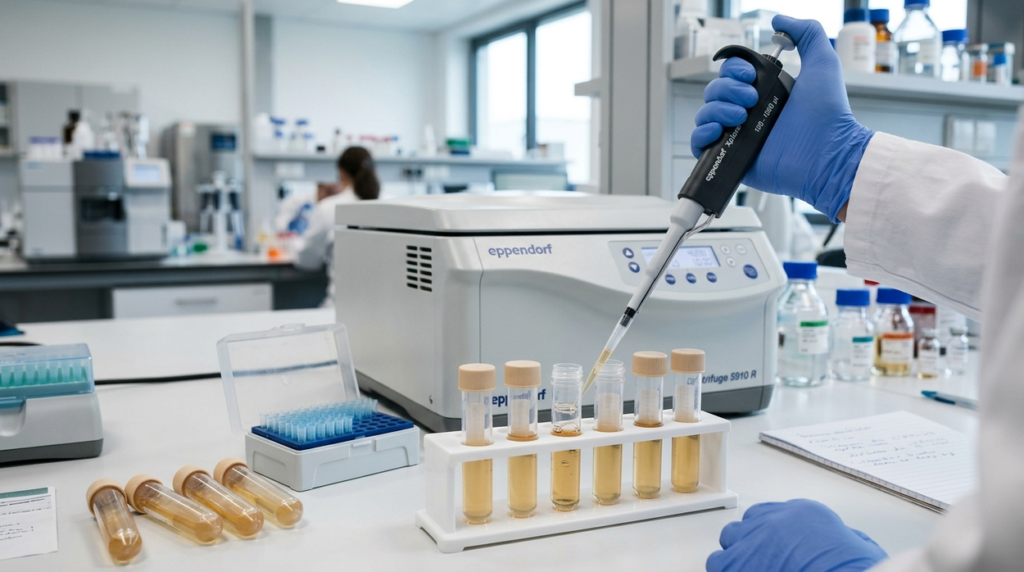

A Pasteur pipette is a simple laboratory tool used to transfer small quantities of liquid, dispense drops, and move samples between containers when an accurately measured volume is not required. Commonly found in research, pharmaceutical, biotechnology, diagnostic, and teaching laboratories, it offers a convenient way to handle liquids during routine preparation and sample processing.
Despite its straightforward design, a Pasteur pipette is not suitable for every liquid-handling task. A transfer that is acceptable during exploratory research may require a calibrated micropipette or volumetric instrument when preparing analytical standards, PCR mixtures, or solutions with defined concentrations.
Choosing the right pipette therefore involves more than selecting glass or plastic. Laboratory personnel must consider the required volume control, chemical compatibility, contamination risks, sterility requirements, and the procedure being performed.
This guide explains how Pasteur pipettes work, their main functions, the differences between common pipette types, safe handling practices, and their applications in pharmaceutical and biotechnology laboratories.
What Is a Pasteur Pipette?
A Pasteur pipette is a narrow laboratory tube with a tapered tip, designed primarily for transferring liquids rather than measuring precise volumes. Traditional designs use a separate rubber bulb to draw liquid into the tube and dispense it. Many plastic versions incorporate a squeezable reservoir directly into the body.
The instrument is useful when a laboratory worker needs to move a small quantity of liquid, add a reagent gradually, or collect a liquid layer without requiring calibrated volumetric delivery.
Definition and basic operating principle
A Pasteur pipette works through pressure differences. When the bulb or integrated reservoir is compressed and then released, the resulting pressure change draws liquid through the tip into the pipette body. Compressing it again pushes the liquid out.
The amount transferred depends on several factors, including the pipette’s geometry, the degree of bulb compression, the liquid’s viscosity and surface properties, and the operator’s technique. Consequently, an ordinary Pasteur pipette should not be assumed to deliver a specific volume consistently.
Glass Pasteur pipettes generally have a rigid stem and require a compatible separate bulb. Plastic transfer pipettes often combine the stem and squeezing reservoir into one disposable unit. The two designs serve similar purposes, but their materials, handling characteristics, and intended uses can differ.
Main parts of a Pasteur pipette
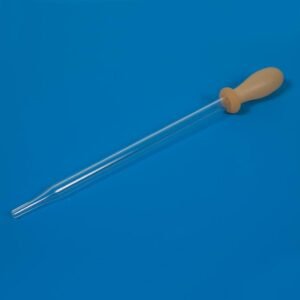
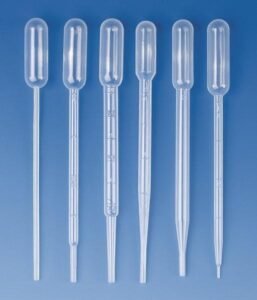
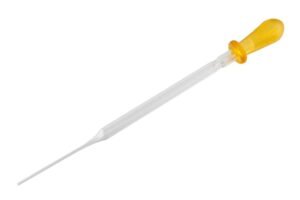
The main components vary by design, but commonly include:
- Body or stem: Holds the liquid temporarily during transfer.
- Narrow tip: Directs liquid into the receiving vessel and helps control dispensing.
- Bulb or squeezing reservoir: Generates the pressure changes required for aspiration and dispensing.
- Connection point: Present in bulb-operated designs, where the bulb attaches to the glass stem.
The opening and shape of the tip influence liquid flow and drop formation. A narrow opening may support slower dispensing, while a wider opening can release liquid more quickly. However, tip geometry alone does not guarantee a particular drop size or delivered volume.
Glass versus plastic Pasteur pipettes
Glass and plastic Pasteur pipettes are not universally interchangeable. Selection should reflect the liquid being handled and the requirements of the procedure.
| Feature | Glass Pasteur pipette | Plastic Pasteur pipette |
| Construction | Rigid glass stem, usually with a separate bulb | Flexible or semi-rigid polymer body, often with an integrated reservoir |
| Handling | Allows controlled positioning but requires care to avoid breakage | Lightweight and less prone to breakage |
| Chemical compatibility | Depends on glass type, bulb material, and other components | Depends on the specific polymer and any additives |
| Typical format | Reusable designs may be available, subject to suitability and cleaning requirements | Commonly supplied as single-use products |
| Main consideration | Breakage, sharp edges, and compatibility | Polymer compatibility, potential extractables or leachables, and reuse restrictions |
Glass may be appropriate for certain solvent transfers, but compatibility should never be assumed for every chemical or for the complete pipette assembly. The bulb and any connecting components may have different resistance properties from the glass itself.
Plastic products also vary substantially. For sensitive pharmaceutical applications, manufacturers’ technical specifications and relevant chemical-compatibility documentation should guide selection. Where product contact could affect a drug substance, formulation, or analytical result, documented suitability may be necessary.
What Are the Main Functions of a Pasteur Pipette?
Pasteur pipette uses center on convenient liquid transfer rather than precise measurement. Their value lies in making routine handling easier when a defined delivery volume is not essential.
Transferring small quantities of liquid
Pasteur pipettes can transfer compatible aqueous solutions, buffers, reagents, stains, and other liquids between tubes, vials, flasks, and similar laboratory vessels.
For example, a technician may use one to move a small quantity of buffer into a container during preliminary sample preparation. The procedure may not require an exact volume, making a simple transfer pipette a practical option.
Nevertheless, the quantity transferred should not be treated as reproducible simply because the same pipette design is used each time. Where liquid volume affects concentration, reaction performance, or a reported analytical result, a suitable calibrated instrument is preferable.
Adding liquids drop by drop
A Pasteur pipette is useful for adding indicators, stains, and compatible reagents gradually. Dropwise addition can help an operator observe a reaction or adjust a mixture when approximate delivery is sufficient.
Drop size is affected by tip diameter, liquid viscosity, surface tension, dispensing angle, and the force applied to the bulb. A particular number of drops therefore does not reliably represent a fixed volume unless the complete dispensing procedure has been validated for that purpose.
Moving supernatants and preparing samples
After centrifugation, settling, or phase separation, a Pasteur pipette may be used to transfer a visible liquid layer while leaving sediment or another phase behind.
The operator should position the tip carefully and aspirate slowly enough to avoid disturbing the material below. As the liquid level approaches the unwanted layer, aspiration should stop before sediment or debris enters the pipette.
This technique is useful for routine sample handling, but it may not provide the recovery, selectivity, or reproducibility required for every analytical method. Where sample recovery or separation performance is critical, the specified method and transfer equipment should take precedence.
Supporting small-scale laboratory preparation
Pasteur pipettes also support preliminary reaction setup, solvent transfer, staining, and other small-scale manipulations. They are particularly convenient when the main requirement is to move a liquid rather than measure it.
For procedures involving defined reagent concentrations, quantitative sample preparation, or controlled formulation composition, a calibrated pipette, volumetric instrument, or another method-specified device is more appropriate.
🏢 Featured Laboratory Suppliers Directory Listing
Looking for verified and trusted laboratory suppliers partners related to this topic? Explore our comprehensive directory.
Explore Directory →How Is a Pasteur Pipette Different from Other Laboratory Pipettes?
The most important distinction is whether a task requires approximate transfer or a defined volume. Several laboratory pipettes may look similar, but their measurement capabilities and intended applications differ.
Pasteur pipette vs. micropipette
A Pasteur pipette is suitable for general liquid transfer and approximate dropwise dispensing. A micropipette, by contrast, allows the user to select a target volume within the instrument’s specified operating range.
Micropipettes are generally preferable for molecular biology, PCR preparation, analytical testing, and other procedures in which small-volume accuracy and repeatability matter. They still require appropriate tips, correct operating technique, and calibration or performance verification as required by the laboratory.
For example, transferring a few drops of buffer into a container may be appropriate with a Pasteur pipette. Dispensing a specified microliter volume into a PCR reaction generally requires a suitable calibrated micropipette.
Pasteur pipette vs. graduated and volumetric pipettes
Graduated pipettes have volume markings that help users measure and transfer specified quantities, subject to the instrument’s tolerances and operating instructions.
Volumetric pipettes are calibrated to deliver a particular volume under defined conditions. They are useful when preparing reference solutions, analytical standards, and other solutions requiring controlled volumetric accuracy.
An ordinary Pasteur pipette generally lacks calibration marks and is not designed for accurate volumetric delivery. The importance of calibration and measurement procedures is reflected in the National Institute of Standards and Technology’s guidance on volumetric calibration.
Pasteur pipette vs. serological pipette and transfer dropper
Serological pipettes are graduated instruments commonly used for measuring and transferring milliliter-scale volumes. They may be operated with a compatible pipette controller.
General-purpose droppers may resemble Pasteur pipettes, but their suitability for laboratory work depends on their materials, cleanliness, intended use, and documented performance. A familiar appearance does not establish that a product is sterile, calibrated, or chemically compatible.
| Instrument | Primary purpose | Volume control | Principal limitation |
| Pasteur pipette | General transfer and dropwise dispensing | Usually approximate | Not intended for precise volumetric measurement |
| Micropipette | Small-volume measurement and dispensing | Set volume within specified limits | Technique, tips, and calibration affect performance |
| Graduated pipette | Measuring and transferring specified volumes | Graduated scale and stated tolerances | Accuracy depends on specifications and technique |
| Volumetric pipette | Delivering a defined calibrated volume | High volumetric precision within specifications | Designed for a particular calibrated volume |
| Serological pipette | Measuring and transferring larger liquid volumes | Graduated scale and stated tolerances | Requires suitable handling and dispensing equipment |
How to Use a Pasteur Pipette Correctly
Correct Pasteur pipette handling helps minimize spills, sample loss, contamination, and unnecessary exposure. The precise procedure depends on the pipette design, liquid properties, and laboratory protocol.
Prepare the pipette and receiving vessel
Before beginning:
- Confirm that the pipette material is compatible with the liquid.
- Inspect glass pipettes for cracks, chips, sharp damage, or other defects.
- Check the packaging and stated sterility status if the procedure requires a sterile product.
- Label the receiving vessel and prepare the appropriate waste container.
- Wear the personal protective equipment specified by the laboratory’s risk assessment and procedure.
- Confirm that the bulb or reservoir is compatible with the pipette, if it is a separate component.
Do not use damaged glassware or an unsuitable disposable product simply because the intended transfer is small.
Aspirate liquid without creating avoidable errors
For a traditional bulb-operated glass Pasteur pipette, attach a compatible bulb securely. Compress the bulb before introducing the tip into the liquid, then release it gradually to draw liquid into the stem.
Keep the tip submerged only as far as necessary. Excessive immersion can contaminate the outside of the tip, while rapid aspiration may introduce bubbles, cause splashing, or disturb suspended material.
Avoid filling the pipette to the point where liquid could enter the bulb. If a liquid is volatile, hazardous, infectious, or otherwise high risk, follow the prescribed handling and containment procedure rather than relying on a basic transfer pipette.
Never pipette by mouth. Mechanical pipetting devices should be used wherever appropriate. The CDC and NIH’s Biosafety in Microbiological and Biomedical Laboratories guidance explicitly prohibits mouth pipetting and emphasizes risk assessment and appropriate laboratory practices.
Transfer and dispense the liquid
Position the tip over or inside the receiving vessel as directed by the procedure. Squeeze the bulb or integrated reservoir gently to release the liquid at a controlled rate.
Avoid touching the tip to unrelated surfaces, other samples, or non-sterile parts of a receiving vessel when contamination control is important. For supernatant transfer, keep the tip away from sediment and stop before unwanted material enters the pipette.
If the method requires a specified volume, use the appropriate calibrated or method-specified instrument instead of estimating delivery through bulb pressure or drop count.
Complete the transfer and dispose of or clean the pipette
Single-use pipettes should be discarded according to the laboratory’s biological, chemical, and general waste procedures. Do not assume that a plastic pipette can be autoclaved or safely reused.
Reusable glass pipettes may be cleaned and reused only when the manufacturer and laboratory procedure permit it. Cleaning and decontamination must be appropriate for the substances handled and the intended subsequent use. Visual cleanliness alone does not establish that a pipette is free from chemical residues or biological contamination.
Store reusable equipment in a manner that protects it from breakage, dust, and contamination.
Handling Mistakes That Can Affect Sample Quality
A Pasteur pipette may be simple to operate, but small errors can affect sample integrity and the consistency of laboratory work.
Treating a Pasteur pipette as a precision measuring instrument
A common mistake is assuming that a particular number of drops or a particular stem fill corresponds to an exact volume. In practice, the delivered quantity can vary with tip geometry, liquid properties, and operating technique.
Use calibrated equipment when volume affects assay performance, reagent concentration, analytical results, or reproducibility. This is especially important when preparing reference solutions or small-volume reaction mixtures.
Reusing pipettes between samples without an approved procedure
Residues from one sample may contaminate another, even when the pipette appears clean. Cross-contamination can affect research results, diagnostic testing, and analytical measurements.
Use single-use pipettes when required by the method or contamination-control plan. Reusable pipettes require a documented, appropriate cleaning and decontamination procedure before they are used again.
Aspirating too quickly or disturbing settled material
Sudden suction can produce bubbles, splashing, or unwanted particle transfer. When removing a supernatant, poor tip positioning can disturb the sediment and compromise the separation.
Gradual aspiration, careful observation, and appropriate tip placement help reduce these avoidable errors.
Ignoring material compatibility and pipette damage
Using a polymer that is incompatible with a solvent can affect the pipette or introduce unwanted material into the sample. Damaged glass can create cuts and increase the risk of breakage during handling.
Check the manufacturer’s chemical-compatibility information, inspect reusable glassware, and confirm that any separate bulb fits securely.
🏢 Featured Laboratory Suppliers Directory Listing
Looking for verified and trusted laboratory suppliers partners related to this topic? Explore our comprehensive directory.
Explore Directory →Pasteur Pipette Applications in Pharmaceutical and Biotechnology Laboratories
Pasteur pipettes have a useful role in laboratory workflows, but their suitability depends on the purpose of the transfer and the controls required by the method.
Pharmaceutical research and formulation development
During exploratory research, a Pasteur pipette may be used to transfer compatible reagents, stains, solvents, or small quantities of liquid between containers. It can also support preliminary experiments where approximate delivery is acceptable.
However, exploratory preparation is different from producing a formulation with a defined concentration or preparing material for a controlled manufacturing process. Where quantities must be measured, recorded, and reproduced, the procedure should specify suitable volumetric equipment and the required documentation.
Quality control and analytical laboratories
In pharmaceutical quality control, transfer pipettes may be suitable for certain non-critical preparation tasks, such as moving a visible supernatant or adding a reagent when the method allows approximate delivery.
Sample identity and traceability remain important regardless of the instrument used. A transfer that does not require volumetric measurement may still need to follow established sample-handling procedures.
For quantitative assays, standardized analytical methods, and preparation of reference standards, laboratories should use the equipment specified by the method or an appropriately qualified alternative. A Pasteur pipette should not replace required calibrated equipment simply because the transfer appears straightforward.
Molecular biology, PCR, and diagnostic research
Pasteur pipettes may support selected tasks involving compatible buffers, stains, or non-critical liquid transfers. They are generally not the preferred instrument for preparing PCR reactions or dispensing small, defined volumes into diagnostic assays.
These workflows often require calibrated micropipettes, suitable tips, and contamination controls appropriate to the sample and assay. Single-use consumables and segregation of work areas may be necessary to reduce the risk of carryover contamination.
A Pasteur pipette alone does not provide sterility or contamination control. Those depend on the product specification, handling procedure, workspace, and overall laboratory process.
Cell culture and microbiology
Sterile, appropriately specified transfer pipettes can be useful for certain liquid transfers when the procedure permits them. Aseptic technique remains essential: operators must protect the pipette tip from contact with non-sterile surfaces and follow the laboratory’s rules for working with biological materials.
Specialized sterile equipment or closed-system transfer methods may be needed for more sensitive or higher-risk applications. The instrument must be selected according to the biological risk assessment and the procedure’s requirements.
Academic research and teaching laboratories
In educational settings, Pasteur pipettes help students learn basic liquid handling, dropwise reagent addition, and sample transfer. Their simple operation makes them useful for demonstrations where exact volumetric delivery is not the learning objective.
Teaching should also establish the limits of approximate dispensing, the importance of preventing contamination, and the need to select calibrated equipment for quantitative experiments.
Choosing the Right Pasteur Pipette for a Laboratory Task
The appropriate product is the one that meets the requirements of the liquid, transfer procedure, and receiving sample.
Select glass or plastic based on the application
Consider the following factors when comparing glass and plastic Pasteur pipettes:
- Chemical compatibility: Confirm suitability for the liquid and any separate bulb or connecting component.
- Breakage risk: Plastic may be preferable where glass breakage is a concern, provided its material is suitable.
- Tip geometry: Select an opening and length appropriate for the vessel and liquid properties.
- Extractables and leachables: Consider whether substances released from the material could affect a sensitive sample or product.
- Reuse requirements: Confirm whether the product is designed for single use or may be reused under an approved procedure.
- Cleaning and sterilization: Verify compatibility with the required process rather than assuming a material can tolerate a particular treatment.
Decide whether sterility is necessary
A sterile pipette is supplied with a documented sterility claim, whereas a non-sterile product should not be treated as sterile simply because it is individually packaged or visually clean.
When sterility is required, check packaging integrity, the manufacturer’s sterilization information, shelf-life or expiry details where applicable, and any documentation required by the laboratory procedure.
Sterility alone does not establish low endotoxin, low particulate levels, low extractables, or suitability for a particular pharmaceutical application. Additional product specifications may be necessary depending on the intended use.
Check tip design, capacity, and compatibility
Review the tip opening, overall length, body capacity, and bulb fit before purchasing or using a pipette. A very narrow tip may slow the transfer of a viscous liquid, while a different geometry may be more appropriate for a particular vessel.
The stated capacity, if available, should not be interpreted as a calibrated delivery volume unless the manufacturer explicitly specifies that performance.
Evaluate suppliers and product documentation
Laboratory procurement teams should assess more than price and pack size. Depending on the application, relevant information may include:
- Material composition, dimensions, and product specifications.
- Intended use and chemical-compatibility information.
- Sterility status, packaging details, and shelf life where applicable.
- Batch identification and traceability documentation.
- Relevant manufacturer quality documentation and declarations.
- Availability, pack size, and consistency of supply.
Routine research consumables do not all require the same level of qualification. Procurement controls should be proportionate to the risks of the intended application.
When Is a Pasteur Pipette Not the Right Choice?
Procedures requiring accurate volume measurement
A conventional Pasteur pipette is not the right choice when a method requires a defined, reproducible volume. Examples include preparing analytical standards, dispensing specified small-volume assay reagents, and preparing PCR master mixes.
Use a suitable calibrated micropipette, graduated pipette, volumetric pipette, or other instrument specified by the method.
High-risk biological and hazardous chemical handling
A basic Pasteur pipette may be unsuitable when a task requires aerosol containment, closed-system transfer, specialized chemical resistance, or additional engineered safeguards.
🏢 Featured Laboratory Suppliers Directory Listing
Looking for verified and trusted laboratory suppliers partners related to this topic? Explore our comprehensive directory.
Explore Directory →Consult the laboratory risk assessment, applicable safety data sheets, and established biosafety or chemical-handling procedures. OSHA’s laboratory safety standard provides relevant requirements for covered US laboratories handling hazardous chemicals.
Sterile pharmaceutical manufacturing and validated processes
Routine laboratory transfer and sterile pharmaceutical manufacturing are not equivalent activities. In a validated process, the transfer device may need to meet documented requirements for material compatibility, cleanliness, sterility, traceability, and process suitability.
A Pasteur pipette should not automatically be considered appropriate for aseptic manufacturing or critical product-contact operations. Its suitability depends on the specific process, applicable regulatory requirements, and qualified equipment and materials.
How Pasteur Pipettes Support Laboratory Efficiency Without Replacing Precision Equipment
Simplicity and flexibility in routine transfers
A Pasteur pipette offers a straightforward way to move liquid without setting a target volume or operating a calibrated volume-setting mechanism. This makes it practical for non-critical transfers, dropwise addition, and exploratory laboratory preparation.
Its simplicity is an advantage only when the procedure permits approximate delivery. Convenience should not be confused with measurement accuracy or suitability for every laboratory application.
Balancing consumable cost with sample integrity
Disposable transfer pipettes can be economical for routine tasks, particularly when using a fresh pipette for each sample helps meet contamination-control requirements. Reusable glass designs may be suitable for other applications when appropriate cleaning and reuse procedures are available.
Purchase price should not be the only consideration. Sample loss, contamination incidents, repeat testing, and unsuitable material selection can create costs that outweigh the initial savings from a cheaper consumable.
Matching the instrument to the procedure
A practical selection framework is straightforward:
- Approximate liquid transfer: Consider a compatible Pasteur pipette when the method permits it.
- Defined volume: Select an appropriate calibrated pipette or volumetric instrument.
- Sterile handling: Verify the sterility claim, packaging integrity, and suitability for the intended procedure.
- Hazardous material: Follow the risk assessment and use the required containment and protective measures.
- Validated or regulated process: Follow the specified method, equipment requirements, and documentation procedures.
The best choice is the instrument that meets the actual performance and safety requirements of the task.
What Laboratory Professionals Should Remember Before Using a Pasteur Pipette
A Pasteur pipette is a useful laboratory transfer tool for moving small quantities of liquid and dispensing drops when approximate delivery is acceptable. Its simple design supports routine work across research, pharmaceutical development, biotechnology, diagnostics, and education.
However, correct selection and handling depend on the liquid, material compatibility, sterility requirements, contamination risks, and purpose of the procedure. Glass and plastic designs have different handling characteristics, and single-use and reusable products must be treated according to their intended use.
For pharmaceutical and biotechnology laboratories, the essential distinction is between convenience and precision. A Pasteur pipette can simplify a routine transfer, but it should never override requirements for volumetric accuracy, sample traceability, validated methods, or laboratory safety. Selecting consumables according to documented product specifications and the actual needs of the procedure helps maintain both operational efficiency and sample integrity.
Frequently Asked Questions About Pasteur Pipettes
Is a Pasteur pipette used to measure volume?
A conventional Pasteur pipette is generally designed for liquid transfer and dispensing rather than accurate volumetric measurement. Its delivered volume can vary with tip geometry, liquid properties, and handling technique. When a defined volume is required, use a suitable calibrated micropipette, graduated pipette, volumetric pipette, or other instrument specified by the method.
Are Pasteur pipettes reusable?
Some glass Pasteur pipettes may be reusable if the manufacturer and laboratory procedure permit reuse and an appropriate cleaning and decontamination process is available. Many plastic transfer pipettes are intended for single use. Reuse should never be assumed safe or appropriate based on appearance or material alone.
What is the difference between a Pasteur pipette and a dropper?
Both devices can transfer liquid and dispense drops, and their appearance may be similar. A laboratory Pasteur pipette is selected according to its intended use, material, and product specifications. A general-purpose dropper may lack documentation for laboratory cleanliness, chemical compatibility, or performance. Neither device should be assumed to be calibrated or sterile without supporting specifications.
Can Pasteur pipettes be used in sterile laboratory work?
Yes, appropriately specified sterile Pasteur pipettes may be suitable for certain transfers when the procedure permits their use and aseptic technique is maintained. However, a sterile product is not automatically suitable for every sterile process. Additional requirements for endotoxin, particulate matter, extractables, or product-contact compatibility may apply.
Should a Pasteur pipette be used for PCR or pharmaceutical quality control?
It may be suitable for certain non-critical transfers in these settings, but calibrated micropipettes and method-specified equipment are generally preferable when volume accuracy or contamination control is essential. PCR preparation and quantitative quality-control procedures can be sensitive to small handling errors. The selected instrument should meet the requirements of the assay or approved analytical method.