
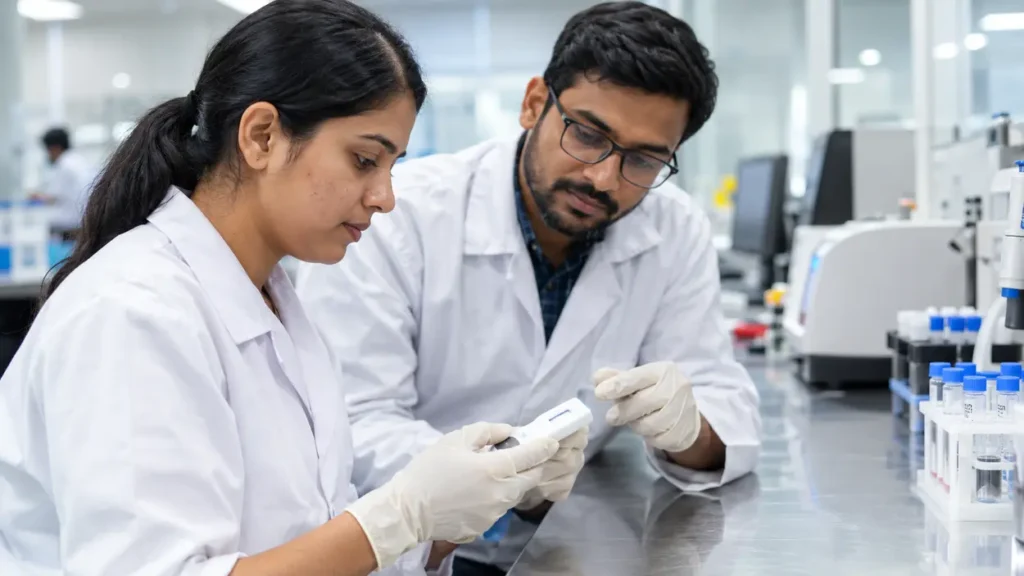
Diagnostic testing works well when patients live near an accredited laboratory, uninterrupted electricity, and trained technicians. That combination is common in metro hospital chains but hard to find in the district hospitals and primary health centres that serve most of India. Even proven point-of-care molecular tests such as Cepheid’s Xpert MTB/RIF typically need stable three-phase power, a temperature-controlled environment, and centralized lab placement—which keeps them out of reach for many peripheral facilities and leaves patients waiting days for results.
Goa-based Molbio Diagnostics built its business around that specific gap. Founded in 2000 by diagnostics veteran Sriram Natarajan and molecular biologist Chandrasekhar Nair, the company spent two decades developing Truenat, a battery-operated, chip-based real-time PCR platform. The World Health Organization endorsed Truenat’s tuberculosis assays in 2020, India’s National Tuberculosis Elimination Programme (NTEP) has installed the system at more than 6,000 sites, and Molbio completed its IPO on the NSE and BSE in August 2026. That’s a verifiable track record to examine—not just a pitch.
The Diagnostic Testing Problem This Startup Is Trying to Solve
Tuberculosis remains one of the clearest examples of the diagnostic gap Molbio set out to close. Global health agencies estimate roughly 10 million new TB cases occur each year, and close to 40% of people with active TB are never formally diagnosed—largely because testing infrastructure doesn’t reach where patients actually seek care.
Sputum-smear microscopy, still widely used across India’s public health system, is inexpensive but has limited sensitivity and can miss a meaningful share of true cases. Xpert MTB/RIF, the molecular test the WHO recommended in 2010, solved much of that accuracy problem but introduced a new one: it typically requires uninterrupted power, air-conditioned rooms, and centralized laboratory placement, which many high-burden regions struggle to guarantee outside major cities.
India illustrates why this matters. The country carries one of the world’s highest TB burdens, and its healthcare system spans everything from advanced urban diagnostic chains to sub-district primary health centres with irregular electricity. A test validated for a controlled city laboratory doesn’t automatically work at a rural clinic — and a delay of even a few days between suspicion and diagnosis can mean a patient drops out of the care pathway entirely. That mismatch between where tests are built and where they’re actually needed is the specific problem Truenat was designed around, rather than diagnostics broadly.
What Makes This Startup’s Diagnostic Technology Different?
How the Technology Works
Truenat is built from two devices used together: the Trueprep sample-preparation unit, which extracts and purifies DNA from a patient sample, and the Truelab analyzer, which runs real-time PCR using disease-specific Truenat micro-PCR chips. Both devices are portable and battery-operated, and the reagents are designed to stay stable at room temperature rather than needing cold-chain storage. A full cycle — roughly 20 minutes for extraction and 35 minutes for the PCR reaction — returns a result in under an hour. Because the chips are disease-specific cartridges, the same Truelab device can run tests for tuberculosis, rifampicin resistance, COVID-19, hepatitis C, HPV, and other infections without cross-contamination between assays, which is part of why the platform scaled quickly during the COVID-19 pandemic.
How It Compares With Conventional Testing
Against smear microscopy, Truenat offers meaningfully higher sensitivity and molecular-level detection, including drug-resistance testing that microscopy can’t provide at all. Against Xpert MTB/RIF, the more direct molecular comparator, the real difference is infrastructure rather than core accuracy: independent field evaluations have found Truenat’s limit of detection comparable to Xpert MTB/RIF, while its battery operation and room-temperature reagents let it run in primary health centres and even roadside clinics that can’t support Xpert’s power and environmental requirements.
That advantage isn’t universal, though. Centralized hospital labs running very high sample volumes may still prefer automated, high-throughput platforms built for that scale, where a single-sample cartridge format is less efficient. And because each test uses a proprietary, disease-specific cartridge, ongoing consumable costs matter more for budget-constrained facilities than they would in a lab already equipped with other molecular platforms. Truenat’s advantage is decentralization — not blanket superiority.
Why the Indian Market Could Be a Strong Testing Ground
India isn’t simply a low-cost market for diagnostics companies — it’s a genuinely complex one, spanning metro diagnostic networks, tier-2 city labs, and remote sub-district health centres, often within the same state. That range is precisely what makes decentralized testing relevant here in a way it might not be in more uniformly resourced markets.
🏢 Featured Diagnostic Companies Directory Listing
Looking for verified and trusted diagnostic companies partners related to this topic? Explore our comprehensive directory.
Explore Directory →The government’s own procurement channel gives Molbio a built-in distribution path: NTEP is the company’s largest customer and has deployed Truenat machines primarily at district and sub-district levels to replace smear microscopy. Broader policy momentum reinforces this — 2026 has seen renewed government emphasis on strengthening India’s domestic diagnostics capability, including guidance on indigenising diagnostic manufacturing and continued expansion of free public testing services under the National Health Mission.
For patients, the practical benefit is fewer clinic visits and faster treatment decisions — meaningful in a country where travel time and lost wages are often enough to make someone skip a follow-up test altogether.
From Laboratory Innovation to Real-World Diagnostic Testing
Validation and Accuracy
Molbio’s TB assays didn’t reach WHO endorsement on company data alone. The endorsement, announced jointly with the Foundation for Innovative New Diagnostics (FIND) and India’s ICMR in July 2020, was backed by multicentre field evaluations assessing performance in the settings the test was actually intended for — primary healthcare facilities, not reference labs. Independent researchers have continued testing the platform under real deployment conditions since then, including a cluster-randomized trial evaluating Truenat’s effect on TB detection at primary health clinics in Mozambique and Tanzania — the kind of field evidence that matters more than laboratory-only accuracy claims.
Regulatory and Quality Requirements
In India, diagnostic kits and devices fall under CDSCO’s regulatory framework, and Molbio’s TB assays carry WHO prequalification, which enables procurement through global health funders such as the Global Fund and the Stop TB Partnership. That regulatory position isn’t static, either: competitors are actively entering the same space. Molecular diagnostics company Co-Diagnostics recently received its own CDSCO license to manufacture and sell a portable PCR platform in India — a sign that decentralized testing is becoming a more contested regulatory category, not one company’s exclusive territory. Manufacturers focused on audit-readiness in this environment increasingly benchmark against evolving global quality frameworks, including the EU’s updated GMP guidelines for pharmaceutical supply chains, which point to where international quality expectations are heading.
Manufacturing and Scale
Molbio manufactures both its instruments and its disease-specific cartridges in-house at a vertically integrated facility in Verna, Goa, giving it more control over supply and new-assay rollout than companies that outsource chip fabrication. Scale brings real exposure too: the company imports a substantial share of its raw materials, creating currency risk it doesn’t currently hedge formally, and its 2026 IPO disclosures showed outstanding debt taken on partly to fund recent acquisitions. Proceeds from the public listing are earmarked partly for a new R&D facility and Centre of Excellence, along with added manufacturing capacity in Goa and Visakhapatnam — signs that scaling decentralized diagnostics profitably is still active work, not a solved problem.
Where the Startup’s Approach Could Have the Biggest Impact
The clearest, most evidenced impact so far is India’s public TB programme, where Truenat has effectively become the primary molecular alternative to smear microscopy at district and sub-district facilities. Beyond TB, the same device architecture allowed a fast pivot to COVID-19 testing during the pandemic, expanding molecular testing capacity outside major city labs when it was needed most.
Internationally, deployment across more than 40 countries — including trial-based evaluations of decentralized TB testing in Mozambique and Tanzania — suggests the platform’s core advantage translates to other high-TB-burden, resource-constrained health systems, not just India’s. Realistic near-term use cases stay concentrated in primary healthcare, public TB and infectious-disease programmes, and outbreak response, rather than as a general replacement for centralized diagnostic laboratories.
What Could Still Hold the Startup Back?
Technology adoption in diagnostics is rarely just about the device. Molbio now competes directly with established global players like Cepheid’s Xpert platform, and newer entrants are arriving — Co-Diagnostics’ recent CDSCO license signals that India’s decentralized-testing market is likely to get more crowded, not less.
Financially, Molbio’s own IPO disclosures point to real near-term pressure: consolidated debt of roughly ₹422 crore as of May 2026, a foreign-exchange loss tied to its heavy reliance on imported raw materials, and a few recently acquired subsidiaries still operating at a loss. None of this is unusual for a scaling diagnostics manufacturer, but it’s the kind of operational friction that doesn’t show up in a product demo.
🏢 Featured Diagnostic Companies Directory Listing
Looking for verified and trusted diagnostic companies partners related to this topic? Explore our comprehensive directory.
Explore Directory →Beyond the balance sheet, Molbio’s growth depends heavily on public-sector procurement cycles — national TB programmes, state health departments, and global health funders — which move on budget and tender timelines rather than commercial demand alone. Expanding the assay menu, training peripheral health workers consistently across thousands of decentralized sites, and maintaining quality control outside a controlled lab environment all remain ongoing operational challenges rather than problems already solved.
What This Could Mean for the Future of Diagnostic Testing in India
Molbio’s listing on the NSE and BSE in August 2026 marks a shift from venture-backed scale-up to public company — a change that adds accountability but also pressure to keep growing. Part of the IPO proceeds are directed toward a new R&D centre through its Bigtec subsidiary, suggesting the company intends to expand its assay menu beyond TB and COVID-19 rather than rely on its existing portfolio indefinitely.
More broadly, the direction of India’s diagnostics policy — renewed focus on indigenising diagnostic manufacturing and expanding free testing access through public health programmes — aligns with the decentralized model Molbio has built. Whether that translates into a larger shift toward point-of-care testing across other disease areas, or stays concentrated in infectious-disease programmes like TB, will depend on continued clinical evidence, pricing, and how well the model holds up against rising competition. Further background on the company’s growth and funding history is available on its Wikipedia profile.
Frequently Asked Questions
What does the Indian biotech startup do?
Molbio Diagnostics, based in Verna, Goa, develops Truenat, a portable, battery-operated molecular diagnostic platform used to detect infectious diseases — including tuberculosis, COVID-19, hepatitis C, and HPV — at the point of care.
What makes its diagnostic technology different?
Truenat pairs a battery-powered sample-prep device with a chip-based real-time PCR analyzer and room-temperature-stable reagents, letting it run outside centralized, air-conditioned laboratories, unlike comparable molecular platforms such as Xpert MTB/RIF.
Is the startup’s diagnostic test clinically validated or approved?
🏢 Featured Diagnostic Companies Directory Listing
Looking for verified and trusted diagnostic companies partners related to this topic? Explore our comprehensive directory.
Explore Directory →For its core TB use case, yes. The WHO endorsed Truenat’s TB and rifampicin-resistance assays in 2020 based on multicentre field evaluations, and the assays carry WHO prequalification, enabling procurement through bodies like the Global Fund.
Where can this type of diagnostic technology be used?
Primarily in primary health centres, district-level public TB programmes, and low-resource clinical settings in India and other high-burden countries — decentralized deployment trials in Mozambique and Tanzania offer supporting evidence — rather than as a general substitute for centralized hospital laboratories.
Final Thoughts
What distinguishes Molbio Diagnostics isn’t one dramatic claim — it’s that its technology, WHO endorsement, government deployment, and now a public listing form a chain of independently verifiable milestones rather than promotional language. Truenat solves a specific, well-documented problem: getting molecular-accuracy TB testing into places that can’t support conventional lab infrastructure. The harder, less visible work — managing supply chains, navigating rising competition, training frontline health workers, and sustaining growth as a newly public company — will determine whether that early advantage holds. Diagnostic innovation, in other words, is only partly about the test itself.