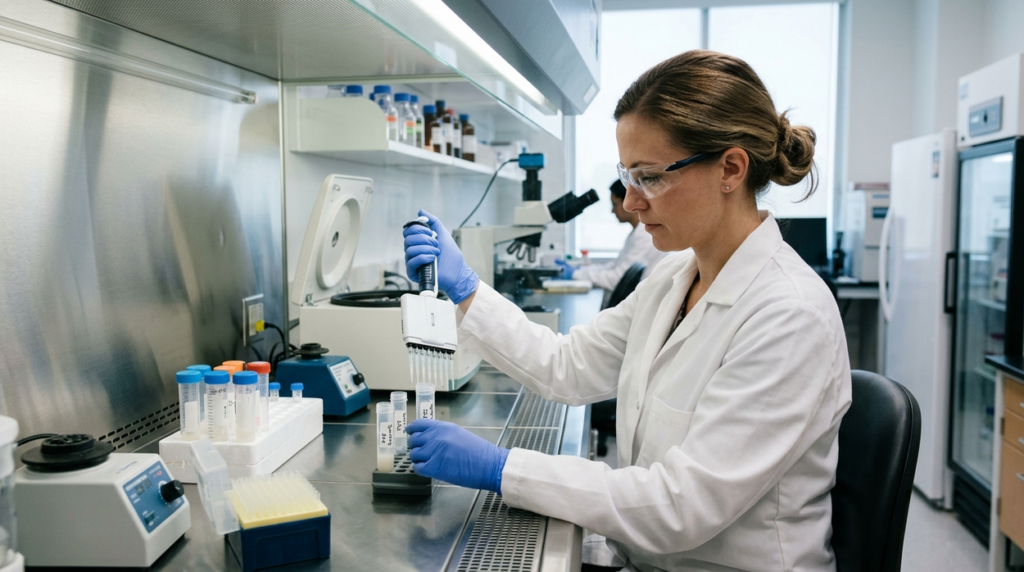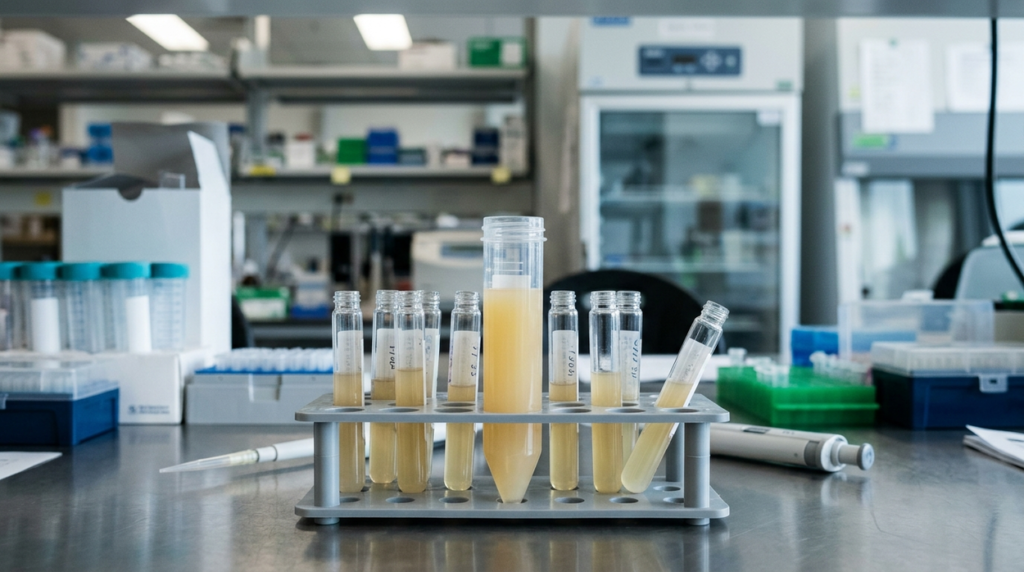
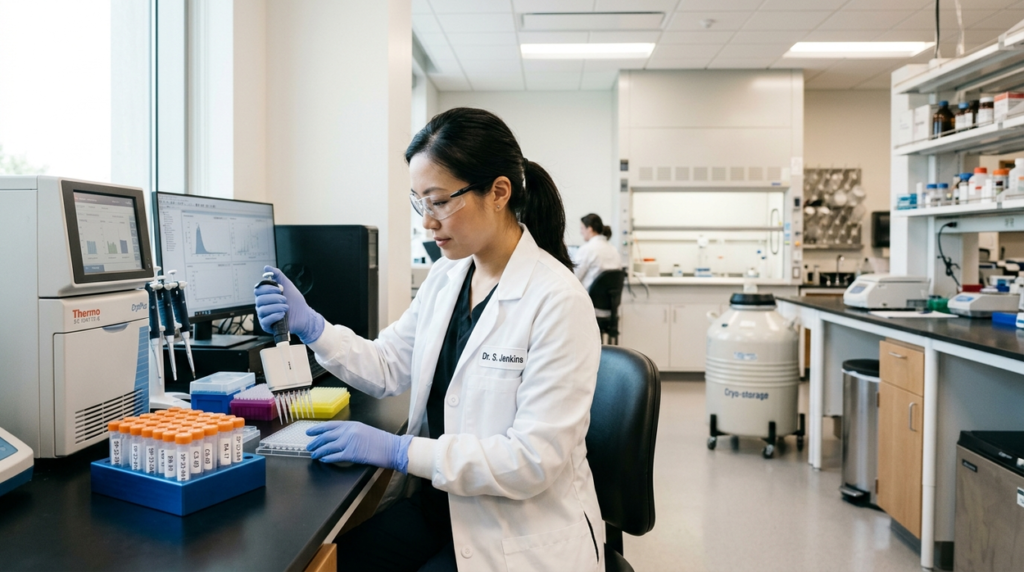
Human semen is a complex biological matrix rather than simply a suspension of spermatozoa. It contains sperm cells suspended in seminal plasma, along with proteins, enzymes, metabolites, lipids, nucleic acids and other biological components contributed by the reproductive tract and accessory glands. Because these components can vary substantially between individuals, researchers must consider both the composition of a sample and the way it was collected, processed and stored when designing experiments.
One approach used in some biomedical research is to combine specimens from multiple donors into a pooled human semen sample. Pooling can provide a larger quantity of material and, for selected experimental purposes, reduce the influence of an individual donor’s unusually high or low characteristics. It can therefore be useful for assay development, analytical-method work, quality-control studies and certain experimental models.
However, pooling is not simply a way of making a “standard” semen sample. The resulting material still reflects the donors included in the pool, the relative contribution of each sample and the processing strategy used. At the same time, pooling removes or obscures much of the donor-level information that can be important in biomarker, epidemiological and biological-variation studies.
The distinction between pooled human semen for laboratory research and semen intended for reproductive treatment is also important. Regulatory requirements can differ substantially according to intended use and jurisdiction.
The World Health Organization’s Laboratory Manual for the Examination and Processing of Human Semen, Sixth Edition provides standardized, evidence-based methods for examining and processing human semen in clinical and research settings, including specialized research tests, sperm preparation, cryopreservation and quality assurance.
This article examines what pooled human semen is, why researchers use it, where it fits into biomedical research, what happens when donor samples are combined, and the quality, biosafety, ethical and regulatory considerations that should accompany its use.
What Is Pooled Human Semen?
How pooled semen differs from an individual donor sample
Pooled human semen refers to semen material created by combining samples obtained from multiple human donors. The pool can consist of whole semen or, depending on the research objective, may be prepared from specific fractions such as seminal plasma or isolated spermatozoa.
These distinctions matter because the different fractions have different biological characteristics:
- Whole semen contains spermatozoa together with seminal plasma and its dissolved and suspended constituents.
- Seminal plasma is the fluid component surrounding sperm and contains proteins, metabolites, lipids, enzymes and other molecules.
- Isolated spermatozoa are separated from much of the surrounding seminal plasma for experiments focused specifically on sperm biology.
- Processed or fractionated samples have undergone additional laboratory preparation that can alter their composition.
Consequently, two materials described broadly as “semen” may not be experimentally interchangeable.
Pooling also does not necessarily mean that equal volumes from every donor are combined. The pooling strategy can depend on the purpose of the study and the characteristics researchers want the resulting material to have. For that reason, the number of donors, individual sample characteristics and pooling ratios are important parts of sample provenance.
Why researchers may choose pooled biological material
A pooled matrix can provide a practical supply of material for repeated laboratory experiments. Instead of relying on a limited quantity from one donor, researchers can obtain a larger research material that can be aliquoted for multiple analyses.
Potential reasons for pooling include:
- Obtaining sufficient volume for repeated experiments.
- Reducing dependence on a single donor.
- Supporting assay-development and optimization work.
- Creating a comparatively consistent biological matrix for analytical testing.
- Reducing the influence of unusually high or low characteristics from one contributor in some experimental contexts.
- Supporting method-comparison or quality-control experiments.
Published research illustrates this use. For example, pooled semen specimens have been used in work examining computer-assisted semen analysis and laboratory quality-control approaches. PubMed
The important qualification is that pooling does not automatically create a population-representative reference material. Its characteristics depend on who contributed to it and how the pool was prepared.
Why Pooling Matters in Biomedical Research
Managing biological variability between donors
Semen varies considerably between individuals. Differences can occur in sperm concentration, motility and morphology, but they also extend to the molecular composition of seminal plasma.
Protein abundance, metabolites, inflammatory components and exposure-related chemicals can differ among donors. Lifestyle, environmental exposure, reproductive health, age and other biological factors can contribute to this variation.
For certain laboratory applications, that variability can make it difficult to obtain comparable material across repeated experiments. Pooling can moderate the influence of an individual sample, although it does not eliminate biological variation altogether.
The trade-off between standardization and biological diversity
Pooling creates a fundamental scientific trade-off.
On one side, a pool can provide a relatively consistent matrix for repeated analytical work. On the other, combining donors means that individual biological characteristics become less visible.
A pool should therefore not automatically be described as “representative” of the general population. A pool made from five donors with similar characteristics is different from one made from 30 donors selected using predefined inclusion criteria.
The donor composition, number of contributors and pooling methodology all influence the resulting material.
Pooling versus analyzing donors separately
The experimental question should determine whether researchers pool specimens.
For assay development, method validation or matrix-effect studies, pooled material can be useful because the primary objective may be to understand how an analytical system performs in a biological matrix.
For biomarker discovery, however, individual-donor samples may be more informative because researchers need to determine whether a molecular difference is consistently associated with a biological characteristic or merely reflects the composition of a particular pool.
Similarly, studies examining population variability, environmental exposure or disease-associated differences generally need donor-level information.
Pooling and individual analysis are therefore complementary approaches rather than competing standards.
Where Pooled Human Semen Is Used in Biomedical Research
Semen and seminal-plasma biomarker research
Seminal plasma contains a broad range of molecular components that can be investigated using proteomic, metabolomic and other analytical approaches.
Recent research published in 2026 used pooled semen samples from defined study groups for quantitative seminal-plasma proteomics and investigated protein differences associated with secondary infertility and oxidative stress. The researchers identified hundreds of differentially expressed proteins and examined associated biological pathways.
Such work demonstrates one reason pooled material can be valuable during discovery or analytical phases. A researcher may need sufficient material to perform mass-spectrometry analysis or optimize a workflow before moving to larger sets of individual specimens.
But a pooled sample should not automatically replace individual specimens during validation. If a candidate biomarker is identified in pooled material, researchers generally need appropriately designed individual-donor studies to establish whether the finding is reproducible across the relevant population.
Analytical chemistry and exposure research
Semen can also serve as a biological matrix for investigating environmental contaminants, metabolites and other chemical exposures.
Research has investigated compounds such as polybrominated diphenyl ethers (PBDEs) in human semen. One study examined PBDE concentrations in paired semen and blood samples and explored semen as a matrix for assessing chemical burden.
🏢 Featured Research Institutes Directory Listing
Looking for verified and trusted research institutes partners related to this topic? Explore our comprehensive directory.
Explore Directory →This type of work illustrates another potential role for pooled samples: analytical method development may require enough matrix for repeated extraction, instrument testing, calibration-related experiments or comparison of preparation approaches.
Pooling can be particularly useful during early analytical development, but researchers must distinguish between developing a method in a pooled matrix and drawing conclusions about exposure levels in a population. Those are different scientific objectives.
Sperm biology and reproductive research
Sperm-focused research can involve measurements of:
- Motility
- Concentration
- Morphology
- Viability
- Capacitation
- Acrosome reaction
- Oxidative stress
- Mitochondrial function
- Sperm chromatin
- Membrane characteristics
The WHO sixth-edition manual includes basic, extended and advanced semen examination as well as research-oriented areas such as oxidative stress, sperm chromatin, membrane ion channels, acrosome reaction and computer-assisted sperm analysis. It also addresses sperm preparation and cryopreservation.
Pooled material can sometimes provide enough experimental material for laboratory investigations that require repeated measurements or standardized test conditions. However, the biological properties of the resulting pool still depend on its contributors and preparation.
Infectious-disease and mucosal research
Human semen and seminal plasma can also be studied in infectious-disease and mucosal research.
For example, a published ex-vivo study evaluated pooled fresh and frozen/thawed human semen and seminal plasma in a human colorectal explant HIV research model. The study compared the effects of these materials under defined experimental conditions.
The significance of such studies is methodological as much as biological: researchers can use human-derived material to investigate interactions between semen components and tissues or pathogens under controlled experimental conditions.
Results from these models should still be interpreted within the specific experimental system. Findings from pooled specimens do not automatically describe the behavior of semen from every individual donor.
Assay development and laboratory method validation
Pooled human semen can be particularly useful when an experiment requires repeated access to a relatively consistent biological matrix.
Applications may include:
- Analytical method development
- Assay optimization
- Matrix-effect testing
- Instrument-method comparisons
- Laboratory quality-control experiments
- Repeated validation measurements
An earlier study examining quality control for computer-assisted semen analysis used pooled semen specimens in an academic research environment. The work illustrates how standardized or repeated specimen conditions can be valuable when assessing analytical systems and interlaboratory variation.
The key is to define what is being standardized. A pooled specimen can standardize access to a particular material, but it does not turn that material into a universal biological reference.
What Changes When Multiple Donor Samples Are Combined?
Pooling is a biological transformation as well as a logistical step.
Dilution of donor-specific characteristics
Suppose one donor has an unusually high concentration of a particular protein or metabolite. After that specimen is combined with samples from several other donors, the contribution of that individual measurement may become less prominent.
That can be useful when the research objective is to create a broadly consistent matrix. But it can be problematic when unusual values are biologically meaningful.
A pool can therefore reduce the visibility of extremes without necessarily making them irrelevant.
Changes in sperm and seminal-plasma composition
Pooling can affect the composition of the resulting material depending on how the samples are combined.
Researchers should distinguish whether the material contains:
- Whole semen
- Seminal plasma
- Spermatozoa
- Processed semen
- A defined fraction of semen
Processing can also change the relative abundance of different components. A centrifugation or separation procedure, for example, creates a material that should not automatically be treated as equivalent to untreated whole semen.
Why pool composition must be documented
For research reproducibility, a pool should have a traceable identity and documented history.
Useful records can include:
- Number of contributing donors
- Donor inclusion criteria
- Individual sample characteristics, where available
- Pooling ratios
- Collection and processing intervals
- Processing method
- Sample volume and concentration
- Storage conditions
- Freeze/thaw history
- Relevant donor screening information
- Quality-control results
Without this information, researchers may find it difficult to explain why two ostensibly similar pools produce different experimental results.
Quality, Processing and Storage Considerations
Pre-analytical variables
The quality of a human biological specimen can be influenced before the analytical experiment even begins.
Collection conditions, the interval between collection and processing, temperature exposure, sample liquefaction, container characteristics and potential contamination can all affect sample integrity.
The WHO manual emphasizes standardized procedures, quality assurance and quality control to improve the comparability of semen analysis between laboratories.
For research-use material, documenting these variables is particularly important when experiments are performed over extended periods or across multiple laboratories.
Processing and fractionation
Whole semen and isolated fractions answer different research questions.
If the study concerns seminal-plasma proteins, researchers may need a defined seminal-plasma preparation. If the study concerns sperm function, isolated spermatozoa may be more appropriate.
Processing techniques such as centrifugation, sperm preparation or other fractionation procedures can change the composition of the material. Consequently, researchers should record the preparation method rather than describing every specimen simply as “semen.”
Cryopreservation and freeze–thaw effects
Fresh and frozen/thawed samples should not automatically be considered equivalent.
Cryopreservation and subsequent thawing can affect biological characteristics, and the effect may depend on the material, preparation method and experimental endpoint. The WHO manual contains dedicated sections on sperm preparation and cryopreservation as part of its laboratory framework.
For research involving pooled human semen, storage history should therefore be treated as part of the sample’s identity. If one experimental group uses fresh material and another uses repeatedly frozen and thawed material, differences could reflect sample handling rather than the experimental variable being investigated.
Biosafety and Donor Screening Cannot Be Treated as Optional Details
Human semen should be handled as human biological material
Human-derived research specimens require appropriate institutional biosafety procedures and risk assessment.
Semen may contain infectious agents, and the fact that a specimen is intended for laboratory research does not make biological-risk considerations irrelevant. Laboratories should follow applicable biosafety procedures, containment requirements, waste-management practices and institutional policies.
The appropriate controls depend on the research activity and jurisdiction.
Donor screening and documentation
Where donor-derived material is obtained from a repository or supplier, researchers should understand what screening and documentation accompany the specimen.
This may include information about donor eligibility, infectious-disease testing, specimen traceability and processing history. However, requirements should not be assumed to be identical across all uses.
🏢 Featured Research Institutes Directory Listing
Looking for verified and trusted research institutes partners related to this topic? Explore our comprehensive directory.
Explore Directory →Research-use material versus reproductive-use material
This distinction is particularly important.
FDA states that human cells or tissues intended for implantation, transplantation, infusion or transfer into a human recipient can fall within the HCT/P framework, and FDA specifically lists semen among examples of reproductive HCT/Ps.
FDA’s reproductive-tissue materials describe requirements associated with donated reproductive tissue, including registration and applicable requirements under 21 CFR Part 1271.
Those rules should not be casually treated as a universal regulatory framework for every semen specimen used solely in laboratory research. Intended use, processing, jurisdiction and the applicable regulatory pathway matter.
Researchers working with material that could fall within an FDA-regulated HCT/P pathway should review the current requirements directly. FDA’s donor-eligibility framework addresses donor screening and testing under 21 CFR Part 1271, Subpart C.
Ethical and Data-Privacy Considerations for Human Semen Research
Informed consent and intended use
Human biospecimen research should have an appropriate ethical and governance framework.
Where specimens are collected directly from donors for research, consent should address the intended research use in accordance with the applicable institutional and jurisdictional requirements. Secondary use can introduce additional considerations if the original consent did not clearly encompass the later research.
The relevant requirements can vary substantially depending on whether specimens are identifiable, coded or fully de-identified.
Donor privacy and sample traceability
Research teams often need a balance between privacy protection and scientific traceability.
Coded specimens can allow researchers to maintain controlled records without routinely exposing donor identities. However, coding does not necessarily mean that a specimen is legally or ethically equivalent to an anonymous specimen.
U.S. HHS Office for Human Research Protections guidance explains that whether biospecimens are considered identifiable depends on whether investigators can readily ascertain the individual’s identity, including through coding systems.
This makes data governance an important part of human biospecimen research, particularly where donor characteristics or clinical information accompany samples.
Ethical implications of pooling
Pooling can make some privacy risks less directly connected to an individual result because measurements are generated from combined material.
At the same time, pooling can complicate scientific interpretation. If a molecular signal is detected in a pool, researchers may not know which donor contributed to it or whether the signal was shared by most contributors.
Pooling therefore does not remove the need for appropriate consent, governance and documentation.
The Scientific Limitations of Pooled Samples
Loss of individual-level information
The central limitation is straightforward: once individual specimens are combined, measurements generally cannot be attributed reliably to specific donors.
That matters when researchers are studying:
- Biomarker variation
- Disease-associated differences
- Environmental exposures
- Age-related effects
- Individual sperm characteristics
- Associations between clinical variables and molecular measurements
For these questions, individual-donor analysis is usually necessary somewhere in the research workflow.
Hidden biological extremes
Pooling can also mask biologically meaningful extremes.
A pool may contain one donor with an unusually high biomarker concentration and another with an unusually low value. The combined measurement can appear relatively ordinary even though the underlying donor-level distribution is highly variable.
This is one reason pooled samples are generally more appropriate for some analytical and methodological purposes than for drawing conclusions about population distributions.
Reproducibility between different pools
Two independently prepared pools can differ even when they are created using the same nominal procedure.
Differences in donor composition, sample quality, pooling ratios, processing and storage history can create batch-to-batch variation.
Researchers should therefore assign clear identifiers to individual pools and retain records describing how each was generated. Treating “pooled human semen” as a single universally uniform material would overlook this important source of variation.
How Researchers Can Decide Whether Pooling Makes Sense
The decision should be made during study design rather than after samples have already been collected.
Start with the experimental objective
Ask what the experiment is actually trying to accomplish:
- Develop an assay or analytical method?
Pooling may provide a practical matrix for repeated method-development work. - Characterize population variability?
Individual donor samples are generally more informative. - Identify biomarkers?
Pools may be useful for exploratory analytical work, but individual samples are important for subsequent validation. - Investigate biological mechanisms?
The answer depends on whether donor-specific variation is part of the mechanism being studied. - Test a laboratory method?
A defined pool can support repeated measurements under comparable matrix conditions. - Study toxicology or environmental exposure?
Researchers need to distinguish matrix development from population-level exposure assessment.
Determine whether donor-level variability is part of the research question
If the research question asks “How does semen vary between individuals?”, pooling removes information the study needs.
If the question is “How does this analytical method perform in a human semen matrix?”, pooling may be more appropriate.
The distinction is fundamental: sample design should follow the scientific question.
Define the pool before the experiment begins
A robust research plan should specify, where relevant:
- Donor inclusion criteria
- Number of donors
- Pooling ratio
- Sample fraction
- Processing method
- Storage conditions
- Freeze/thaw history
- Quality-control criteria
- Analytical endpoints
- Replicate strategy
- Pool identification and documentation
This information can make later interpretation considerably easier.
🏢 Featured Research Institutes Directory Listing
Looking for verified and trusted research institutes partners related to this topic? Explore our comprehensive directory.
Explore Directory →What to Ask When Sourcing Pooled Human Semen for Research
Researchers purchasing or obtaining pooled human semen for research should evaluate the material as a human biospecimen rather than focusing only on volume or price.
Questions about donor and sample provenance
Ask:
- How many donors contributed to the pool?
- Are donor characteristics documented?
- What donor eligibility or screening information is available?
- Is the specimen anonymous, coded or otherwise de-identified?
- What was the collection and processing history?
Questions about sample quality
The specification should clarify:
- Whether the material is whole semen or a defined fraction.
- Whether it is fresh, frozen or processed.
- The freeze/thaw history.
- Available concentration or quality-control information.
- Whether a Certificate of Analysis is supplied.
- The storage conditions and recommended handling.
Questions about intended use and documentation
Researchers should also establish:
- Whether the material is explicitly designated for research use.
- What biosafety documentation accompanies it.
- What storage conditions are required.
- Whether restrictions on downstream use exist.
- Whether there are jurisdiction-specific requirements affecting import, handling or use.
Supplier specifications should be verified directly rather than inferred from a generic product description.
Where Pooled Human Semen Fits in the Broader Biomedical Research Landscape
From reproductive biology to multi-omics research
Semen research is increasingly connected with broader molecular-analysis disciplines, including:
- Proteomics
- Metabolomics
- Genomics
- Transcriptomics
- Biomarker discovery
- Systems biology
Seminal plasma is particularly interesting because its molecular composition can provide information beyond conventional sperm-count and motility measurements. Recent proteomic work illustrates how researchers can combine mass spectrometry with bioinformatics to investigate biological pathways and candidate biomarkers. PubMed
Increasing importance of standardized biological matrices
As biomedical research becomes increasingly analytical, standardized and well-characterized biological matrices can support:
- Reproducibility
- Method validation
- Inter-laboratory comparisons
- Quality assurance
- Analytical development
- Reference-material development
The WHO’s emphasis on standardized semen examination and laboratory quality control reflects the broader need for comparable methods and well-documented procedures in semen research. World Health Organization
Why standardization still cannot replace biological diversity
Standardization and biological diversity serve different scientific purposes.
A carefully characterized pooled sample may help researchers develop and test a laboratory method under relatively consistent conditions. Individual-donor specimens, meanwhile, are essential when the objective is to understand how biology differs across people.
The strongest study designs may therefore use both approaches at different stages: pooled material for analytical development or controlled experimentation, followed by individual samples for biological validation.
Conclusion
Pooled human semen is a specialized human biological research matrix, not a universally preferable sample type.
Its value comes from the ability to combine material from multiple donors for applications such as assay development, analytical chemistry, sperm research, proteomics, method validation and selected experimental models. Pooling can provide greater material availability and, in some settings, reduce the influence of an individual donor’s extreme characteristics.
But those advantages come with an important trade-off. Combining samples removes or obscures donor-level biological information and can mask meaningful variation. Different pools can also differ because of donor composition, processing, storage and pooling methodology.
For researchers, the most important question is therefore not simply whether a specimen is pooled. It is whether the pooling strategy matches the research question and is adequately documented.
Before incorporating pooled human semen into a study, researchers should evaluate provenance, donor information, sample fraction, processing history, storage conditions, quality-control data, biosafety requirements, ethical oversight and intended use. When those factors are clearly defined, pooled material can serve a useful role within a broader, carefully designed biomedical research workflow.
FAQs
1. What is pooled human semen?
Pooled human semen is a research material created by combining semen samples from multiple human donors. Depending on the study, the material may consist of whole semen, seminal plasma, spermatozoa or another defined fraction.
2. Why do researchers use pooled human semen?
Researchers may use pooled material when they need a larger or comparatively consistent biological matrix for assay development, analytical-method development, quality-control studies or certain experimental applications.
3. Does pooling semen eliminate biological variability?
No. Pooling can reduce the influence of individual donors in some circumstances, but the resulting material still depends on the number and characteristics of contributing donors, pooling ratios and processing methods.
4. Is pooled human semen the same as semen used for fertility treatment?
No. Research-use material and semen intended for reproductive use have different purposes. Regulatory requirements can also differ according to intended use, processing, jurisdiction and the applicable regulatory framework. FDA specifically regulates certain semen products as reproductive HCT/Ps when they are intended for transfer to a human recipient. U.S. Food and Drug Administration
5. What should researchers consider before using pooled human semen?
Researchers should assess donor and sample provenance, screening information where applicable, sample fraction, processing and storage history, quality-control documentation, biosafety, ethical requirements, intended use and whether pooled or individual-donor material is appropriate for the scientific question.