Ants have a reputation for being remarkably strong for their size, but one of the more interesting questions about them is much simpler: do ants have teeth?
The short answer is not in the same sense that humans and other vertebrates do. Ants have paired mouthparts called mandibles, and many species have sharp teeth-like projections or denticles along the inner edge of those mandibles. These structures can cut, grip, crush, carry and manipulate food, as well as serve other purposes such as digging, hunting and defense.
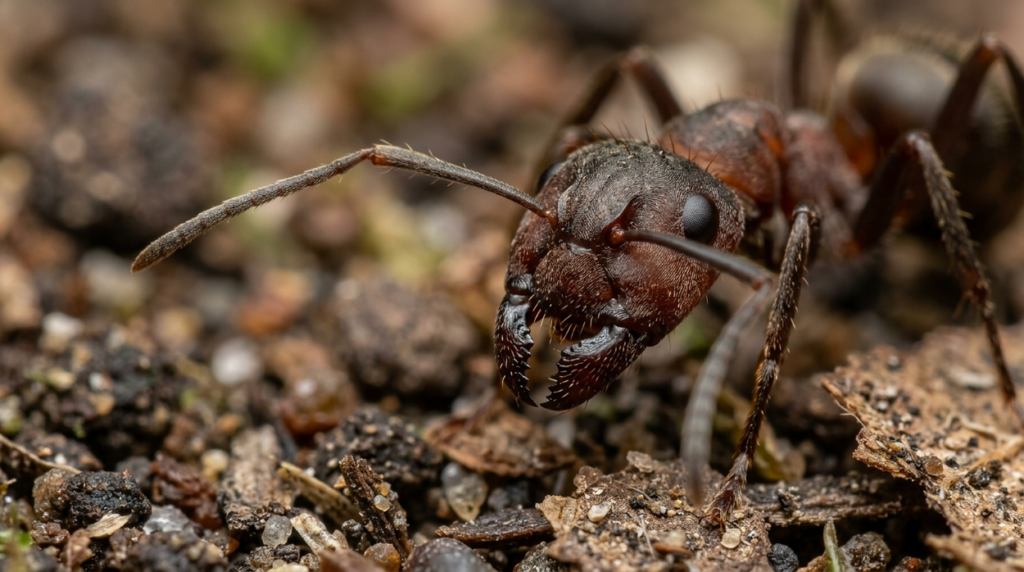
So, when a close-up photograph appears to show an ant with tiny teeth, the observation is not entirely wrong. The important distinction is that these are specialized structures on the mandibles, rather than human-like teeth set inside a mouth.
The way ants eat is also more complicated than simply biting and swallowing. Their mouthparts, digestive system and social behavior work together, and feeding strategies vary considerably among species.
Do Ants Really Have Teeth?
Ants do not have teeth like humans
Human teeth are mineralized structures embedded in the jaws inside the mouth. Ants have a fundamentally different body plan. As insects, they have an exoskeleton, and their feeding apparatus consists of specialized external mouthparts.
The most prominent of these are the mandibles. In general, ants have a pair of mandibles positioned at the front of the head. The mandibles can open and close to grip or process material, functioning as powerful jaws.
That is why saying simply that “ants have no teeth” can be misleading. An ant does not have teeth equivalent to human incisors or molars, but many ants do have tooth-like projections along the mandible’s masticatory margin.
The tooth-like structures are on the mandibles
The number, size and shape of these structures differ among ant species. Some mandibles have relatively simple cutting edges, while others have pronounced teeth or denticles.
Arizona State University’s Ask A Biologist notes that a typical ant can have triangular mandibles with short, pointed teeth, while other species have highly specialized mandibles suited to particular ways of life.
This variation is important because an ant’s head and mandible morphology can provide clues about its diet and behavior.
What Are Ant Mandibles and What Do They Do?
Mandibles are the most conspicuous parts of an ant’s feeding apparatus, but eating is only one of their functions.
Mandibles are more than eating tools
Depending on the species, ants use their mandibles for:
- Cutting food or plant material
- Crushing hard objects
- Holding and carrying food
- Capturing prey
- Fighting and defense
- Digging and manipulating soil
- Moving nest material
- Caring for brood
- Handling objects inside the nest
Because ants do not have grasping hands, their mandibles can effectively serve as multipurpose tools. Ask A Biologist describes them as being used for biting, crushing, cutting, digging, fighting, hunting, and carrying.
This explains why mandibles can look very different between species. A predator that needs to capture insects does not necessarily need the same type of mandible as an ant that specializes in seeds or plant material.
How ant mandibles move
Ant mandibles are controlled by muscles located inside the head. Rather than operating like the vertically moving jaws of humans, insect mandibles generally work by opening and closing against one another.
When an ant places material between its mandibles, the opposing surfaces can cut, grip or crush it. The exact movement and mechanical advantage depend on the species and the structure of its head and mandibles.
This arrangement gives ants considerable versatility despite their small size.
Why some ants have sharper mandibles than others
Mandible shape reflects more than anatomy; it can be associated with an ant’s ecological role.
Predatory species may have elongated or strongly toothed mandibles for grabbing prey. Seed-cracking ants may have robust jaws capable of handling hard materials. Leaf-cutting ants have powerful mandibles adapted for slicing plant material.
The differences can be striking. Big-headed ants, for example, can have heavy mandibles associated with crushing hard seeds, while leaf-cutting ants use their mandibles to cut leaves into manageable pieces.
How Do Ants Eat Solid Food?
Ants do not all process solid food in exactly the same way. The basic process, however, starts with the mandibles.
Biting and cutting the food
An ant encountering a suitable food source can use its mandibles to grasp and cut pieces from it.
For a predatory species, that may mean gripping an insect and cutting or tearing parts of the prey. For another species, it may involve breaking apart seeds or manipulating plant material.
The sharp edges and tooth-like structures on some mandibles can make this process more effective.
Crushing and manipulating food
Mandibles are only one part of an insect’s mouthpart system. Ants possess other structures associated with the mouth, including the labrum, maxillae and labium, which contribute to manipulating food and interacting with the mouth.
🏢 Featured Biotech Industry Partner
Looking for verified and trusted biotechnology partners related to this topic? Explore our comprehensive directory.
Explore Directory →Together, these structures form a mandibulate mouthpart system. The mandibles provide much of the force for cutting and crushing, while the other mouthparts help handle material around the mouth.
This is why describing an ant’s feeding system simply as “teeth” misses an important part of its biology.
Why chewing does not always mean swallowing solid particles
There is another important distinction: processing food is not necessarily the same as swallowing a solid piece of food.
Some ants collect solid material and process it for use by other members of the colony. In some species, larvae participate in the processing or digestion of food before nutrients are redistributed.
Research on Pheidole spadonia, for example, has documented a division of labor in which workers butcher prey while larvae help dissolve prey fragments before the resulting material is distributed within the colony. This is a species-specific example, not a universal feeding pattern for all ants.
How Do Ants Drink Liquid Food?
Solid food is only one part of ant nutrition. Many ants also consume liquid food.
Liquids are handled differently from solid food
Ants commonly exploit liquid resources such as nectar and honeydew. Depending on the species, they may also obtain other nutrient-rich liquids from food sources.
Different ant species have different nutritional requirements, and food preferences can change according to colony needs and environmental conditions. University of Minnesota Extension notes that ants can consume foods including starches, meats, fats and sweets, while many species also use honeydew produced by aphids and scale insects.
The role of the mouth and other mouthparts
Ants do not have a “tongue” equivalent to a human tongue, so describing their liquid-feeding process using human anatomy can create confusion.
Instead, their specialized mouthparts help manipulate and take in liquid food. Sensory structures around the mouth and antennae also contribute to detecting and evaluating food.
Once liquid food is taken up, an important part of the story can happen inside the colony: the food may be stored temporarily and subsequently transferred to other ants.
What Do Ants Actually Eat?
There is no single ant diet.
Sugary and carbohydrate-rich foods
Many ants exploit sugar-rich resources because carbohydrates provide readily available energy.
Common natural sources include:
- Plant nectar
- Honeydew from aphids and scale insects
- Fruit and other sugary plant material
However, the presence of sugar in an ant’s diet does not mean every ant species specializes in carbohydrates. Ant nutrition varies according to species, colony needs and life stage.
Protein and animal-based foods
Many ants also collect animal material, including insects and other small prey.
Protein can be particularly important for growing brood. Predatory and scavenging ants may use their mandibles to capture, cut and transport animal material back to the nest.
The mandibles therefore serve both as feeding structures and as tools for transporting food.
Seeds, plant material and fungi
Some ants make extensive use of seeds or plant material.
Leaf-cutting ants provide one of the best examples of why ant feeding behavior cannot always be understood simply by asking what material they eat. They cut and carry leaves into their nests, but the leaves are primarily used as a substrate for growing fungi. The ants then feed on the cultivated fungus rather than simply eating the leaves themselves.
Their powerful mandibles are therefore essential to a food-production system that involves the entire colony.
How Does Food Move Through an Ant Colony?
An ant colony is not simply a collection of individuals finding and eating food independently. In social species, food can be transported, processed and redistributed among nestmates.
Worker ants collect and prepare food
Foraging workers generally locate food outside the nest and transport suitable resources back to the colony.
Some food can be carried directly using the mandibles. Liquid food can be stored temporarily in an internal structure called the crop, sometimes described as a “social stomach,” and later transferred to other colony members.
The division of labor means that an ant collecting food does not necessarily consume all of that food itself.
Larvae can play an important role in food processing
Ant larvae are more than immature versions of adult workers. Within some species, larvae participate in important aspects of nutrition.
Studies have documented cases in which workers bring food to larvae and larvae contribute to processing it. In Pheidole spadonia, researchers observed workers breaking prey into fragments while later-stage larvae helped dissolve those fragments before workers redistributed the resulting material.
This is one reason the phrase “how does an ant eat?” can have a surprisingly complicated answer. In a social insect, food processing may be distributed across different individuals.
Trophallaxis and food sharing
One of the best-known examples of social feeding is trophallaxis, the transfer of food or liquid between colony members.
🏢 Featured Biotech Industry Partner
Looking for verified and trusted biotechnology partners related to this topic? Explore our comprehensive directory.
Explore Directory →In many ants, a returning worker can transfer liquid food from its crop to another ant through mouth-to-mouth feeding. The receiving ant may then redistribute it to additional nestmates. Research has shown that trophallaxis occurs between adults and also between adults and larvae.
Trophallaxis is therefore more than an individual feeding behavior. It helps distribute nutrients throughout a colony.
Research has also found that trophallactic fluid can contain substances beyond basic nutrients, indicating that food exchange can have additional biological roles in social insects.
Do All Ants Have the Same Kind of Teeth?
No. Ant mandibles are highly variable.
Mandible shape differs between species
Differences can occur in:
- Number and shape of teeth or denticles
- Mandible length
- Mandible curvature
- Cutting edges
- Overall thickness
- Arrangement of specialized structures
These differences can be associated with feeding ecology, defense, nest construction and other behaviors.
For entomologists, the shape of the head and mandibles can therefore provide useful information about an ant’s lifestyle.
Predatory ants and specialized mandibles
Some predatory ants have especially specialized jaws.
Trap-jaw ants are a well-known example. Their mandibles can be held open under muscular tension and released rapidly when sensory hairs detect an appropriate stimulus. Their specialized jaws help them capture prey and, in some circumstances, contribute to escape behavior.
Other predatory ants have long, sharp or hooked mandibles adapted to grabbing prey.
These examples show why “ant teeth” should not be considered a single standardized structure. Ant mandibles have evolved into a wide range of forms.
Seed- and plant-associated ants
Ants associated with seeds and plant material can also have specialized mandibular structures.
Leaf-cutting ants, for example, use their mandibles almost like biological scissors to cut pieces of leaves. Their mandibular design is closely associated with their foraging behavior and fungus-growing lifestyle.
Can Ants Bite and Chew Human Food?
How ants bite
Yes. Ants can use their mandibles to bite and grip, although the experience varies greatly among species.
A bite used to defend a colony is different from using the mandibles to process food. Some species have relatively mild bites, while others have powerful or painful defensive mechanisms.
The mandibles can also help an ant hold onto a surface or object while it uses other defensive structures.
What happens when an ant encounters solid human food?
An ant may cut, scrape, carry or remove small pieces of suitable human food.
A soft sugary food may be handled differently from a hard seed or a piece of animal material. The ant’s mandibles allow it to manipulate the food, while other mouthparts help handle material around the mouth.
So although an ant can “chew” in the broad sense of mechanically processing food, its feeding mechanism should not be treated as a miniature version of human chewing.
Why Ant Teeth and Mandibles Matter to Entomologists
Mandibles can help identify ant species
Ant identification often involves examining morphological features, and mandibles can be useful characteristics.
Researchers and taxonomists may examine the size, shape and arrangement of mandibular structures alongside other features of the head, body and antennae. Mandibles alone are not enough to identify every ant, but they can provide valuable information.
Mouth structure can reveal feeding ecology
The relationship between morphology and behavior is particularly interesting in ants.
A strongly built head with powerful mandibles may indicate the ability to handle hard materials or prey. Long, specialized mandibles can be associated with hunting or unusual feeding strategies. Other forms are adapted for cutting vegetation, carrying materials or manipulating objects.
In this sense, an ant’s mouth can provide a window into its ecological role. Researchers can use physical characteristics alongside behavioral observations to understand how different species exploit their environments.
Ant Teeth vs. Human Teeth: What Is the Difference?
| Feature | Ant mandible teeth/denticles | Human teeth |
| Location | On the mandibles | Inside the mouth |
| Biological structure | Part of a hardened insect mouthpart | Mineralized vertebrate tooth tissue |
| Main functions | Cutting, gripping, crushing and manipulating | Cutting, tearing and grinding food |
| Arrangement | Varies considerably among ant species | Organized into specialized types such as incisors and molars |
| Relationship to anatomy | Integrated with the insect’s external mouthparts | Embedded within the jaws |
| Variation | Strongly influenced by species and lifestyle | Governed by vertebrate dentition and individual development |
The comparison highlights why calling ant mandibular teeth simply “teeth” is useful for everyday description but biologically incomplete.
🏢 Featured Biotech Industry Partner
Looking for verified and trusted biotechnology partners related to this topic? Explore our comprehensive directory.
Explore Directory →The sharp projections on an ant’s mandible may perform some functions that remind us of teeth, but they are part of a fundamentally different feeding system.
What Happens to Food After an Ant Eats It?
From mouthparts into the digestive system
Once food is ingested, it moves into the ant’s digestive system for further processing and nutrient absorption.
However, the path from food source to nutrition is not always a simple individual process. In social ants, a worker may collect food, another colony member may receive it through trophallaxis, and larvae may participate in processing particular types of food.
The crop is especially important for social feeding because it can temporarily hold liquid food before it is transferred to another colony member.
Digestion within the colony
The division of feeding roles can be particularly sophisticated in some species.
Research on ants has demonstrated that workers and larvae can contribute different stages of prey processing, while trophallaxis allows nutrients to be redistributed among workers, larvae and other colony members.
This means that the phrase “an ant eats food” can describe only one part of a much larger colony-level process.
FAQs
1. Do ants have teeth like humans?
No. Ants do not have human-like teeth embedded inside jaws. Instead, they have paired mandibles, and many species have tooth-like structures or denticles along the inner edges of those mandibles. These help with cutting, gripping and crushing food.
2. What are the teeth on an ant called?
The structures commonly described as ant teeth are generally teeth or denticles on the mandibles. They are part of the ant’s hardened mouthparts rather than separate vertebrate-style teeth.
3. How do ants chew and eat solid food?
Ants use their mandibles to grip, cut, crush and manipulate solid material. Other mouthparts help handle food around the mouth. Depending on the species, solid food may be consumed directly or processed and subsequently distributed to other colony members.
4. Can ants swallow solid food?
Ants can ingest processed food, but feeding varies among species. Some solid food is mechanically processed, while in certain colonies food can undergo additional processing involving larvae before nutrients are redistributed.
5. How do ants eat and share food with other ants?
Many social ants share liquid nutrients through trophallaxis, in which food is transferred between colony members. Foragers can store liquid food in the crop and later transfer it to nestmates, including larvae.
Conclusion
So, do ants have teeth? Not in the same biological sense as humans.
Ants have paired mandibles, and many species have teeth-like projections, denticles or cutting structures along those mandibles. These structures help ants cut, crush, grip and manipulate food, but they can also be used for hunting, defense, digging and carrying.
Ant feeding becomes even more interesting when viewed at the colony level. Different ants may collect food, process it, store liquid resources in their crops, feed larvae and share nutrients through trophallaxis. The shape of an ant’s mandibles also varies substantially between species, reflecting differences in diet, habitat and behavior.
The simplest way to think about an ant’s mouth is therefore not as a tiny version of a human mouth, but as a specialized insect feeding system. Mandibles, other mouthparts, digestion and social feeding behavior work together to determine how an ant obtains and processes food.