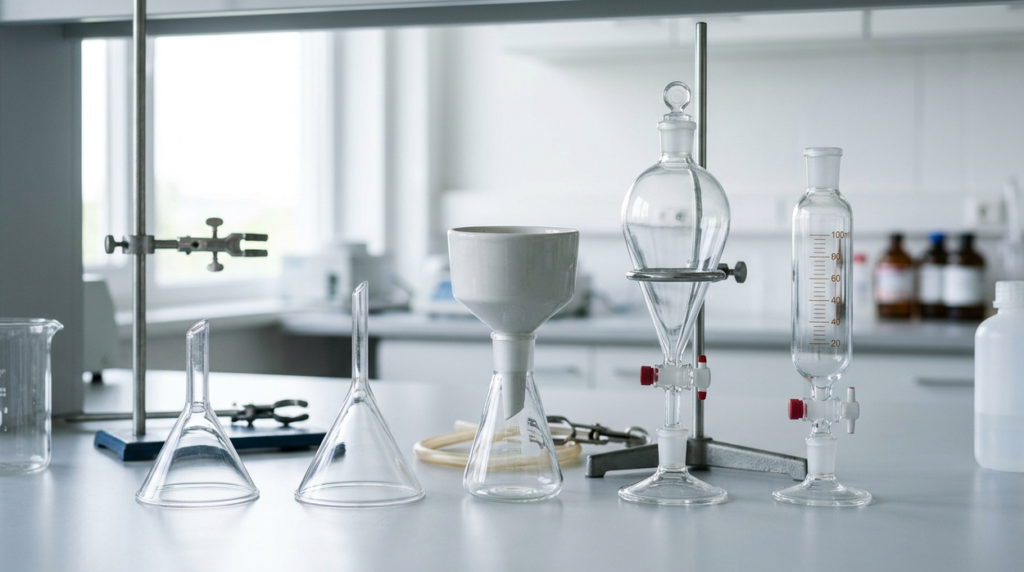
A laboratory funnel is a basic but essential piece of laboratory glassware used to transfer liquids and powders, separate suspended solids from liquids, isolate immiscible liquid phases, and introduce reagents into reaction vessels under controlled conditions. Although many funnels share a wide opening and a narrower outlet, their designs differ according to the operation they are intended to perform.
Understanding laboratory funnel uses helps laboratory technicians, chemistry students, pharmaceutical researchers, and quality-control personnel select appropriate equipment for sample preparation, chemical synthesis, filtration, and reagent handling. A conventional funnel may be sufficient for transferring a solution into a narrow-necked bottle, while recovering crystals from a reaction mixture may require a Büchner funnel and vacuum filtration. Separating two immiscible solvents, meanwhile, calls for a separatory funnel with a stopcock.
The right choice depends on the intended operation, the material being handled, the required separation, and the equipment’s chemical compatibility. This guide explains the major types of laboratory funnels, how they work, where they are used, and what to consider when selecting them for pharmaceutical, biotechnology, and research applications.
What Is a Laboratory Funnel Used For?
A laboratory funnel directs material into a receiving vessel or supports a specific separation or liquid-delivery process. Its main functions include the following.
Transferring liquids into narrow-necked containers
A conventional funnel guides liquids into bottles, test tubes, volumetric flasks, and other vessels with restricted openings. Its broad bowl collects the incoming liquid, while the stem directs the flow and helps reduce spills.
The funnel should sit securely in or above the receiving vessel. An unsuitable stem diameter or unstable arrangement can cause splashing, overflow, or accidental tipping.
Transferring powders and granular materials
Wide-stem funnels help transfer dry reagents, excipients, crystalline compounds, and granular materials into containers with relatively small openings. Their larger outlets can reduce clogging compared with narrow liquid-transfer stems, particularly when the material flows freely.
Powder handling also requires attention to dust generation, operator exposure, static effects where relevant, and cross-contamination. Equipment should be clean, compatible with the material, and appropriate for the required containment measures.
Separating solids from liquids
When a mixture contains insoluble particles, a funnel fitted with suitable filter paper or another porous medium can separate the solid from the liquid. In gravity filtration, liquid passes through the filter under gravity while particles retained by the medium remain behind.
The liquid collected below is called the filtrate. The retained material is the residue or filter cake, depending on the process.
Filtration performance depends on the filter medium, particle characteristics, liquid viscosity, and operating conditions. Ordinary filtration does not automatically remove dissolved substances or guarantee sterility.
Separating immiscible liquids
A separatory funnel allows two liquids that form distinct phases to be separated after settling. It is commonly used in liquid-liquid extraction, washing, and laboratory-scale chemical work-up.
The two phases may contain different proportions of the compounds being processed. Their positions depend on density and composition, so the lower layer is not necessarily aqueous.
Controlling reagent addition
A dropping funnel introduces a liquid or reagent into a reaction vessel at a regulated rate. This is useful when addition speed affects heat generation, mixing, reaction rate, or selectivity. Its stopcock provides control over delivery that a conventional transfer funnel does not offer.
Types of Laboratory Funnels and Their Functions
Different types of funnels in chemistry are designed around distinct operating principles. The following designs cover routine transfer, filtration, extraction, and specialized laboratory tasks.
1. Simple or general-purpose laboratory funnel

A general-purpose funnel typically consists of a conical bowl and a narrow stem. It is used primarily to transfer liquids and suitable dry materials into containers with small openings.
Glass models are common in chemistry laboratories, while compatible plastic versions are useful for selected transfer operations. The appropriate material depends on the chemical, temperature, cleaning method, and handling environment.
For example, a technician may use a conventional funnel to transfer a prepared buffer or solvent into a laboratory bottle. The funnel can also support gravity filtration when suitable filter paper is fitted inside it, but the filter medium—not the funnel alone—performs the particle separation.
2. Filter funnel or gravity filtration funnel
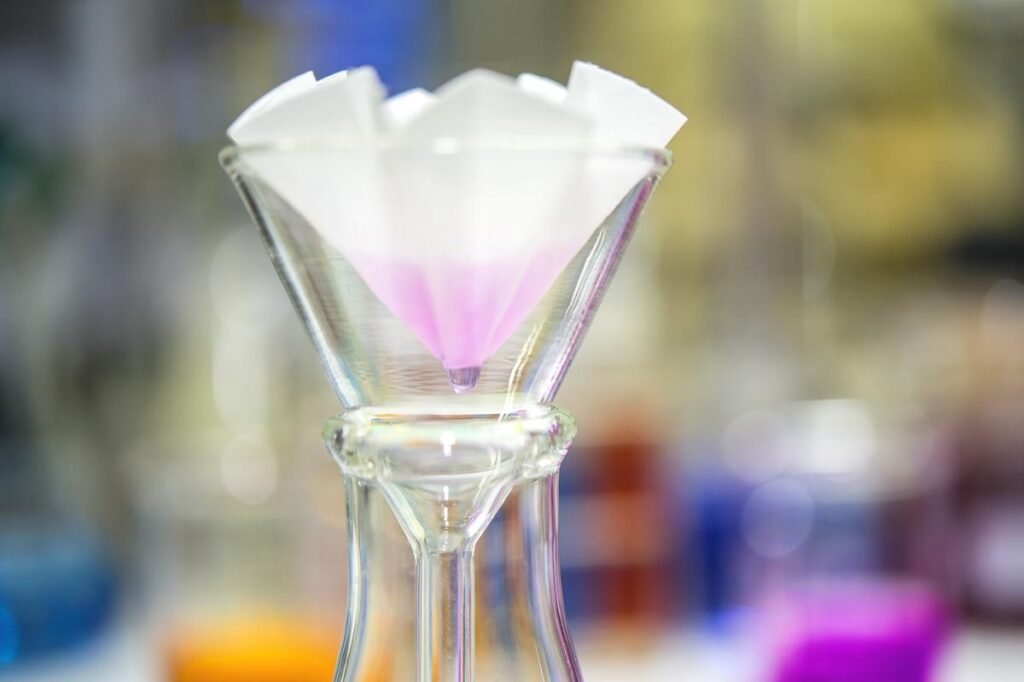
A filter funnel is used with filter paper or another compatible porous medium to separate suspended solids from a liquid. The filter paper must fit appropriately within the funnel so that the sample does not bypass the filtering surface.
During gravity filtration, the liquid flows through the medium under its own weight. Depending on the procedure, the paper may be wetted before use to help it seat against the funnel and reduce bypass around its edges.
Common applications include removing insoluble particles during solution preparation, clarifying a reaction mixture, and separating a liquid product from unwanted solid material.
Gravity filtration is generally straightforward but may be slow when particles are fine, the liquid is viscous, or the filter medium has low permeability. It should not be treated as interchangeable with vacuum filtration or membrane-based sterilizing filtration.
3. Büchner funnel
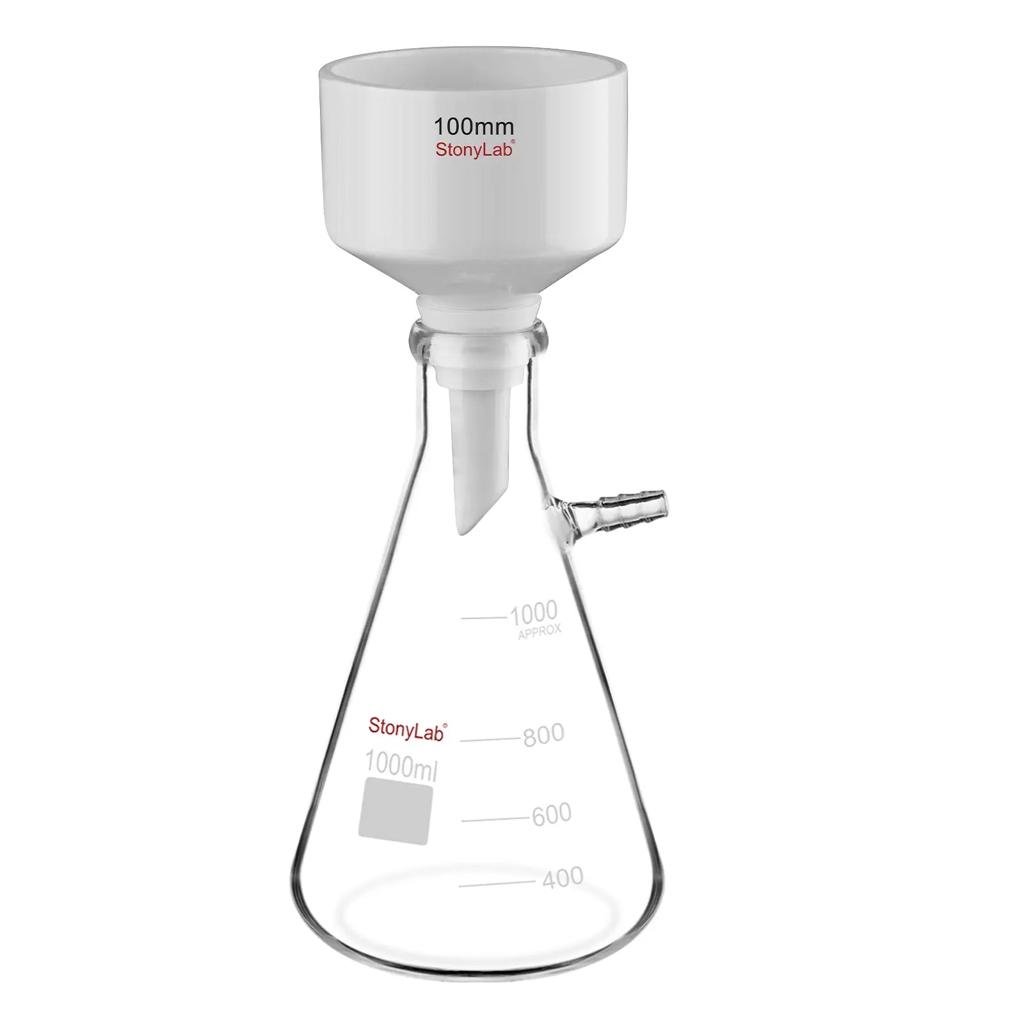
A Büchner funnel usually has a cylindrical body and a perforated plate that supports filter paper or a compatible filtering surface. It is commonly used for vacuum-assisted filtration, particularly when the objective is to recover a solid from a liquid mixture.
The funnel is fitted to a compatible filter flask, typically through a suitable seal or adapter. A vacuum source creates a pressure difference that draws liquid through the filter more rapidly than gravity alone may allow.
Typical applications include collecting precipitates, recovering crystals after laboratory synthesis, and separating a filter cake from its mother liquor during process development.
The desired product determines what is collected: the solid remains on the filter, while the liquid passes into the flask. Vacuum filtration equipment must be suitable for the intended pressure conditions, and glassware should be inspected for damage before use.
A Büchner funnel is laboratory-scale filtration equipment; it does not replace appropriately designed industrial filtration systems.
4. Hirsch funnel

🏢 Featured Laboratory Suppliers Directory Listing
Looking for verified and trusted laboratory suppliers partners related to this topic? Explore our comprehensive directory.
Explore Directory →A Hirsch funnel is generally smaller and more conical than a Büchner funnel. It is commonly selected for small-scale vacuum filtration when only a limited amount of precipitate or crystalline material is available.
Like a Büchner funnel, it uses a filtering surface to retain solids while reduced pressure assists liquid removal. Its smaller capacity can be advantageous when working with small research samples, although the appropriate size depends on the sample quantity and the specific model.
The main distinction is practical rather than absolute: Hirsch funnels are typically suited to smaller quantities, while Büchner funnels are often chosen for larger laboratory-scale solid recovery.
5. Separatory funnel

A separatory funnel is designed to separate immiscible liquids, commonly during liquid-liquid extraction and chemical work-up. It has a vessel-shaped body, a top stopper, and a lower outlet controlled by a stopcock.
After the liquid phases settle into distinct layers, the operator can drain the lower phase through the stopcock and collect the other phase separately. The position of each phase depends on its density and composition; an organic solvent may form either the upper or lower layer.
Separatory funnels are useful for extracting or washing laboratory-scale reaction mixtures and isolating compounds between liquid phases. However, phase separation alone does not establish the purity of a pharmaceutical intermediate or demonstrate that a material meets product-release specifications.
Volatile solvents and certain reactions can generate pressure. The operator must follow the applicable procedure and risk assessment, use suitable protective equipment, and manage pressure safely.
6. Dropping funnel

A dropping funnel is used to add liquids gradually to a reaction vessel. Its reservoir holds the reagent, while a stopcock regulates the flow through the outlet. Graduated models provide approximate volume indications where applicable, but they are not necessarily calibrated analytical measuring devices.
Controlled addition is valuable when a reaction is sensitive to reagent concentration, heat generation, mixing, or reaction rate. For example, a chemist may add a reagent slowly during a synthesis according to an established experimental procedure.
Pressure-equalizing dropping funnels are designed for compatible apparatus configurations in which pressure differences could otherwise impede flow or disturb the reaction setup. Their use does not, by itself, control reaction temperature or guarantee a particular outcome.
7. Powder funnel or wide-stem funnel

A powder funnel has a relatively wide outlet that helps transfer dry chemicals, excipients, and granular materials without the frequent blockage associated with narrow stems.
It is useful in laboratory-scale weighing, formulation preparation, and material transfer. Cohesive powders may still bridge or adhere to the funnel, so the design should match the material’s flow properties.
Cleanliness is particularly important when handling pharmaceutical ingredients or analytical reference materials. Dedicated equipment or an appropriate cleaning procedure may be needed to prevent carryover between materials. Production-scale powder charging may require specialized contained transfer equipment rather than a simple laboratory funnel.
8. Thistle funnel
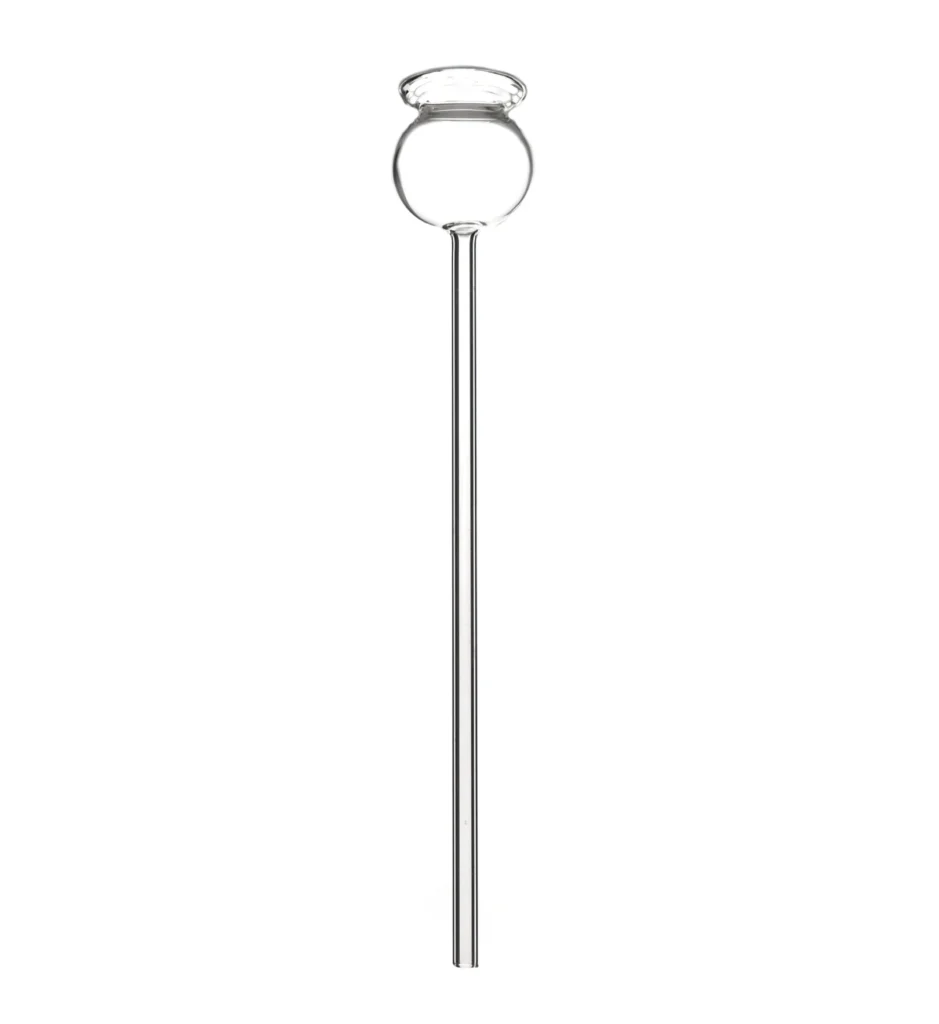
A thistle funnel has a small reservoir connected to a long, narrow tube. It is used to introduce liquids through a restricted opening in a reaction vessel or apparatus.
This design can be useful in selected small-scale experimental setups where direct pouring is impractical. However, a thistle funnel generally provides less precise flow regulation than a dropping funnel with a stopcock. The choice depends on the required degree of control and the arrangement of the apparatus.
9. Stemless funnel

A stemless funnel lacks the long outlet stem found on a conventional funnel. Its design can be useful in selected hot-filtration procedures, particularly when a long stem might cool the solution and encourage premature crystallization.
Whether it is suitable depends on the solvent, temperature, solubility characteristics, receiving vessel, and experimental procedure. A stemless funnel is not automatically the best choice for every hot filtration.
10. Sintered-glass or fritted filter funnel
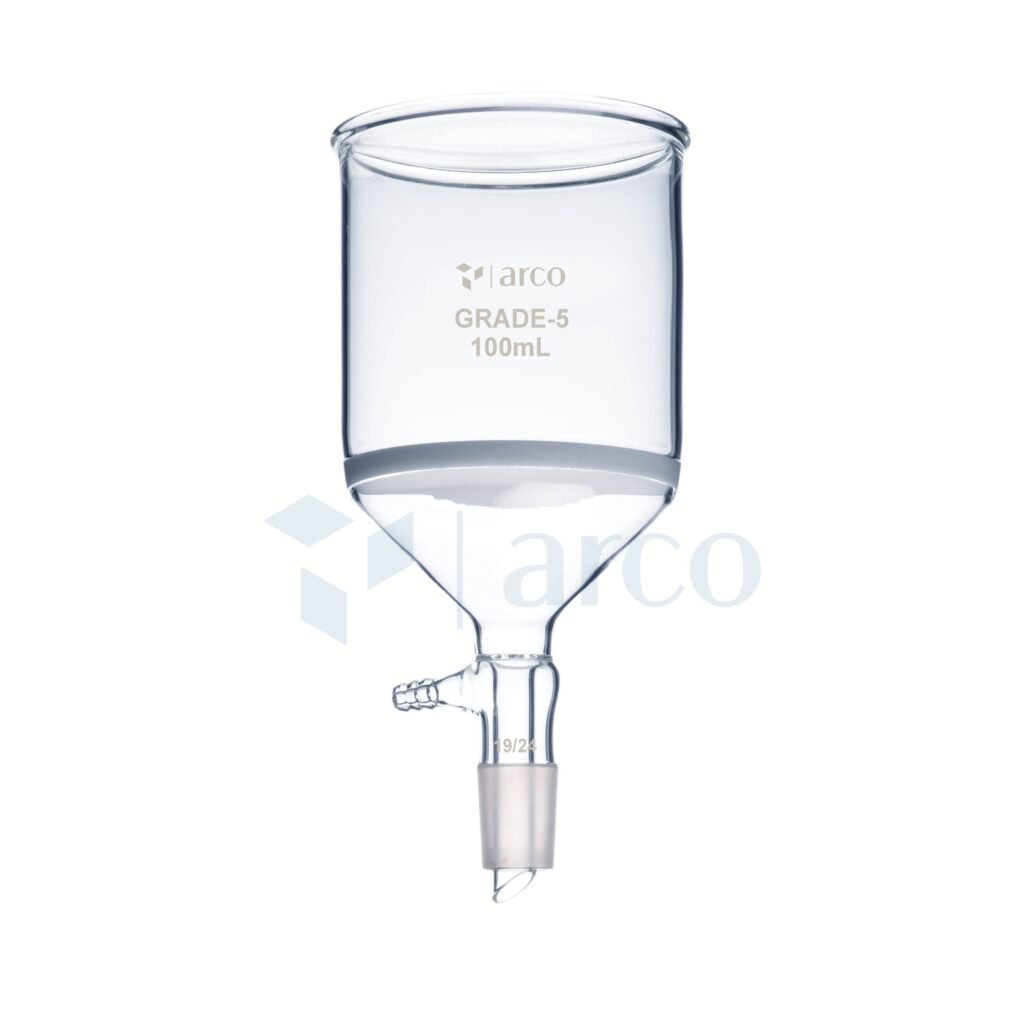
A sintered-glass funnel contains an integrated porous glass disc that serves as the filtering surface. Different porosity grades provide different combinations of particle retention and liquid flow.
These funnels can be useful when a reusable filtering surface is preferred over filter paper. However, fine particles or precipitates may clog the porous disc, making cleaning difficult. Chemical compatibility, temperature limits, cleaning procedures, and the intended operating conditions should be checked before use.
11. Weighing funnel

A weighing funnel is used in selected analytical and sample-preparation workflows to hold and transfer solid materials. Depending on its design, it can help move a weighed sample into a preparation vessel while minimizing material loss.
It is distinct from a conventional liquid-transfer funnel and should not be confused with a calibrated volumetric measuring device. The weighing vessel and balance procedure must still be appropriate for the required measurement accuracy.
How Different Laboratory Funnels Work
The main difference between laboratory funnels lies in how they move material or create the conditions needed for separation. Understanding these operating principles makes equipment selection more straightforward.
Gravity filtration versus vacuum filtration
Gravity filtration relies on gravity to move liquid through filter paper or another porous medium. It is commonly used when the filtrate is the desired product and the suspended solid is unwanted. It can also be useful when the sample is small or when vacuum-assisted processing is unnecessary.
Vacuum filtration creates a pressure difference across the filter medium, drawing liquid through it more rapidly. It is often preferred when recovering a solid product, such as a precipitate or crystals, from a reaction mixture.
The University of York’s chemistry teaching-laboratory filtration guidance explains how the desired product, filtration method, and available equipment influence the choice.
Neither method is universally better. Filter-medium permeability, particle size, liquid viscosity, solvent volatility, and the amount of material being processed can all affect performance. Vacuum filtration also requires a compatible flask, suitable seals and connections, and equipment rated for the intended operating conditions.
Liquid-liquid separation using a separatory funnel
Liquid-liquid extraction takes advantage of the distribution of a compound between two immiscible liquid phases. When the phases settle, they form distinct layers that can be recovered separately.
🏢 Featured Laboratory Suppliers Directory Listing
Looking for verified and trusted laboratory suppliers partners related to this topic? Explore our comprehensive directory.
Explore Directory →The operator uses the stopcock to release the lower phase while retaining the upper phase in the funnel. Before collection, the phases must be identified rather than assumed to be aqueous and organic based on position alone.
Repeated extraction or washing may be part of a chemical work-up, depending on the compounds and solvents involved. The University of York’s separatory-funnel guidance discusses the importance of suitable capacity, secure fittings, and safe handling during extraction.
Controlled liquid addition with a dropping funnel
A dropping funnel regulates liquid delivery through a stopcock. The operator can adjust the flow according to the requirements of the experiment, allowing a reagent to enter a reaction mixture gradually rather than all at once.
This can be important when rapid addition could cause excessive heat generation, poor mixing, or an undesirable change in reaction conditions. In a compatible closed apparatus, a pressure-equalizing design can help maintain appropriate pressure relationships during addition.
A dropping funnel does not measure reaction temperature, control the reaction independently, or guarantee a particular yield. Its function is to provide controlled delivery within an experimental setup that is otherwise designed and operated appropriately.
Laboratory Funnel Comparison: Which Type Should You Use?
The following table summarizes common laboratory funnel types and their principal applications. These are typical uses rather than absolute restrictions; the appropriate choice depends on the design, sample, and experimental procedure.
| Funnel type | Primary function | Typical application |
| General-purpose funnel | Transfers liquids or suitable solids | Filling narrow-necked vessels |
| Gravity filter funnel | Separates suspended solids from liquids | Routine solution clarification |
| Büchner funnel | Supports vacuum-assisted filtration | Recovering precipitates or crystals |
| Hirsch funnel | Supports small-scale vacuum filtration | Recovering small solid samples |
| Separatory funnel | Separates immiscible liquid phases | Extraction and chemical work-up |
| Dropping funnel | Controls liquid addition | Reagent addition during synthesis |
| Powder funnel | Transfers dry powders | Moving excipients or reagents into vessels |
| Thistle funnel | Introduces liquids through restricted openings | Small-scale liquid addition |
| Stemless funnel | Supports selected transfer and hot-filtration operations | Reducing premature crystallization in a stem |
| Sintered-glass funnel | Filters through an integrated porous disc | Filtration without separate filter paper |
| Weighing funnel | Holds and transfers weighable solids | Analytical sample preparation |
Choosing a funnel based on the material being handled
- Liquids: A general-purpose funnel is often sufficient for straightforward transfer, provided its material and dimensions suit the liquid and receiving vessel.
- Dry powders: A wide-stem powder funnel can help prevent blockage and reduce spills during transfer.
- Suspended solids: Use a gravity filter funnel when gravity filtration meets the process requirements, or consider a Büchner or Hirsch funnel when vacuum-assisted solid recovery is appropriate.
- Immiscible liquids: Select a separatory funnel designed for the solvent system and expected working volume.
- Reagents requiring gradual addition: Use a dropping funnel when the addition rate needs to be regulated.
- Small quantities of precipitate: A Hirsch funnel may be suitable when its capacity and filtering area match the sample.
Choosing a funnel based on the desired outcome
The intended product is often just as important as the starting material.
If the liquid is the desired product, gravity filtration may be appropriate when the goal is to remove insoluble material. If the solid is the desired product, vacuum filtration can help recover it efficiently, although the choice depends on the solid’s properties and the solvent.
If the objective is to distribute compounds between two immiscible phases, a separatory funnel supports phase recovery. If the goal is to introduce a reagent gradually, a dropping funnel provides a more suitable level of control than a simple transfer funnel.
These distinctions prevent a common error: selecting equipment based on appearance rather than the operation it must perform.
Glass, Plastic, and Other Funnel Materials: What Matters in the Laboratory?
Funnel construction affects chemical compatibility, mechanical durability, temperature tolerance, cleaning, and the possibility of sample contamination. The material should be selected for the actual application rather than appearance or price alone.
Glass laboratory funnels
Glass funnels are widely used in chemistry laboratories because their contents are visible and many glass types are compatible with common laboratory chemicals. Borosilicate glass is used in numerous laboratory applications because of its useful thermal and chemical properties.
However, glass is not universally resistant to every reagent. Compatibility depends on the glass composition, chemical concentration, temperature, and exposure conditions. Glass funnels can also chip or break, so damaged equipment should not be used.
Inspect the funnel before use, particularly around the stem, rim, stopcock connections, and other areas subject to mechanical stress.
Plastic laboratory funnels
Plastic funnels are useful for selected liquid-transfer and powder-handling tasks. Depending on the polymer, they may offer lower weight, reduced breakage risk, and convenient single-use options.
Different plastics have different resistance to solvents, temperature, and mechanical stress. A plastic funnel suitable for an aqueous buffer may be unsuitable for a strong organic solvent or a heated process.
For sensitive analytical or pharmaceutical work, also consider extractables, leachables, and potential contamination where relevant to the intended use. Reusable plastic funnels must be compatible with the cleaning and decontamination methods applied to them.
Porcelain and other specialized materials
Porcelain is used in some Büchner and Hirsch funnels, while sintered-glass funnels incorporate a porous glass filtering surface. These designs serve different filtration requirements and should not be treated as interchangeable.
For vacuum filtration, verify the ratings of the funnel, flask, seal, and connected components. For sintered glass, select an appropriate porosity and check whether the material can be cleaned effectively after exposure to the sample.
Manufacturer specifications and laboratory procedures should guide the selection of all specialized materials. Fisher Scientific’s laboratory funnel overview provides a useful reference for common funnel designs, construction materials, and applications.
How Laboratory Funnels Are Used in Pharmaceutical and Biotechnology Workflows
Funnels are simple pieces of laboratory equipment, but their selection can affect sample handling, material recovery, and the consistency of routine laboratory operations.
Analytical chemistry and sample preparation
In analytical laboratories, funnels may be used to transfer prepared samples, solvents, and reagents between vessels. Gravity filtration can remove insoluble particles when the analytical method requires clarification before a subsequent measurement.
Incorrect funnel selection may cause spills, incomplete transfers, or contamination. An unsuitable filter medium can also retain part of the target analyte, release interfering material, or fail to remove the particles of concern.
Routine clarification should be distinguished from procedures intended to achieve defined analytical or microbiological requirements. A conventional funnel and filter paper are not substitutes for a validated membrane-filtration method when the analytical specification requires one.
Pharmaceutical research and chemical synthesis
During laboratory-scale chemical synthesis, a separatory funnel may be used to extract a compound into a suitable solvent or wash a reaction mixture. A Büchner or Hirsch funnel may then recover precipitated or crystallized material, while a dropping funnel may support controlled reagent addition during a subsequent reaction.
Each piece of equipment addresses a different step. Extraction separates liquid phases, filtration separates solids from liquids, and controlled addition regulates how a liquid enters a reaction vessel.
These operations can support early-stage research and process development, but laboratory equipment must be selected and operated according to the procedure. A funnel by itself does not establish the purity, identity, or release suitability of a pharmaceutical material.
Biotechnology and laboratory reagent preparation
Funnels may assist in transferring compatible buffers, aqueous solutions, and laboratory reagents. Particle filtration may be useful when a preparation contains insoluble material that should be removed before use.
For sensitive biological work, however, a suitable funnel does not automatically make a solution sterile. Sterile filtration, aseptic processing, and specialized bioprocess equipment have distinct requirements.
Material compatibility is also important when handling biological reagents, since residues, incompatible surfaces, or inadequate cleaning may affect subsequent experiments. The appropriate transfer and filtration method should follow the requirements of the intended application.
Quality control, cleaning, and contamination prevention
Reusable funnels can retain chemical residues, precipitates, or biological material. If the equipment is used for different samples without appropriate cleaning, carryover may affect analytical results or compromise sample integrity.
Good laboratory practice includes selecting equipment appropriate to the material, cleaning it using a compatible method, inspecting it before reuse, and storing it to prevent contamination. Single-use equipment may be appropriate in some workflows, but it still needs to be suitable for the intended application.
Cleaning documentation, verification, and other controls should reflect the laboratory’s quality system and the risks associated with the equipment’s use. Not every laboratory funnel requires the same level of cleaning validation or documentation.
Common Mistakes When Selecting or Using Laboratory Funnels
Even a simple funnel can cause problems when its design does not match the task or when it is used outside its operating limits.
Using the wrong funnel for the operation
A general-purpose funnel is suitable for routine transfer but cannot automatically replace a Büchner funnel, separatory funnel, or dropping funnel. These specialized designs support different operations: filtration, phase separation, and controlled liquid addition.
🏢 Featured Laboratory Suppliers Directory Listing
Looking for verified and trusted laboratory suppliers partners related to this topic? Explore our comprehensive directory.
Explore Directory →Before selecting equipment, identify whether the goal is to transfer a material, separate a mixture, collect a solid, or regulate reagent delivery.
Selecting an unsuitable filter medium or funnel size
Filter paper that does not fit correctly can allow solids to bypass the filtering surface. A medium that is too restrictive may cause slow filtration or blockage, while a funnel that is too small may overflow when the sample volume exceeds its practical capacity.
Vacuum filtration requires particular attention to the integrity and pressure ratings of the entire assembly. Follow manufacturer instructions and established laboratory procedures rather than assuming that ordinary glassware is suitable for vacuum service.
Ignoring chemical compatibility and cleanliness
An incompatible funnel material may degrade, contaminate the sample, or fail during use. Residues from previous samples can also interfere with analytical measurements or subsequent experiments.
Check compatibility with the sample and cleaning agents, inspect reusable equipment, and ensure it is clean and dry where required by the procedure. Use dedicated equipment or an appropriate cleaning process when cross-contamination presents a concern.
Misusing a separatory funnel
Confusing the upper and lower phases can result in the wrong fraction being collected. Phase identity should be established from the solvent system and experimental conditions, not assumed from layer position.
A separatory funnel must also be supported securely, with its stopper and stopcock checked before use. Shaking mixtures containing volatile solvents or reactive reagents can generate pressure, so pressure must be managed according to the laboratory’s safety procedure.
Operations involving corrosive chemicals, volatile solvents, heat, or vacuum should follow the relevant risk assessment, standard operating procedure (SOP), and equipment instructions.
How to Select the Right Laboratory Funnel for Your Application
A practical selection process starts with the operation and then considers material compatibility, capacity, dimensions, and handling requirements.
Start with the intended task
Identify the primary purpose before choosing the design:
- Liquid or powder transfer: Choose a general-purpose or wide-stem funnel.
- Gravity filtration: Select a compatible filter funnel and appropriate filter paper.
- Vacuum filtration: Choose a Büchner, Hirsch, or sintered-glass funnel according to the required capacity and filtering surface.
- Liquid-liquid extraction: Use a separatory funnel suited to the solvent system.
- Controlled reagent addition: Select a dropping funnel with suitable flow control.
- Small-scale solid recovery: Consider a Hirsch funnel when its filtering area is adequate.
- Weighing and solid transfer: Choose a suitable weighing funnel if the design supports the intended procedure.
Check material compatibility and operating conditions
Identify the sample’s chemical composition, including solvents, reagents, and any potentially incompatible substances. Check the funnel material’s resistance to these chemicals and confirm the applicable temperature limits.
If the operation involves vacuum or pressure, verify the ratings of the complete assembly. Also consider whether a reusable or single-use funnel is appropriate and whether the equipment can tolerate the required cleaning or decontamination process.
Evaluate capacity, dimensions, and handling
The funnel should accommodate the expected working volume without making the setup unstable or difficult to control.
Check that the stem fits the receiving vessel, the filter area suits the filtration load, and the filter medium is compatible with the sample. For separatory funnels, examine the working capacity, stopper fit, and stopcock operation. For dropping funnels, consider the required addition control and compatibility with the reaction apparatus.
What should laboratory procurement teams verify before purchasing?
Procurement teams should focus on specifications that directly affect safe, reliable use:
- Intended application and funnel design.
- Construction material and chemical compatibility.
- Capacity, dimensions, connections, and applicable pressure ratings.
- Availability of compatible replacement stoppers, stopcocks, and filter media.
- Manufacturer instructions for operation, cleaning, and maintenance.
- Suitability for the laboratory’s sample-integrity and contamination-control requirements.
For routine transfer, a simple funnel may be entirely adequate. Specialized filtration or extraction tasks, however, justify selecting equipment specifically designed for those operations.
Conclusion
A laboratory funnel is more than a transfer accessory. Its geometry, filtering surface, outlet controls, and construction material determine whether it is suitable for transferring materials, separating solids from liquids, extracting immiscible phases, or controlling reagent addition.
Three practical principles guide effective selection: match the funnel to the intended operation, verify material compatibility and operating limits, and follow appropriate procedures for safe handling and contamination prevention.
In pharmaceutical and biotechnology laboratories, these considerations help protect sample integrity and support consistent research and analytical workflows. Understanding the differences between laboratory funnel types enables technicians, researchers, and procurement teams to avoid common handling errors and select equipment that fits the task.
Frequently Asked Questions About Laboratory Funnels
1. What is the main purpose of a funnel in a laboratory?
A laboratory funnel primarily transfers liquids or suitable solids into containers with narrow openings. Specialized funnels also support filtration, liquid-liquid separation, and controlled reagent addition.
2. What is the difference between a filter funnel and a separatory funnel?
A filter funnel separates suspended solids from liquids using filter paper or another porous medium. A separatory funnel separates two immiscible liquid phases, allowing them to be recovered independently through a stopcock.
3. What is a Büchner funnel used for?
A Büchner funnel is used for vacuum-assisted filtration, commonly to recover precipitates or crystals from liquid mixtures. Reduced pressure helps draw liquid through the filtering surface.
4. Which funnel is used to separate two immiscible liquids?
A separatory funnel is used to separate immiscible liquids. Once the phases settle, its stopcock allows the lower phase to be drained separately from the upper phase.
5. Why are different laboratory funnels made from different materials?
Materials such as glass, plastic, and porcelain offer different chemical resistance, temperature tolerance, durability, and handling characteristics. The appropriate choice depends on the sample, operating conditions, cleaning requirements, and intended use.