Choosing between a porcelain and a glass Büchner funnel involves more than comparing materials or purchase prices. Both are used for vacuum-assisted solid–liquid separation, but their suitability can differ depending on the sample chemistry, cleaning requirements, visibility needs, and operating conditions.
For pharmaceutical quality control laboratories, API process-development teams, biotech researchers, and academic chemistry laboratories, the choice can affect inspection practices, sample recovery, contamination control, and equipment maintenance. A funnel that works well for routine precipitate collection may not be appropriate for trace-level analytical work or filtration involving aggressive reagents.
Neither material is universally superior. The most suitable Büchner funnel is the one whose material, construction, and operating limits match the intended procedure. This guide compares porcelain and glass funnels, explains the factors that influence filtration performance, and provides a practical framework for laboratory procurement.
How porcelain and glass Büchner funnels differ in construction
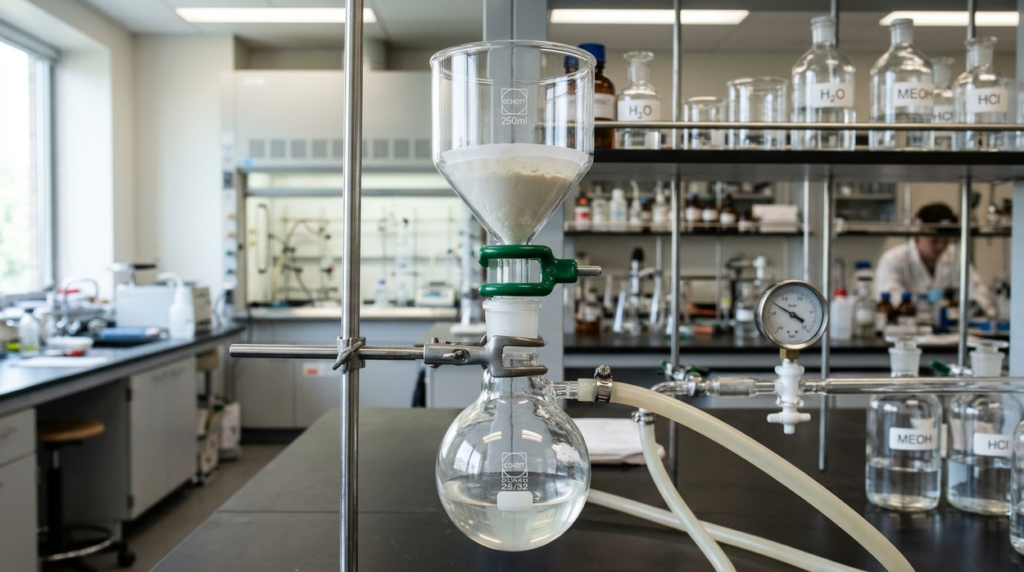
A Büchner funnel is designed to collect solids from a liquid using vacuum filtration. A filter medium, usually filter paper or a compatible membrane, rests on a perforated support plate. Vacuum applied through a suitable receiving flask draws liquid through the medium while retaining the solid material.
The funnel provides the supporting structure, but the filter medium, sample characteristics, vacuum conditions, and assembly design also determine the outcome.
What a porcelain Büchner funnel is designed for
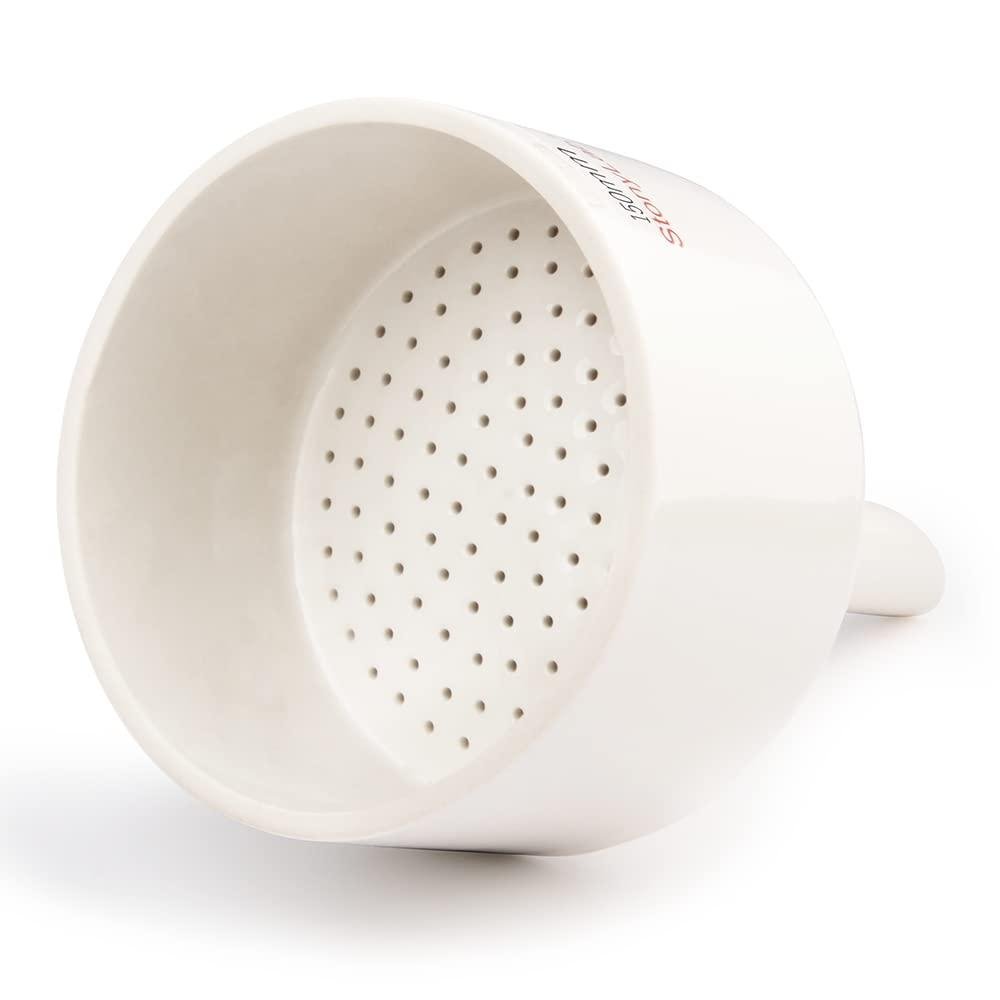
Image Source: snapklik.com
A laboratory-grade porcelain Büchner funnel is made from a ceramic material manufactured for laboratory use. Depending on the product, its surfaces may be glazed or otherwise finished to provide the intended surface characteristics and resistance to the specified operating conditions.
Its perforated plate supports the filter medium and distributes the area available for filtration. The opaque body, however, prevents direct inspection through the funnel walls.
Porcelain funnels are commonly used for routine chemical filtration, precipitate collection, and general laboratory solid–liquid separation. Their rigid construction can suit established workflows in which transparency is unnecessary and the material is compatible with the sample.
However, laboratory porcelain should not be treated as interchangeable with ordinary ceramic household products. Ceramic composition, glaze quality, exposed surfaces, manufacturing defects, and the design of the funnel can all affect suitability. A damaged glaze or unsuitable exposed surface may create additional concerns for cleaning and sample compatibility.
Porcelain can be a practical option for routine procedures, but its chemical resistance, thermal limits, and service life must be confirmed against the manufacturer’s specifications.
What a glass Büchner funnel is designed for
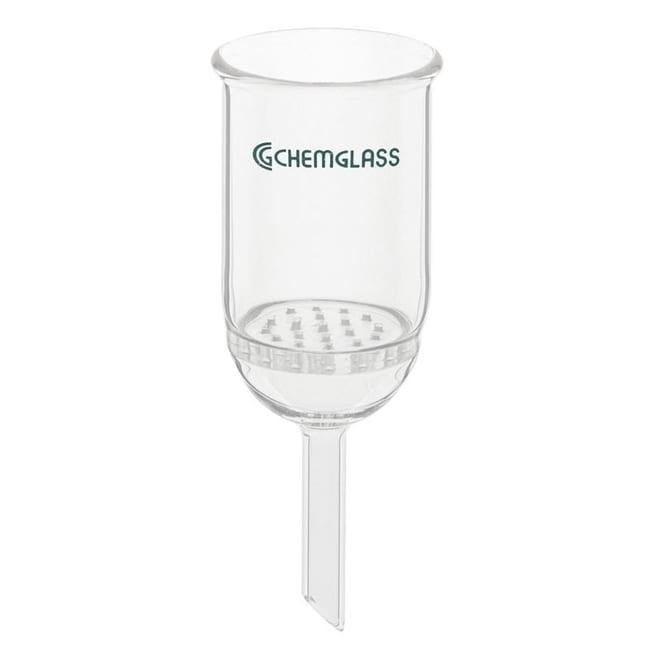
Image Source: fishersci.com
A glass Büchner funnel offers an important operational advantage: transparency. When the design permits, laboratory personnel can observe liquid movement, visible deposits, retained liquid, and residue along the funnel walls.
That visibility can be useful during method development, analytical sample preparation, and experiments in which observing the filtration process helps identify practical problems.
The type of glass matters. Borosilicate glass and other laboratory glass compositions have different properties, so the generic term glass funnel is insufficient for a compatibility decision. Conventional laboratory glass can be attacked by hydrofluoric acid, while strong alkaline solutions and elevated temperatures can also affect certain glass compositions under particular exposure conditions.
Glass funnels may be available with different joint designs, adapters, filtration areas, and support-plate configurations. These features should be matched to the receiving flask and the intended filter medium.
Transparency is helpful for inspection, but it does not establish that a funnel is chemically compatible, free of trace contaminants, or safe to operate under every vacuum or temperature condition.
Which design features matter regardless of material?
Before comparing materials, check the specifications that directly affect the filtration setup:
- Funnel diameter and filtration area: These influence the available filter area and may affect throughput.
- Perforated plate design: Hole size, distribution, support, and construction affect how the filter medium sits and how the assembly behaves.
- Funnel depth and wall geometry: These influence sample capacity, handling, and residue accumulation.
- Filter-medium compatibility: The paper or membrane must fit properly and suit the sample and separation objective.
- Connection and sealing arrangement: The funnel, adapter, and receiving flask must form a suitable assembly.
- Operating limits: The manufacturer must specify acceptable vacuum and temperature conditions for the product and its intended use.
Two funnels made from different materials may provide similar filtration performance when their geometry, filter media, sample characteristics, and operating conditions are comparable.
Porcelain vs. glass Büchner funnel: The differences that affect daily laboratory work
The following comparison describes general tendencies, not guaranteed properties of every product.
| Comparison factor | Porcelain Büchner funnel | Glass Büchner funnel |
| Visibility | Opaque; limited inspection through the body | Transparent models support visual observation |
| Chemical compatibility | Depends on ceramic composition, finish, glaze, and exposed surfaces | Depends on glass composition and exposure conditions |
| Mechanical handling | Rigid, but vulnerable to chipping and fracture | Can chip or fracture; impact resistance varies by design |
| Thermal changes | Sudden temperature changes may damage some products | Thermal shock can cause cracking; resistance depends on glass type and conditions |
| Cleaning and inspection | Requires inspection of accessible surfaces, plate, and joints | Transparent walls help reveal visible deposits |
| Routine maintenance | Check for cracks, chips, glaze damage, and plate defects | Check for cracks, chips, scratches, and plate damage |
| Process observation | Limited visibility through the body | Often preferable when visual observation is useful |
| Cost and replacement | Compare product quality, quotations, and availability | Compare equivalent specifications, quotations, and availability |
| Best selection basis | Compatible material and finish, suitable design, and established handling procedures | Compatible glass type, visibility needs, and verified operating conditions |
Chemical resistance is application-specific
There is no reliable universal rule that porcelain is more chemically resistant than glass, or that glass is always the safer choice for chemical filtration.
A compatibility assessment should consider:
- The chemical identity and concentration of the sample.
- Operating temperature and contact duration.
- The material grade and surface finish of the funnel.
- All wetted components, including adapters, seals, and joints.
- The possibility of corrosion, surface degradation, contamination, or changes in sample composition.
Hydrofluoric acid is a particularly important concern for conventional glass. Strong alkaline solutions may also attack certain glass compositions, especially under more severe temperature and exposure conditions. Porcelain requires its own assessment because the ceramic body, glaze, and any exposed surfaces may not have identical resistance.
Consult the manufacturer’s chemical-resistance documentation for the specific product and actual exposure conditions. If compatibility cannot be established, obtain technical advice or consider a different material or filtration design.
Visibility, inspection, and residue detection
Transparent glass can make it easier to identify visible deposits, liquid retention, blocked areas, or irregular flow during filtration. This can help laboratory staff investigate unexpected behaviour without immediately dismantling the assembly.
Porcelain offers less visibility through the funnel body. Inspection therefore depends more heavily on accessible surfaces, the condition of the plate, the filter medium, and the surrounding setup.
🏢 Featured Laboratory Suppliers Directory Listing
Looking for verified and trusted laboratory suppliers partners related to this topic? Explore our comprehensive directory.
Explore Directory →However, visible cleanliness is not the same as analytical cleanliness. Thin films, adsorbed compounds, trace residues, and contaminants below the detection capability of visual inspection may remain on either material. Appropriate cleaning procedures and verification methods are necessary when the application is sensitive to carryover.
Mechanical strength, thermal shock, and handling
Rigidity, impact resistance, and thermal-shock resistance are different properties. A funnel may be rigid during normal use but still fracture when dropped, struck, or subjected to unsuitable temperature changes.
Porcelain can chip or crack, while glass can fracture suddenly if damaged or exposed to an excessive thermal gradient. Neither should be assumed to be universally stronger or safer without comparable product-specific evidence.
Before vacuum use, inspect the funnel and associated equipment for visible damage. Handle and store ceramic and glass components to prevent impacts, avoid abrupt temperature changes unless explicitly permitted, and follow the manufacturer’s operating instructions. Damaged equipment should be removed from service or assessed according to laboratory procedures.
Which funnel is better for pharmaceutical and biotech laboratory applications?
The most useful way to choose is to match the funnel to a particular procedure rather than selecting one material for an entire laboratory. Different teams may have different priorities, even when they perform similar filtration tasks.
Routine filtration of chemical precipitates and laboratory solids
For gravimetric preparation, precipitate collection, crystallization work, and routine reagent filtration, either porcelain or glass may be suitable if the material is compatible and the product meets the operating requirements.
Consider how frequently the funnel will be used, how it will be cleaned, and how easily the laboratory can inspect and replace it. In routine applications, filter-paper grade, pore characteristics, fit, plate support, and stable vacuum may have a greater effect on filtration time and solids recovery than the choice between porcelain and glass.
For example, a laboratory collecting a relatively large precipitate may prioritize filtration area and support-plate design. A researcher studying a small-scale reaction may place greater value on observing liquid movement through a transparent funnel. These are workflow differences, not evidence that one material inherently performs better.
Pharmaceutical analytical and quality control laboratories
Pharmaceutical QC laboratories often place particular emphasis on reproducibility, sample integrity, equipment condition, and contamination control. A funnel used for routine preparation of a compatible laboratory precipitate may be appropriate for general use, while a funnel used in a trace-level analytical procedure may require a more detailed assessment of surface interactions and potential interference.
Relevant considerations include:
- Whether the funnel material or finish could affect the analyte or introduce interfering substances.
- Whether residues from previous samples could affect subsequent measurements.
- Whether the cleaning method removes the relevant compounds without damaging the equipment.
- Whether the funnel dimensions and filter medium are consistent with the analytical procedure.
- Whether the procedure requires documented equipment specifications or method-specific suitability checks.
Where adsorption, extractables, leachables, or trace contamination could affect results, assess the risk for the actual method. If sample recovery is critical, perform suitable recovery studies rather than assuming that either material is inherently inert.
Routine laboratory filtration should also be distinguished from sterile filtration and regulated manufacturing operations. A conventional Büchner funnel is not automatically suitable for sterile processing, bioburden reduction, or a validated manufacturing filtration step.
Biotech research and process-development laboratories
In biotech research, glass may be advantageous when researchers need to observe visible precipitate formation, liquid movement, or residue accumulation during an experiment. This can be particularly useful during early process development, where the filtration procedure itself is still being evaluated.
Porcelain can suit established procedures involving compatible materials when direct observation through the funnel body is unnecessary.
For either material, small-scale experiments may involve changing sample compositions, concentrations, or cleaning methods. These changes can affect compatibility and recovery, so the equipment should be assessed against the protocol rather than assumed suitable because it worked in a previous experiment.
Neither a porcelain nor a glass Büchner funnel should be confused with a dedicated membrane-filtration assembly designed and validated for sterile filtration or a specified microbiological control objective.
Filtration involving aggressive reagents or unusual operating conditions
When a procedure involves aggressive chemicals, elevated temperatures, unusual exposure durations, or demanding vacuum conditions, selection requires a more rigorous technical review.
Identify the complete chemical composition, concentration, temperature, and contact time. Check every wetted component, including seals, adapters, joints, and the funnel’s surface finish. Then compare those conditions with the manufacturer’s compatibility and operating documentation.
If neither porcelain nor glass is demonstrably suitable, consider another material or filtration design. Avoid choosing based on a general statement that a material is resistant to acids, solvents, or heat; those labels do not establish compatibility with every chemical under every condition.
How the choice of funnel affects filtration quality and workflow
Changing funnel material does not automatically improve filtration speed, purity, or recovery. These outcomes depend on the complete setup and the characteristics of the sample.
Filtration speed depends on more than the funnel material
Several variables influence how quickly a sample passes through a vacuum-filtration assembly:
- Applied vacuum: The available pressure difference and its stability influence liquid flow, within the limits of the equipment and filter medium.
- Filter paper or membrane: Pore characteristics, permeability, thickness, and compatibility with the sample affect flow and retention.
- Filtration area: A larger effective area may increase throughput, depending on the sample and filter resistance.
- Sample properties: Liquid viscosity, particle size, solids concentration, and particle shape influence filtration behaviour.
- Filter-medium fit: Poor seating can allow bypass, reducing separation quality.
- Cake formation and clogging: Accumulated solids may increase flow resistance and slow filtration.
A porcelain funnel and a glass funnel with comparable filtration areas, suitable support plates, and equivalent operating conditions may perform similarly. Any meaningful performance advantage should be demonstrated under the intended procedure rather than inferred from the material alone.
Sample recovery and contamination control
Recovery depends on how effectively the solid is retained and the filtrate is collected. Residues can remain on the filter medium, around the perforated plate, along the funnel walls, or at joints and adapters.
Inadequate cleaning can transfer material between samples. In addition, unsuitable surfaces or materials may interact with particular analytes or contribute contaminants to sensitive measurements.
For analytical procedures, establish recovery experimentally when surface interactions or carryover could materially affect accuracy. Use an appropriate cleaning and rinsing procedure, and verify its effectiveness where the risk justifies it. Dedicated equipment may be warranted for incompatible compounds, potent substances, or especially sensitive workflows.
Vacuum compatibility and equipment setup
The entire assembly must be suitable for vacuum operation. A funnel that is chemically compatible with a sample does not make an unsuitable receiving flask safe.
Before starting filtration:
- Use a receiving flask specifically designed and rated for vacuum service.
- Confirm that the funnel, adapter, seal, and flask fit securely.
- Inspect glass and ceramic components for cracks, chips, and other damage.
- Check the manufacturer’s vacuum and temperature limits.
- Apply appropriate shielding and personal protective equipment according to the laboratory’s risk assessment.
Vacuum vessels can implode, releasing fragments and splashing chemicals. University laboratory safety guidance recommends using vacuum-rated glassware, inspecting it before use, and applying suitable shielding or containment. See the Duke University guidance on working safely with vacuum for practical precautions.
Cleaning, decontamination, and long-term maintenance
The better funnel is not necessarily the one that appears easier to clean. Suitability depends on the residue, the surface finish, the geometry of the equipment, and the cleaning method.
Cleaning porcelain funnels without damaging the surface
Remove sample residues promptly using a procedure appropriate for the chemicals involved. Inspect the glazed surfaces, perforations, and joints for retained deposits, cracks, chips, or damage to the finish.
Avoid abrasive tools or cleaning treatments that could damage the surface. Check the compatibility of cleaning agents and temperatures with the specific ceramic product. If the glaze is damaged or residues cannot be removed reliably, assess the funnel before returning it to service.
Cleaning glass funnels and checking for visible residue
Choose cleaning agents compatible with the sample residue and the glass composition. Inspect the transparent walls and perforations for films, deposits, and blockages, and check for cracks, chips, and scratches.
🏢 Featured Laboratory Suppliers Directory Listing
Looking for verified and trusted laboratory suppliers partners related to this topic? Explore our comprehensive directory.
Explore Directory →Avoid sudden temperature changes that could cause thermal shock. For contamination-sensitive procedures, use a suitable cleaning method and any required verification steps rather than relying solely on visual inspection.
Glass transparency is helpful because visible residues may be easier to identify, but it cannot establish that trace contaminants are absent.
Preventing cross-contamination between samples
A practical contamination-control approach should address both cleaning and handling:
- Establish cleaning and rinsing procedures appropriate to the sample and subsequent use.
- Dedicate or segregate equipment when the risk of carryover warrants it.
- Keep clean components away from contaminated benches, tools, and storage areas.
- Inspect equipment before use and document cleaning or inspection where required.
- Verify cleaning effectiveness using an appropriate method when carryover presents a meaningful risk.
For pharmaceutical laboratories, the level of documentation should reflect the intended use and applicable quality requirements. The US FDA explains that laboratory glassware must be maintained in a clean condition and that additional residue assessment may be appropriate for particularly sensitive analyses or difficult-to-clean compounds. Its guidance also distinguishes laboratory glassware from manufacturing equipment subject to specific cleaning-validation expectations. See the FDA’s equipment and cleaning guidance.
This distinction matters: not every routine laboratory funnel requires the same validation programme as manufacturing equipment, but every funnel must be suitable for its intended use.
Purchase price versus total cost of ownership
A low purchase price can be attractive, particularly when a laboratory needs several funnels. However, procurement teams should compare equivalent products rather than assuming that porcelain or glass is consistently cheaper, longer-lasting, or easier to maintain.
Compare equivalent products, not material names alone
Compare the following specifications across candidate products:
- Funnel diameter, filtration area, and capacity.
- Perforated plate design and construction quality.
- Material grade, surface finish, and chemical compatibility.
- Vacuum and temperature limits.
- Supplier documentation and technical support.
- Compatibility with available filter media, adapters, and receiving flasks.
- Warranty, lead time, delivery costs, and replacement availability.
Supplier product pages can illustrate the importance of checking individual specifications. For example, BOENMED’s porcelain Büchner funnel information describes a glazed porcelain construction and different diameter options, while WUBOLAB’s glass vacuum-filtration funnel specifications identify borosilicate glass and different joint and filtration configurations. These are examples of product-specific information, not independent proof that either product is superior.
Obtain current quotations when comparing actual prices. Do not assume that products of different dimensions or construction quality are directly comparable.
Calculate the practical cost of using each funnel
A simple total-cost framework can help a laboratory compare alternatives over a defined period:
Total ownership cost = purchase price + cleaning costs + inspection and maintenance costs + replacement costs + relevant downtime costs.
Include the following where they can reasonably be estimated:
- Initial purchase and delivery.
- Cleaning agents, consumables, and staff time.
- Routine inspection and maintenance.
- Expected replacement frequency based on actual usage.
- Downtime caused by damage or limited replacement availability.
- The cost of repeat testing or lost samples when equipment failure or contamination causes a documented problem.
This is not a universal formula for predicting service life. It is a way to compare alternatives using the laboratory’s own usage and cost data. A slightly more expensive product may offer better practical value if it fits the workflow and remains readily available, but that advantage should be demonstrated rather than assumed.
Questions to ask laboratory equipment suppliers
Before placing an order, ask the supplier:
- What is the exact material grade, and is the porcelain surface glazed?
- Is chemical-compatibility information available for the intended application?
- What vacuum and temperature limits apply to this specific product?
- Which filter media, adapters, and receiving flasks are compatible?
- What material specifications, certificates, or other documents are available if required?
- What cleaning, inspection, handling, and storage instructions does the manufacturer provide?
- Is the same model consistently available, and what are the expected replacement lead times?
Documentation should be proportionate to the application. A routine teaching laboratory may need different records from a pharmaceutical laboratory standardizing equipment for a defined analytical method.
A practical decision framework for choosing porcelain or glass
The selection process should begin with compatibility and operating limits, followed by workflow, cleaning, and procurement considerations.
Choose glass when visibility and verified chemical compatibility are priorities
A suitable glass Büchner funnel may be preferable when:
- Observing liquid movement or visible residue helps assess the filtration process.
- The specified glass composition is compatible with the sample and cleaning agents.
- The operating temperature and vacuum conditions fall within the product’s rated limits.
- Visual inspection of the funnel body is useful during troubleshooting or method development.
Transparency is an operational benefit, not a substitute for chemical compatibility, cleaning, or mechanical inspection.
Choose porcelain when its material properties fit the procedure
A laboratory-grade porcelain Büchner funnel may be appropriate when:
- The ceramic material and surface finish are compatible with the sample.
- An opaque body does not interfere with the workflow.
- The funnel meets the required filtration area, capacity, and operating limits.
- The laboratory can handle, clean, inspect, and store the equipment appropriately.
Porcelain should not be selected on the assumption that it is always more chemically resistant, more durable, or more economical than glass.
When neither option should be selected without further assessment
Seek additional technical review if the procedure involves:
- Highly aggressive chemicals or unusual temperature conditions.
- Trace-level analysis where surface interactions could affect results.
- A specified material requirement or documented equipment configuration.
- Vacuum conditions outside the manufacturer’s limits.
- Sterile filtration or a defined bioburden-control objective requiring a different filtration technology.
In these situations, a different material, a specialized filtration assembly, or an alternative separation method may be more appropriate.
Final pre-purchase compatibility check
Use this checklist before ordering a funnel.
Funnel selection checklist
0 of 7
- Confirm the sample’s chemical identity and concentration.
- Check temperature, vacuum, and exposure-time limits.
- Verify the material grade and surface finish.
- Confirm filter-medium and receiving-vessel compatibility.
- Review cleaning, residue, and cross-contamination requirements.
- Check product specifications and required documentation.
- Compare total ownership costs and replacement availability.
Reset checklist
Common mistakes when selecting a Büchner funnel
Several avoidable errors can undermine an otherwise suitable filtration setup.
🏢 Featured Laboratory Suppliers Directory Listing
Looking for verified and trusted laboratory suppliers partners related to this topic? Explore our comprehensive directory.
Explore Directory →Assuming all glass or porcelain products have identical properties
Material composition, surface finish, manufacturing quality, and design vary between products. Confirm the specifications of the actual funnel rather than relying on generic material descriptions.
Choosing by filtration speed or purchase price alone
Filtration speed depends on the filter medium, vacuum stability, sample characteristics, filtration area, and solids loading. Likewise, purchase price does not account for cleaning, replacement, or downtime.
Choose the product that meets the procedure’s requirements, then compare costs between technically suitable alternatives.
Treating visual cleanliness as proof of contamination control
Visible deposits can indicate a cleaning problem, but their absence does not establish that trace residues have been removed. Sensitive analytical work may require additional verification based on the method’s risks and performance requirements.
Ignoring vacuum ratings, cracks, and thermal shock
Damaged equipment and unsuitable vacuum conditions can cause implosion or fragmentation. Inspect the entire assembly, use vacuum-rated receiving vessels, and follow the manufacturer’s instructions and local laboratory safety procedures.
What laboratory teams should document before standardizing a funnel type
Standardizing filtration equipment can improve consistency, simplify purchasing, and make maintenance easier. The level of documentation should reflect the intended use rather than imposing the same requirements on every laboratory.
A laboratory may need to record:
- Intended applications and compatible sample types.
- Manufacturer, model, material grade, and relevant specifications.
- Chemical compatibility and applicable temperature and vacuum limits.
- Cleaning, storage, and inspection procedures.
- Acceptance criteria for damage, residue, and unacceptable performance.
- Equipment identification or traceability where needed.
- Method-specific checks for sample recovery or contamination control.
In pharmaceutical manufacturing, equipment cleaning and maintenance may be subject to formal procedures under applicable GMP requirements. The FDA’s Q7A guidance for active pharmaceutical ingredient manufacturing addresses equipment cleaning, maintenance, and contamination prevention in its relevant manufacturing context.
That does not mean every laboratory funnel requires formal qualification or manufacturing-style cleaning validation. The appropriate controls depend on the activity, the consequences of contamination, the applicable quality system, and any method-specific requirements.
Conclusion: Choose the material that fits the procedure
The decision between a porcelain and a glass Büchner funnel should start with material compatibility, operating limits, and the intended filtration task.
Glass can be useful when transparency supports process observation and inspection, provided the specific glass type is compatible with the sample. Laboratory-grade porcelain can be appropriate for established procedures where its material properties meet the requirements and visibility through the funnel body is unnecessary.
Neither material guarantees faster filtration, better sample recovery, easier cleaning, or a longer service life. Those outcomes depend on the individual product, filter medium, sample, operating conditions, and maintenance practices.
For pharmaceutical and biotech laboratories, the most defensible purchasing decision is based on the complete filtration assembly, manufacturer documentation, contamination-control needs, and realistic ownership costs. Verify these factors before standardizing either material so the selected equipment supports safe operation, reliable filtration, and the laboratory’s quality requirements.
FAQs
1. Is a porcelain or glass Büchner funnel better for laboratory filtration?
Neither is universally better. The right choice depends on chemical compatibility, visibility requirements, operating conditions, cleaning procedures, and the specifications of the individual product.
2. Can a glass Büchner funnel be used with strong acids and solvents?
It depends on the glass composition, chemical identity, concentration, temperature, and exposure duration. Hydrofluoric acid is incompatible with conventional laboratory glass, and certain strong alkaline solutions can also attack some glass compositions. Check the manufacturer’s compatibility information before use.
3. Does a porcelain Büchner funnel filter faster than a glass funnel?
Not inherently. Filtration speed depends mainly on the filter medium, available filtration area, vacuum conditions, liquid viscosity, particle characteristics, and solids loading.
4. Which Büchner funnel is easier to clean and inspect?
Transparent glass can make visible residues easier to identify. However, cleaning suitability depends on the residue, surface finish, geometry, and cleaning method. Neither material guarantees complete contaminant removal.
5. What should I check before purchasing a Büchner funnel for a pharmaceutical laboratory?
Verify the material grade, chemical compatibility, vacuum and temperature limits, dimensions, filter-medium compatibility, cleaning requirements, supplier documentation, and replacement availability. Assess sample recovery and contamination risks where they could affect analytical results.