A researcher preparing a buffer, dissolving a formulation ingredient, or heating a reaction mixture needs more than a hot surface. The equipment must provide suitable heating performance, maintain the required operating conditions, accommodate the vessel safely, and avoid exposing the sample or operator to unnecessary risks.
Choosing the right laboratory hot plate equipment therefore requires an application-based assessment rather than a simple comparison of maximum temperature ratings or purchase prices. Standard laboratory hot plates, magnetic stirrer hot plates, and probe-controlled systems differ in their heating and mixing capabilities, temperature regulation, surface materials, and safety features.
These differences matter in pharmaceutical quality-control laboratories, biotechnology research facilities, analytical laboratories, and formulation development environments. A unit suitable for occasional buffer preparation may not provide the control needed for a temperature-sensitive analytical procedure. Similarly, a high-powered heating plate may be unsuitable for a process involving flammable vapors or a chemically aggressive sample.
One distinction is especially important: the displayed heating-plate temperature is not necessarily the temperature of the sample inside the vessel. Heat transfer depends on the vessel, sample volume, mixing, ambient conditions, and heat loss.
This guide explains how to match a laboratory hot plate to its intended application, compare technical specifications, assess safety and maintenance requirements, and evaluate suppliers before purchasing.
Start With the Heating Task, Not the Equipment Specifications
Before comparing products, define what the equipment must accomplish. This prevents laboratories from paying for unnecessary features or overlooking requirements that directly affect sample quality.
Identify the material and sample being heated
Different materials respond differently to heat. Aqueous buffers and laboratory media may require straightforward warming or dissolution, whereas solvent-based samples can introduce volatility and ignition hazards. Formulation ingredients may require controlled heating to dissolve, soften, or combine with other components.
Consider the following characteristics:
- Sample volume: Larger volumes generally require more energy and time to reach the target temperature.
- Viscosity: Thick liquids may mix poorly with a magnetic stir bar, producing uneven temperature distribution.
- Volatility: Low-boiling solvents can evaporate rapidly or create hazardous vapor concentrations.
- Thermal stability: Sensitive compounds may degrade when exposed to excessive temperatures or prolonged heating.
- Chemical compatibility: Reagents, solvents, and cleaning agents must be compatible with the heating surface and vessel.
- Suspended solids: Particles can settle or create localized heating problems if mixing is inadequate.
Ask whether the sample needs continuous mixing, whether it can tolerate direct-contact heating through a vessel, and whether heating might generate hazardous vapors. A conventional hot plate is not appropriate for every heating application.
Define the required temperature and heating duration
Establish the target sample temperature, acceptable variation, required heating time, and expected warm-up period. These requirements should come from the relevant laboratory procedure or experimental objective.
For example, warming a buffer to a specified temperature may tolerate moderate variation, while a temperature-sensitive reaction may require closer control and verification of the actual sample temperature.
Review the manufacturer’s stated operating range, but do not assume that the maximum plate temperature represents the maximum usable sample temperature. The sample may warm more slowly than the surface, and the temperature difference can change as the vessel or sample conditions change.
Repeatability matters as much as reaching a target once. For research and formulation work, consistent heating conditions help laboratories distinguish genuine experimental differences from variation introduced during sample preparation.
Determine sample throughput and vessel requirements
Consider how many vessels need to be heated per session, their dimensions, the volume in each vessel, and how frequently the equipment will be used.
A compact single-position unit may be adequate for occasional reagent preparation. Laboratories handling multiple tubes or repeated small-volume samples may benefit from multi-position equipment or dedicated heating blocks.
Check the usable heating-surface area, the vessel’s footprint, its stability, and the manufacturer’s load limits. A vessel should sit securely on the surface without overhanging or obstructing controls. Do not assume that a larger plate automatically supports every vessel size or load.
Choose the Hot Plate Type That Matches the Workflow
Different configurations address different laboratory needs. The best choice depends on whether the task requires heating alone, simultaneous mixing, or direct feedback from a sample-temperature sensor.
Standard laboratory hot plates for straightforward heating
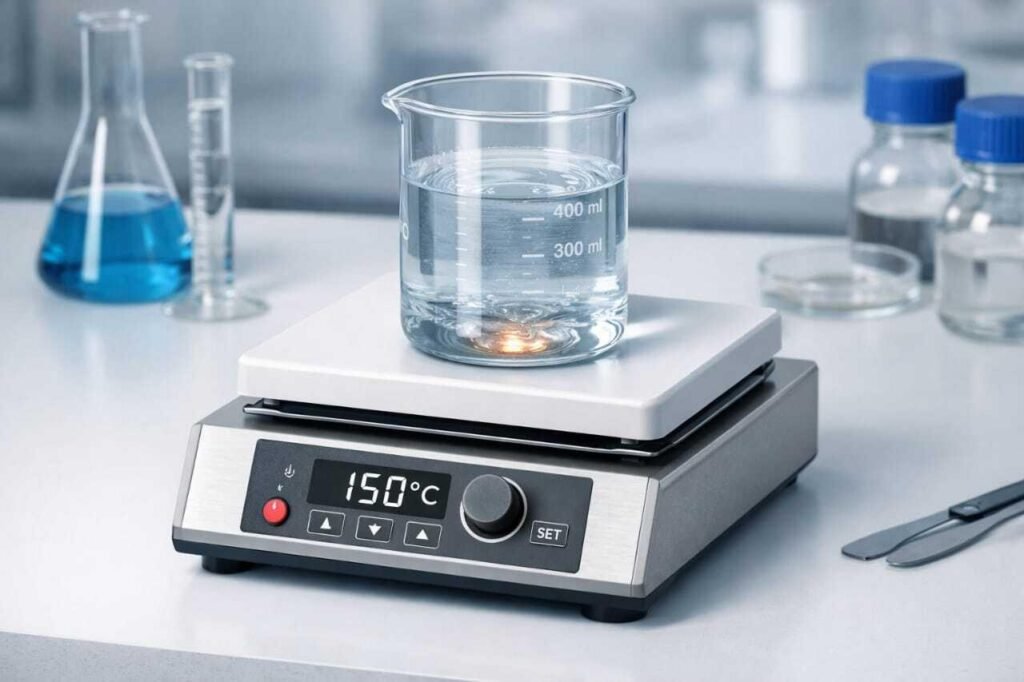
A standard laboratory hot plate provides a heated surface for compatible beakers and other laboratory vessels. It is often suitable for routine warming, solution preparation, and straightforward heating procedures that do not require continuous mixing.
Its main advantages are a relatively simple workflow and fewer functions to configure. However, a basic unit may not provide stirring or direct sample-temperature control. Depending on the design, its temperature regulation may also be insufficient for procedures requiring tight control of the sample temperature.
Choose this configuration when heating is the primary requirement and the procedure does not justify additional control features.
Magnetic stirrer hot plates for heating and mixing together
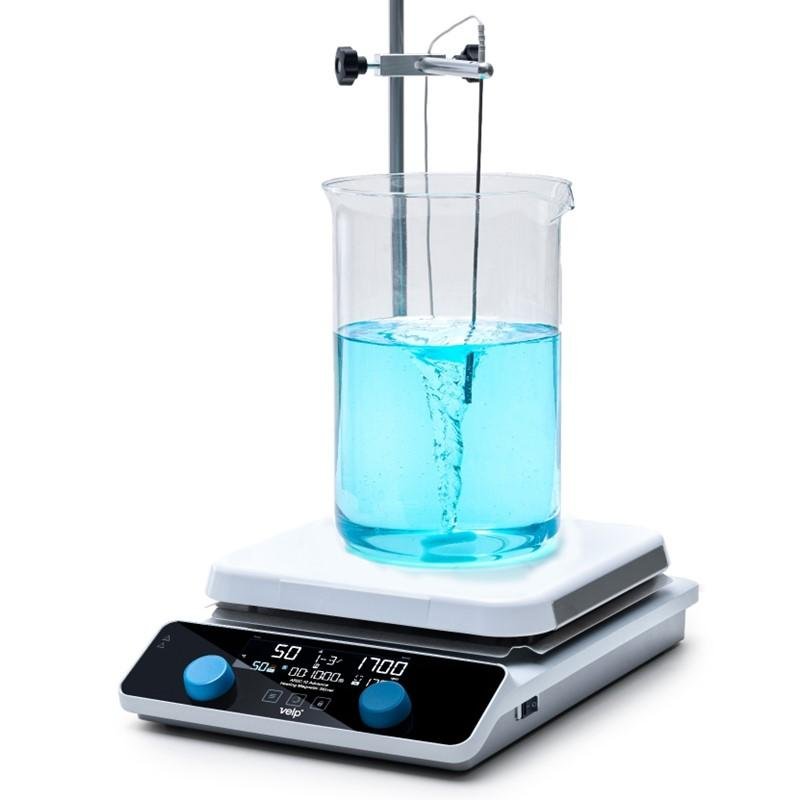
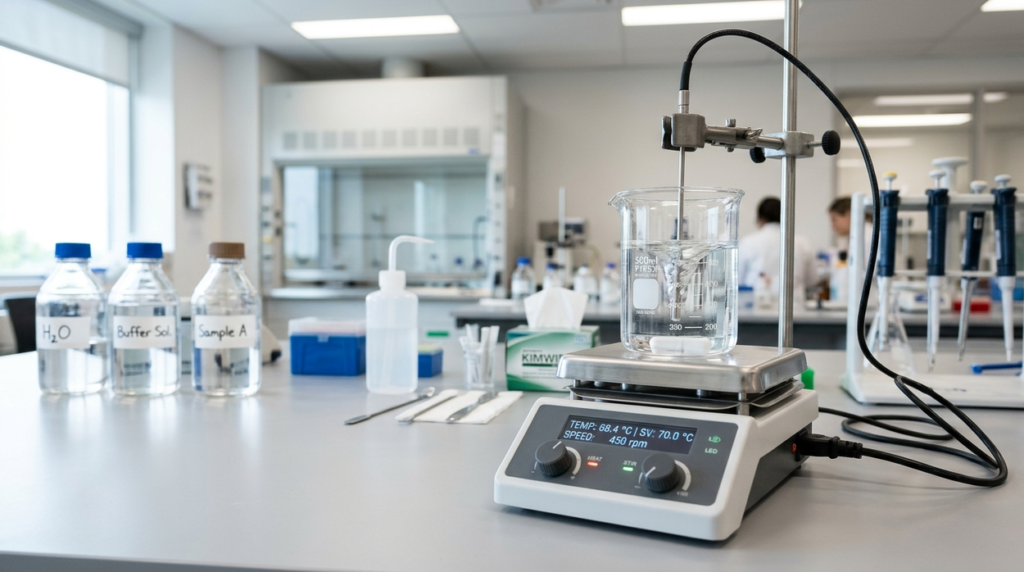
A laboratory hot plate with magnetic stirrer combines a heated surface with a magnetic drive that rotates a stir bar inside the vessel. It can be useful for buffer preparation, reagent dissolution, and compatible formulation-development tasks.
When comparing units, examine:
- Stirring-speed range and adjustment.
- Motor performance under the expected sample volume and viscosity.
- Compatibility with available magnetic stir bars.
- Vessel geometry and the strength of magnetic coupling.
- Whether the heating and stirring controls are clearly differentiated.
Stirring can improve heat distribution, but it does not guarantee a uniform sample temperature. Highly viscous mixtures, suspended solids, unsuitable stir bars, or poor vessel geometry can limit mixing. Verify performance under representative conditions if temperature uniformity matters to the procedure.
Digital and probe-controlled hot plates for demanding temperature requirements
Digital controls make it easier to select and read a setpoint, but a digital display alone does not establish temperature accuracy or stability.
Some systems regulate the heating surface, while others accept an external temperature sensor that measures the sample or an appropriate heating medium. A compatible probe can provide feedback from the material being heated rather than relying exclusively on the plate temperature.
Before purchasing a digital laboratory hot plate, establish:
- Whether the setpoint controls the plate or the sample.
- Which probe types are supported and whether the probe is included.
- How the probe should be positioned and immersed.
- How quickly the sensor responds to temperature changes.
- Whether temperature verification and service documentation are available.
- Which independent over-temperature protections are provided.
Probe placement is critical. A sensor that touches the vessel wall, sits too close to the surface, or measures a poorly mixed region may not represent the sample’s temperature. Follow the equipment manual and verify the temperature under realistic operating conditions.
The manufacturer’s official hot plate and laboratory equipment manuals illustrate why buyers should examine the instructions for the exact equipment configuration rather than assuming every model has the same controls or accessories.
When a hot plate is not the right heating equipment
A different heating system may be more suitable when the sample, vessel, or procedure calls for a specific heat-transfer method.
🏢 Featured Laboratory Suppliers Directory Listing
Looking for verified and trusted laboratory suppliers partners related to this topic? Explore our comprehensive directory.
Explore Directory →| Equipment | When it may be appropriate |
| Water bath | Indirect heating of compatible vessels where a controlled liquid bath is suitable |
| Dry block heater | Repeated heating of tubes or vessels that fit designated blocks |
| Heating mantle | Heating compatible round-bottom flasks and similar vessels |
| Laboratory oven | Drying or heating materials inside an enclosed chamber |
| Dedicated thermostatic system | Applications requiring specialized temperature regulation or vessel arrangements |
These systems are not interchangeable. Selection should account for the required temperature, chemical hazards, sample geometry, heat-transfer needs, and the operating instructions for the specific equipment.
Evaluate the Technical Specifications That Determine Heating Performance
Maximum temperature and usable operating range
The laboratory hot plate temperature range should cover the actual sample requirements, not simply the highest temperature the equipment can reach.
Check the minimum and maximum operating temperatures, the manufacturer’s specified limits, and whether the required sample temperature can be maintained under the expected load. A unit capable of reaching a high plate temperature may still offer inadequate control near a lower operating setpoint.
Avoid selecting equipment solely because it has the highest advertised maximum. Excessive temperature capability provides little benefit if the application needs moderate, stable heating.
Temperature accuracy, stability, uniformity, and response time
These four specifications describe different aspects of heating performance.
| Characteristic | What it means for laboratory work |
| Accuracy | How closely a measured temperature agrees with the relevant reference temperature |
| Stability | How consistently temperature is maintained over time |
| Uniformity | How evenly temperature is distributed across the relevant surface or sample |
| Response time | How quickly the system reaches or adjusts toward the target temperature |
A hot plate may have a stable plate temperature while the liquid inside a beaker continues to warm. Similarly, a sensor may report the target temperature even though different regions of a poorly mixed sample have different temperatures.
For temperature-sensitive work, request the manufacturer’s test conditions and measurement method. Where practical, verify performance using a suitable calibrated reference instrument and a representative vessel, volume, and mixing arrangement.
Do not compare accuracy figures from different suppliers without checking what was measured, where the sensor was placed, and under what conditions.
Heating power, surface dimensions, and vessel capacity
Heating power, usually expressed in watts, influences the rate at which energy is supplied. However, actual heating performance also depends on sample volume, vessel material, starting temperature, ambient conditions, and heat loss.
Review the following together:
- Heating power and expected warm-up time.
- Plate diameter and usable surface area.
- Supported vessel sizes and shapes.
- Maximum permitted load.
- Temperature recovery after a cooler vessel is placed on the surface.
- Bench footprint and clearance requirements.
For example, a large beaker containing a substantial volume of liquid may take considerably longer to reach its target temperature than a small vessel, even when both use the same heating plate. Wattage alone cannot establish which unit will perform better in a specific application.
Heating plate material and chemical resistance
Ceramic or glass-ceramic surfaces
Often useful where resistance to compatible chemical spills, a smooth cleaning surface, or visibility of sample color changes is important. The specific material and construction determine its actual resistance and thermal behavior.
Aluminum or metal surfaces
Can provide effective heat transfer and robust everyday use. Bare aluminum may be vulnerable to certain corrosive chemicals, while coatings can change its chemical resistance and durability.
Neither material is universally superior. Ceramic surfaces may be vulnerable to impact or thermal shock in certain conditions, while metal surfaces may be unsuitable for repeated exposure to specific corrosive reagents.
Before purchasing, check compatibility with the chemicals used in the laboratory, including routine cleaning agents and disinfectants. Follow the manufacturer’s instructions for spills, abrasive cleaning, and permitted vessel materials.
Stirring capability and external sensor compatibility
For a combined hot plate and magnetic stirrer, evaluate stirring performance under the expected sample load rather than relying solely on the maximum speed stated in the datasheet.
A unit that stirs a low-viscosity buffer successfully may struggle with a thicker formulation or a mixture containing suspended solids. Vessel shape, stir-bar length, liquid depth, and magnetic coupling all affect performance.
For probe-controlled systems, confirm the supported sensor type, whether the accessory is included, the connection method, and whether the probe measures and regulates the sample temperature or merely displays a reading. These accessories can add to the initial purchase cost and may require periodic calibration or replacement.
Match Hot Plate Selection to Pharmaceutical and Biotechnology Applications
Buffer preparation, reagent dissolution, and laboratory media preparation
Hot plates and magnetic stirrer hot plates can support the preparation of compatible aqueous buffers, dissolution of ingredients, and routine laboratory reagents.
For these applications, choose a surface compatible with the reagents, a vessel appropriate for the solution, and sufficient mixing capacity where needed. Follow the preparation procedure’s temperature limits and take steps to prevent contamination during handling.
Heating alone does not sterilize a solution. If sterility is required, the preparation and sterilization methods must be established separately according to the material and applicable procedure.
Pharmaceutical formulation development and excipient preparation
Formulation development may involve warming excipients, dissolving ingredients, or preparing liquid and semisolid mixtures. Different ingredients can have distinct solubility profiles, melting behavior, and sensitivity to prolonged heat exposure.
A magnetic stirrer hot plate may suit preliminary formulation experiments when its heating and mixing capabilities match the procedure. A probe-controlled system may be preferable when actual sample temperature is a critical process variable.
Laboratory-scale observations should not be treated as direct predictions of production-scale heating performance. As discussed in CDMO scale-up and process development, moving from laboratory work to larger-scale operations involves additional process and equipment considerations. Heat-transfer behavior, vessel geometry, mixing, and thermal gradients may change significantly with scale.
Analytical sample preparation and research chemistry
Analytical laboratories may use hot plates for compatible sample conditioning, solution preparation, and heating before subsequent measurements. Reproducible temperature conditions and suitable vessel materials help reduce avoidable variation during preparation.
However, specialized digestion, extraction, or solvent-handling procedures may require dedicated systems with specific containment, temperature-control, or pressure-handling capabilities. A conventional open hot plate should not be substituted for equipment specified by a validated or otherwise controlled analytical method without an appropriate technical assessment.
Quality-control laboratories and repeatable procedures
In pharmaceutical quality-control environments, equipment should be suitable for its intended use and consistent with the laboratory’s documented procedures.
Depending on the application, relevant controls may include equipment identification, operating instructions, maintenance records, temperature-performance verification, and documented review of deviations. Requirements vary with the role of the equipment and the applicable quality system.
For example, US pharmaceutical CGMP provisions address equipment maintenance and cleaning under 21 CFR 211.67 and laboratory controls under 21 CFR 211.160. Their applicability depends on the regulated activity; they should not be interpreted as requiring an identical qualification program for every laboratory hot plate.
Build Safety Into the Purchasing Decision
Over-temperature protection and independent safety controls
A normal temperature controller regulates heating during routine operation. A separate safety limit can interrupt heating if the equipment exceeds a defined threshold or its primary control fails.
Depending on the design, useful features may include:
- Independent over-temperature protection.
- Adjustable safety-temperature limits.
- Audible or visual alarms.
- Residual-heat indicators.
- Automatic shutoff or fault detection.
Confirm the function of each feature in the operating manual. An indicator or alarm is not necessarily an automatic power cutoff, and a secondary limit does not eliminate every failure mode.
Flammable solvents, vapors, and hazardous reactions
A conventional laboratory hot plate should never be assumed to be explosion-proof or intrinsically safe. Electrical switching components and hot surfaces can create ignition hazards under certain conditions, particularly when flammable vapors are present.
A fume hood helps control exposure to hazardous vapors, but it does not automatically make an unsuitable heating device safe. The risk assessment must consider the solvent’s properties, potential vapor generation, ignition sources, containment, and the specific equipment design.
The National Research Council’s Prudent Practices in the Laboratory explains the hazards associated with laboratory heating devices, including older equipment with potential electrical-sparking risks. Harvard’s laboratory hot plate safety guidance also emphasizes inspection, hot-surface hazards, and precautions when heating flammable materials.
Where a procedure involves flammable solvents or hazardous reactions, follow the institution’s chemical risk assessment and use equipment specifically suitable for the identified hazards. Do not rely on digital controls or a timer as proof of safe operation.
🏢 Featured Laboratory Suppliers Directory Listing
Looking for verified and trusted laboratory suppliers partners related to this topic? Explore our comprehensive directory.
Explore Directory →Surface-temperature warnings, electrical protection, and spill resistance
The heating surface may remain hot after the unit is switched off. Residual-heat indicators, suitable electrical protection, and an appropriately designed enclosure can reduce particular risks, but safe operation also depends on equipment condition and placement.
Inspect the cord, plug, controls, and surface for damage or corrosion. Keep power cables away from the heated area and arrange vessels to minimize the risk of spills reaching electrical components. Remove damaged equipment from service until it has been assessed or repaired.
Safe operation during extended heating
Timers, alarms, temperature monitoring, and automatic shutoff may help manage prolonged heating tasks. Nevertheless, no single feature makes unattended heating inherently safe.
Before allowing an extended run, assess the possibility of evaporation, vessel failure, overheating, loss of cooling, unexpected reactions, and changes in sample composition. Follow the equipment instructions and laboratory procedures, including any requirements for supervision or emergency response.
Select Equipment That Fits Laboratory Space, Workflow, and Maintenance Capacity
Bench space, sample positioning, and ergonomics
Consider where the hot plate will operate: a shared preparation bench, a dedicated analytical area, or an appropriate containment enclosure. The equipment must fit without compromising access to controls, vessel stability, ventilation, or clearance around the heated surface.
Check the position of knobs, displays, probe connections, and power cables. For frequent use, controls that are easy to distinguish and operate can reduce handling errors, particularly on combined heating and stirring units.
Cleaning, inspection, and serviceability
Choose a design that can be cleaned using the laboratory’s approved methods without damaging its surface, controls, or enclosure. Inspect for corrosion, cracks, damaged insulation, loose connections, and residue around the heating surface.
Maintenance requirements depend on the equipment design, frequency of use, chemical exposure, and manufacturer’s recommendations. Confirm that appropriate replacement parts and technical support are available before purchase.
Temperature verification, calibration, and documentation
Three activities should be distinguished:
- Calibration: Establishing the relationship between an instrument’s indication and a reference measurement, with associated uncertainty where applicable.
- Performance verification: Checking whether the equipment performs adequately for its intended application under defined conditions.
- Qualification: Documenting evidence that equipment is suitable for its intended use when a formal qualification process is required.
A hot plate does not automatically require the same calibration or qualification process as a critical analytical instrument. The laboratory should determine what evidence is necessary based on the procedure, equipment functions, risk, manufacturer guidance, and applicable quality requirements.
For temperature-sensitive applications, a calibrated reference sensor and representative test conditions may help establish whether the sample reaches and maintains the required temperature. Calibration intervals should follow the laboratory’s documented approach rather than an arbitrary universal schedule.
Compare Suppliers and Calculate the Real Cost of Ownership
Evaluate technical documentation and product specifications
Request the complete datasheet, operating manual, safety information, and details of relevant accessories. Compare products using equivalent criteria rather than relying on marketing descriptions.
Review:
- Usable temperature range and available temperature-control modes.
- Accuracy, stability, uniformity, and measurement conditions.
- Heating power, surface dimensions, and rated load.
- Compatible vessels, chemicals, and stirring accessories.
- External probe support and independent safety protections.
- Applicable electrical safety documentation and conformity information.
- Warranty terms, maintenance requirements, and service conditions.
An advertised specification is a manufacturer’s stated performance claim, not necessarily independent evidence of performance under your laboratory’s conditions.
Assess after-sales support and spare-part availability
A suitable hot plate must remain usable throughout its service life. Buyers should establish whether technical assistance, repair services, replacement probes, control components, and other necessary accessories are accessible.
For laboratories in India, verify local service coverage, electrical compatibility, realistic repair turnaround times, and whether the supplier can provide the documentation required by the laboratory.
Do not assume that a local distributor offers calibration, on-site repairs, or equipment qualification support unless these services have been confirmed.
Compare total cost of ownership
The lowest initial price does not necessarily represent the lowest overall cost. Consider the complete ownership picture.
| Cost component | What to assess |
| Initial purchase | Equipment price and included accessories |
| Additional components | Probes, stir bars, adapters, and compatible vessels |
| Setup and training | Installation, user instruction, and any applicable setup costs |
| Maintenance | Inspections, repairs, calibration, and replacement parts |
| Downtime | Availability of service and the impact of equipment failure |
| Replacement | Expected service life and future replacement requirements |
A higher-priced unit may be justified when its performance, safety features, documentation, or support better matches the application. That decision should be supported by actual requirements rather than an assumption that expensive equipment is always more reliable.
Questions to ask a hot plate supplier before purchasing
Use this checklist when requesting quotations or preparing a procurement specification.
Procurement checklist
0 of 9
Does the usable operating range meet our actual sample-temperature requirements?
What accuracy, stability, and uniformity data are available, and under which test conditions?
Is the heating surface compatible with our chemicals and cleaning procedures?
Can the unit accommodate our vessel dimensions, sample volume, and load?
Does the stirring system perform adequately with our expected viscosity and sample volume?
Which independent safety protections are included?
Are external temperature probes available, and how do they control heating?
What warranty, maintenance, spare-part, and local service arrangements are offered?
What documentation supports temperature verification, maintenance, and equipment records?
Copy checklistReset
Document the supplier’s answers, especially where the equipment will support a controlled laboratory procedure or a temperature-sensitive method.
🏢 Featured Laboratory Suppliers Directory Listing
Looking for verified and trusted laboratory suppliers partners related to this topic? Explore our comprehensive directory.
Explore Directory →Use a Weighted Selection Framework to Shortlist Suitable Models
Separate mandatory requirements from preferred features
Divide the requirements into three groups before reviewing quotations.
- Mandatory requirements: Suitable temperature range, sample and chemical compatibility, adequate capacity, essential safety controls, and electrical suitability.
- Performance-critical requirements: Temperature stability, uniformity, response time, stirring performance, or external probe control where required.
- Optional features: Data interfaces, programmable functions, display enhancements, and other convenience features.
Reject any model that fails a mandatory safety or application requirement, regardless of its price or additional features.
Score shortlisted equipment against laboratory needs
A comparison matrix can help purchasing teams evaluate several technically acceptable models. Assign weights based on the intended application instead of applying the same percentages to every laboratory.
For example, a routine solution-preparation workflow may prioritize chemical compatibility, capacity, ease of cleaning, and service availability. A temperature-sensitive analytical workflow may place greater weight on verified sample-temperature control, stability, and documentation.
A simple scoring method is to rate each model against every criterion using a consistent scale, multiply each score by the criterion’s assigned weight, and compare the totals. Keep mandatory requirements as pass/fail gates rather than allowing a high overall score to compensate for a critical deficiency.
The resulting ranking supports procurement decisions but does not replace technical review, safety assessment, or quality approval where applicable.
Verify performance before routine use
Before introducing the equipment into routine work:
- Review the operating manual and confirm that the equipment and accessories match the purchase specification.
- Inspect the unit, electrical connections, heating surface, and vessel arrangement.
- Verify relevant temperature performance under representative operating conditions.
- Confirm the required operating instructions, maintenance arrangements, and records.
- Obtain any additional review, qualification, or approval required by the laboratory’s quality system.
For temperature-sensitive samples, measuring the sample or a representative medium can provide more useful information than relying only on the heating-plate display.
Common Mistakes That Lead to the Wrong Hot Plate Purchase
Choosing maximum temperature instead of appropriate control
A high maximum temperature does not establish accuracy, stability, uniformity, or suitability for sensitive samples. Select the operating range and control method required by the actual procedure.
Ignoring vessel dimensions and sample volume
An undersized surface, unstable vessel, excessive load, or unsuitable vessel geometry can compromise heating performance. Check the complete vessel arrangement rather than relying on the plate diameter alone.
Buying stirring capability that does not suit the sample
Stirring performance depends on viscosity, suspended solids, stir-bar dimensions, liquid depth, and magnetic coupling. Confirm that the unit can handle the expected mixture.
Treating safety features as a substitute for risk assessment
Timers, alarms, digital displays, and over-temperature cutoffs address particular risks; they do not eliminate hazards from flammable vapors, incompatible chemicals, damaged equipment, or unsuitable operating conditions.
Overlooking service, accessories, and documentation
Missing probes, unavailable replacement parts, limited local support, or inadequate technical records can undermine the equipment’s practical value. Evaluate these requirements before placing the order, not after installation.
Conclusion
The best laboratory hot plate is the one that meets the sample’s actual heating requirements while providing suitable temperature control, chemical compatibility, safety protection, and dependable service support.
For pharmaceutical and biotechnology laboratories, the decision should begin with the material being heated, the required sample temperature, vessel dimensions, mixing needs, and potential hazards. Buyers can then define mandatory specifications, compare suitable equipment configurations, examine technical documentation, and assess total ownership costs.
Reliable results depend on more than the heating device itself. Appropriate vessels, representative temperature measurements, reproducible operating conditions, and consistent maintenance all contribute to dependable laboratory work.
A structured procurement process helps laboratories choose equipment that supports their intended workflow without paying for unnecessary features or compromising essential safety and performance requirements.
Frequently Asked Questions
1. What is the difference between a laboratory hot plate and a magnetic stirrer hot plate?
A standard hot plate provides heating, whereas a magnetic stirrer hot plate combines heating with magnetic stirring. The combined configuration is useful for preparing solutions that require continuous mixing. A heating-only unit may be sufficient when the sample does not need agitation.
2. How do I choose the right temperature range for a laboratory hot plate?
Start with the temperature required inside the sample, its thermal stability, and the procedure’s acceptable variation. Then select equipment with an appropriate operating range and suitable control method. Remember that the plate’s setpoint and the sample temperature may differ.
3. Which heating plate material is best for laboratory use: ceramic or aluminum?
Ceramic or glass-ceramic surfaces can offer useful chemical resistance and easy cleaning, while aluminum surfaces can provide effective heat transfer and mechanical robustness. The better choice depends on chemical exposure, vessel compatibility, cleaning procedures, and the manufacturer’s specifications.
4. Can a laboratory hot plate be used to heat flammable solvents?
Not every hot plate is suitable for flammable-solvent applications. Ignition risks depend on the equipment design, solvent properties, vapor generation, and operating conditions. Use a documented chemical risk assessment and equipment specifically appropriate for the hazards; a fume hood or digital temperature control alone does not establish safety.
5. Does a laboratory hot plate need calibration or qualification?
It depends on the equipment’s intended use and the laboratory’s quality requirements. A laboratory may need to calibrate a temperature-measuring instrument, verify the hot plate’s performance, or formally qualify equipment used in a controlled process. These activities are different and should be determined by documented procedures, risk, and applicable requirements.