A magnetic stirrer is a common laboratory instrument that mixes liquids without requiring a mechanical shaft or impeller to enter the container. It uses a rotating magnetic field beneath a vessel to drive a small magnetic stir bar through the liquid, creating circulation that helps distribute dissolved substances and maintain a more consistent mixture.
Understanding how a magnetic stirrer works is useful for students, laboratory technicians, researchers, and pharmaceutical professionals who prepare buffers, reagents, culture media, and formulation samples. However, effective mixing depends on more than switching on the instrument. Liquid viscosity, vessel geometry, stir-bar design, and operating speed all influence the result.
This guide explains the magnetic stirrer working principle, its main components, how to use the instrument, common performance problems, and the factors to consider when choosing one for a laboratory.
What Is a Magnetic Stirrer and What Is It Used For?
Understanding the basic function of a magnetic stirrer
A magnetic stirrer is a laboratory device designed to mix liquids using magnetic coupling. Its two essential elements are the magnetic drive assembly inside the instrument and a magnetic stir bar placed inside the liquid.
When the instrument operates, the drive assembly generates a rotating magnetic field. The stir bar responds to this field and rotates within the vessel, moving the surrounding liquid.
This movement promotes the distribution of dissolved substances, helps suspend some particles, and supports processes such as dissolution and solution preparation. The effectiveness of mixing depends on the material being stirred and the conditions under which the instrument operates.
Magnetic stirring is not the same as shaking, homogenization, or high-shear processing. Shaking moves a container or its contents, while homogenizers and high-shear mixers are designed to create more intensive processing under appropriate conditions. A magnetic stirrer generally provides straightforward, relatively gentle mixing for suitable liquids.
Importantly, visible circulation does not automatically prove that a solution is completely homogeneous, and magnetic stirring alone does not establish sterility.
Where magnetic stirrers are commonly used
Magnetic stirrers are useful in many routine laboratory workflows, including:
- Solution preparation: Mixing buffers, reagents, and aqueous solutions.
- Dissolution: Helping soluble salts, powders, and other ingredients dissolve in a suitable solvent.
- Microbiology: Preparing selected culture media and laboratory solutions.
- Pharmaceutical research: Mixing small-scale formulation samples and experimental preparations.
- Analytical chemistry: Supporting sample preparation and other procedures that require controlled liquid mixing.
- Biotechnology research: Preparing reagents and solutions used in experimental workflows.
Consider a researcher preparing a buffer for an analytical experiment. A measured quantity of salt is added to water, and a magnetic stir bar rotates at the bottom of the beaker. The resulting circulation brings fresh solvent into contact with the dissolving material and distributes dissolved components throughout the liquid.
The same instrument may perform poorly when used with a thick polymer solution or a concentrated formulation. Suitability depends on viscosity, volume, required mixing intensity, vessel design, and the properties of the materials involved.
How Does a Magnetic Stirrer Work? The Science Behind the Motion
The magnetic stirrer working principle can be understood in three stages: generating a rotating magnetic field, transferring rotational motion to the stir bar, and creating circulation within the liquid.
How the magnetic drive mechanism generates rotation
Inside a conventional magnetic stirrer, a motor rotates one or more magnets beneath the top plate. Some designs use alternative magnetic-drive arrangements, but the purpose is similar: to create a magnetic field whose orientation changes over time.
The vessel sits on the plate, separating the drive mechanism from the liquid. Because the magnetic field can act through suitable nonmagnetic vessel materials, such as ordinary laboratory glass, the drive assembly can influence the stir bar without direct mechanical contact.
A useful analogy is guiding one magnet with another through an invisible connection. The analogy is not exact, but it illustrates the essential idea: magnetic forces transmit motion across the space between the drive assembly and the stir bar.
The motor produces the movement, the magnetic field transfers the influence, and the stir bar acts as the rotating element inside the liquid.
How the magnetic stir bar follows the rotating field
A typical magnetic stir bar contains a magnetic core enclosed in a protective coating, commonly polytetrafluoroethylene (PTFE), selected for its chemical resistance and low-friction surface.
As the drive field changes orientation, magnetic forces exert a torque on the stir bar. Torque is the rotational force that tends to turn an object. When this torque is sufficient to overcome resistance from the liquid and contact with the vessel bottom, the bar rotates in step with the field.
This relationship is known as magnetic coupling.
However, the stir bar cannot follow every operating condition indefinitely. If the drive speed becomes too high, the liquid creates excessive resistance, or the magnetic coupling is insufficient for the setup, the bar may lose synchronization with the rotating field. This is called stir-bar decoupling.
The bar may then wobble, rattle, spin irregularly, or stop rotating even though the instrument’s motor continues to operate.
How stir-bar rotation creates liquid circulation
As the stir bar rotates, frictional forces and fluid motion transfer momentum from the bar to the surrounding liquid. The liquid begins to circulate, carrying dissolved material and helping distribute concentration differences throughout the vessel.
The resulting flow pattern depends on the vessel’s shape, liquid depth, viscosity, bar geometry, and rotational speed.
At higher speeds, a central vortex may form, drawing the liquid surface downward toward the rotating bar. A moderate vortex can be compatible with effective mixing, but a deep vortex may introduce air, increase splashing, or create an unstable flow pattern.
A visible swirl is therefore not a reliable measure of mixing uniformity by itself. Some regions may remain poorly mixed even when the surface appears to rotate rapidly.
The technical guidance in IKA’s magnetic stirrer FAQ explains why operating distance, liquid volume, and viscosity influence magnetic stirring performance.
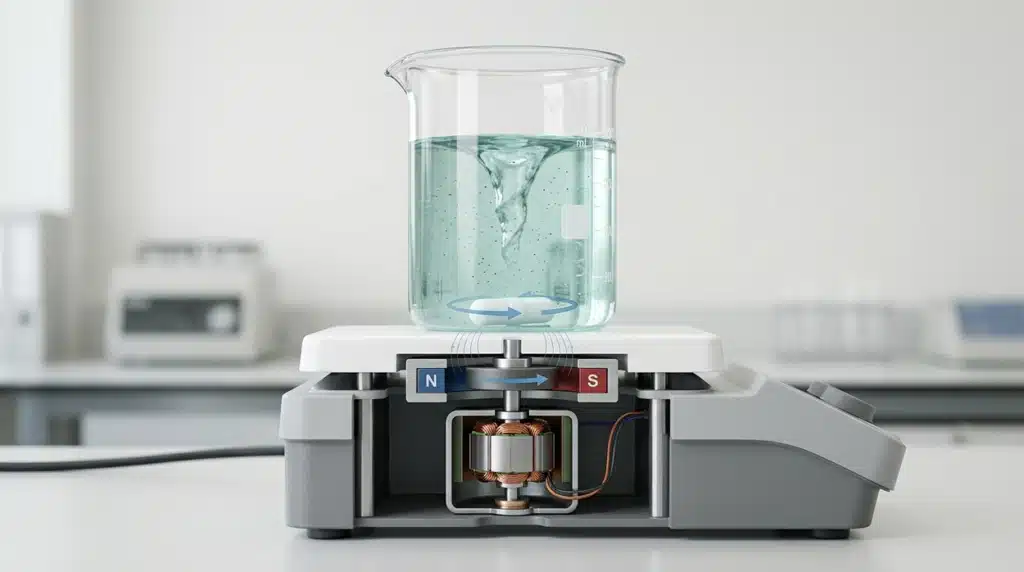
Magnetic stirrer working principle: simplified schematic
Conceptual cross-section showing how motion transfers from the drive magnets to the liquid. This is not a scale drawing of a particular instrument.
Liquid inside the vessel
Rotating stir bar transfers momentum to the liquid
Stirring plate
Vessel support surface
N
Drive magnet
S
Drive magnet
Motor rotates the drive assembly below the plate
🏢 Featured Laboratory Suppliers Directory Listing
Looking for verified and trusted laboratory suppliers partners related to this topic? Explore our comprehensive directory.
Explore Directory →The rotating magnetic field couples the drive assembly to the stir bar through the vessel bottom. The bar rotates inside the liquid without a mechanical shaft entering the vessel.
The Main Components of a Magnetic Stirrer and What Each One Does
Although designs differ, most magnetic stirrers share several functional components.
Motor and magnetic drive assembly
The motor provides the mechanical rotation that drives the magnetic assembly. The magnets generate the field that couples to the stir bar inside the vessel.
Motor design and speed control affect how consistently the instrument maintains rotation as resistance changes. However, the selected speed does not guarantee that the stir bar will remain synchronized under every load.
Stirring plate and vessel support
The stirring plate supports the vessel while allowing the magnetic field to reach the stir bar. Plate construction varies by model and may include ceramic-coated metal, stainless steel, or other materials suited to the instrument’s intended use.
For heated models, the plate must also tolerate the specified operating temperatures. Chemical resistance, surface condition, plate dimensions, and vessel stability are important considerations.
Magnetic stir bar
The stir bar transfers magnetic motion to the liquid. Common designs include cylindrical, octagonal, and pivot-ring bars, each offering different contact and flow characteristics.
Bar length should suit the vessel dimensions and liquid volume. A bar that is too large may strike the vessel walls or rotate erratically, while a bar that is too small may produce inadequate circulation.
The protective coating must remain intact. A chipped, cracked, or chemically incompatible coating can make a stir bar unsuitable for sensitive applications.
Speed controls, display, and optional heating
Basic instruments may use a manual speed control, while digital models can offer numeric settings and additional control functions. Some units include a heating plate, temperature probe, timer, or feedback control.
A basic magnetic stirrer does not necessarily have heating or direct temperature measurement. Similarly, a displayed speed setting may represent the commanded operating speed rather than an independently verified measurement of the stir bar’s actual rotation.
When precise speed or temperature matters, check the manufacturer’s documented performance and determine whether independent verification is necessary.
How to Use a Magnetic Stirrer: A Step-by-Step Laboratory Procedure
Correct setup helps improve mixing stability, reduce spills, and avoid unnecessary wear on the stir bar and instrument.
1. Prepare the vessel, liquid, and stir bar
Choose a stable, chemically compatible vessel with a reasonably flat bottom. Select a stir bar appropriate for the vessel size, liquid volume, and expected viscosity.
Inspect the bar for coating damage and clean it according to the laboratory’s procedure. Place the bar in the vessel, add the liquid, and position the vessel centrally on the stirring plate.
Confirm that the total load, liquid level, and container dimensions fall within the instrument’s specified operating limits.
2. Start stirring at a low speed
Switch on the instrument and begin at a low speed. Observe whether the stir bar starts rotating smoothly.
Increase the speed gradually until the liquid circulates adequately. Avoid jumping immediately to maximum speed, which may cause the bar to decouple, the liquid to splash, or an unnecessarily deep vortex to form.
3. Monitor mixing and adjust operating conditions
Observe the liquid rather than relying only on the display. Check whether the intended material is dissolving, whether circulation reaches the relevant regions of the vessel, and whether the bar remains stable.
If the bar rattles or stops, reduce the speed and check the vessel position, bar dimensions, and liquid resistance. Adjust the setup before increasing the speed again.
4. Stop the instrument and handle the sample
Reduce the speed before stopping when appropriate for the model and procedure. Remove the vessel carefully and retrieve the stir bar with a suitable magnetic retrieval tool if needed.
Clean the bar and relevant surfaces according to the laboratory’s instructions. Where reproducibility matters, record relevant conditions such as vessel size, liquid volume, bar type, speed setting, temperature, and mixing time.
Safety note: Heated models present additional burn and temperature-related hazards. Allow hot surfaces and liquids to cool as appropriate, and follow the manufacturer’s operating instructions and laboratory safety procedures.
What Determines Magnetic Stirring Speed and Mixing Performance?
Two liquids can behave very differently on the same instrument, even when the same speed setting is used. Understanding the factors that affect stirring helps beginners choose appropriate operating conditions and troubleshoot inconsistent results.
Rotational speed and magnetic coupling
Increasing rotational speed can improve circulation and help distribute dissolved material more quickly. However, the benefit is not unlimited.
At excessive speeds, the stir bar may lose synchronization with the drive field. A deep vortex can also draw air into the liquid, while splashing may cause sample loss or contamination.
There is no single ideal RPM for every application. The correct magnetic stirrer operating speed depends on the liquid, vessel, stir-bar design, and desired mixing outcome.
A displayed setting is only one part of the assessment. The bar must rotate reliably, and the liquid must circulate adequately for the intended task.
Liquid viscosity, volume, and density
Viscosity describes a liquid’s resistance to flow. Water has relatively low viscosity, while concentrated polymer solutions, syrups, and some formulation mixtures resist movement more strongly.
As viscosity increases, the stir bar generally needs to overcome greater resistance. This can make stable magnetic coupling more difficult, particularly when combined with a large liquid volume or an unsuitable bar.
Volume matters because the instrument must generate sufficient circulation throughout the vessel, not merely move the liquid immediately surrounding the bar. Density also influences fluid behavior, but it should not be considered in isolation from viscosity and geometry.
For example, a magnetic stirrer may readily mix a low-viscosity aqueous buffer but struggle with a thick polymer solution. The latter may require a different stir bar, a specialized mixer, or a mechanical stirring system.
Stir-bar dimensions and vessel geometry
The stir bar, vessel, and drive assembly operate as a connected system. Their dimensions and relative positions influence magnetic coupling and liquid flow.
Important considerations include:
- Bar length: It should suit the vessel’s diameter and the volume being stirred.
- Bar shape: Different designs influence stability, contact with the vessel bottom, and flow patterns.
- Vessel diameter: A wider vessel may require a different mixing arrangement to achieve effective circulation throughout the liquid.
- Bottom geometry: A flat, stable bottom generally supports more predictable operation than an uneven or strongly curved one.
- Distance from the drive: Greater separation between the magnetic assembly and stir bar can weaken effective coupling.
An oversized bar may strike the vessel or rotate irregularly. An undersized bar may rotate smoothly but fail to provide sufficient circulation.
Rather than automatically increasing speed, first check whether the stir bar and vessel are appropriate for the intended application.
Temperature and changing liquid properties
Heating can reduce the viscosity of some liquids, making them easier to stir. However, temperature also affects evaporation, chemical stability, material compatibility, and the behavior of sensitive ingredients.
A heated magnetic stirrer may be useful for a solution that requires both mixing and controlled warming. It is not necessarily appropriate for temperature-sensitive biological materials or ingredients that degrade under the selected conditions.
When temperature matters, use a suitable measurement method and follow the process-specific temperature limits. Do not assume that heating will always improve mixing or that the plate’s displayed setting equals the actual liquid temperature.
Magnetic Stirrer vs. Mechanical Stirrer: Which Is More Suitable?
Both technologies mix liquids, but they transfer rotational motion differently. Choosing between them depends on the volume, viscosity, required mixing intensity, and practical constraints of the process.
Key differences in the mixing mechanism
| Feature | Magnetic stirrer | Mechanical stirrer |
| Motion transfer | Magnetic coupling through the vessel bottom | Driven shaft and impeller enter the liquid |
| Setup | Usually simple and compact | Often requires mounting, alignment, and vessel support |
| Cleaning | No internal drive shaft in the liquid; stir bar still requires cleaning | Impeller and shaft surfaces require cleaning |
| Typical applications | Small-scale, relatively low-viscosity liquids | Broader range of viscosities, volumes, and mixing duties |
| Mixing intensity | Generally suitable for gentle to moderate mixing | Can provide stronger circulation and greater torque with suitable equipment |
| Main limitation | Bar may decouple under excessive resistance | Shaft and impeller add setup and cleaning requirements |
Mechanical stirrers, including overhead stirrers, use a motor-driven shaft connected to an impeller. The impeller’s design and operating conditions determine the flow generated within the vessel.
🏢 Featured Laboratory Suppliers Directory Listing
Looking for verified and trusted laboratory suppliers partners related to this topic? Explore our comprehensive directory.
Explore Directory →Magnetic stirrers avoid a shaft entering the liquid, which simplifies some setups. However, they cannot automatically match the torque or flow control available from a suitably selected mechanical system.
When a magnetic stirrer is the better choice
A magnetic stirrer is often suitable for:
- Preparing buffers, reagents, and relatively low-viscosity solutions.
- Small-scale analytical and research workflows.
- Dissolving soluble ingredients under controlled conditions.
- Routine laboratory work where simple setup and cleaning are priorities.
- Applications where avoiding a mechanical shaft inside the vessel is advantageous.
When mechanical stirring or another technology is preferable
Consider mechanical stirring or another mixing method when working with highly viscous liquids, large vessels, concentrated formulations, or processes that require substantial torque.
Specialized impellers, overhead stirrers, homogenizers, or other equipment may be more appropriate when a process requires defined flow patterns, intensive dispersion, or more demanding mixing performance.
The important principle is to select equipment based on the actual process requirements. Neither magnetic nor mechanical stirring is universally superior.
What to Consider When Choosing a Magnetic Stirrer for a Laboratory
Equipment selection should begin with the intended application rather than a preferred brand or the highest available speed.
Match the instrument to the intended application
Identify the typical and maximum liquid volumes, vessel dimensions, viscosity range, and expected mixing duration. Consider whether the process requires heating and whether the ingredients are sensitive to temperature or contact materials.
Check the manufacturer’s stated operating range against these conditions. A model that works well for routine aqueous solutions may not be appropriate for a concentrated formulation or a demanding application.
Evaluate speed control, heating, and temperature monitoring
Analog controls can be sufficient for routine work, while digital controls may offer more convenient setting and repeatability. Neither automatically guarantees that the stir bar maintains a specific measured RPM under all conditions.
If heating is required, distinguish between a plate that heats and a system that regulates the actual liquid temperature using a suitable probe. Consider probe compatibility, temperature limits, and the level of control needed for the procedure.
Consider construction, cleaning, and laboratory suitability
Review the plate material, chemical resistance, temperature rating, equipment footprint, electrical compatibility, and ease of cleaning.
For sensitive research, the stir bar’s coating and compatibility with solvents, reagents, and cleaning agents deserve particular attention.
In regulated environments, evaluate equipment suitability against the intended use and applicable quality-system requirements. A basic laboratory instrument does not automatically require the same qualification or verification procedures as equipment used for a critical manufacturing or analytical function.
Questions to ask before purchasing
Before selecting a magnetic stirrer, ask:
- What liquid volumes and viscosity range can it handle under the intended conditions?
- Which stir-bar sizes and shapes are compatible with the drive system?
- What speed-control performance and temperature-control capabilities are documented?
- What cleaning, maintenance, and performance-check procedures does the manufacturer recommend?
- Are replacement parts, technical support, and operating documentation available?
- Does the instrument meet the laboratory’s applicable safety and quality-system requirements?
These questions help ensure that the selected equipment is appropriate for the application rather than simply adequate under ideal conditions.
Common Magnetic Stirrer Problems and How to Troubleshoot Them
Many magnetic stirrer problems can be addressed by checking the setup and operating conditions before considering equipment failure.
The stir bar spins erratically or stops rotating
Possible causes include excessive speed, high liquid viscosity, an unsuitable stir bar, poor vessel positioning, or insufficient magnetic coupling.
Reduce the speed, reposition the vessel centrally, and check whether the bar is compatible with the instrument. If necessary, test the instrument using a suitable lower-viscosity liquid and compatible vessel to help determine whether the problem is related to the sample or setup.
If the issue persists under suitable conditions, consult the manufacturer’s troubleshooting instructions.
The liquid swirls but does not mix uniformly
A visible vortex may indicate surface circulation without demonstrating that the entire vessel is well mixed.
Check the liquid volume, vessel dimensions, and stir-bar position. Consider whether circulation reaches the relevant regions of the vessel and whether settling or poorly mixed zones remain.
If uniformity matters, assess the mixing outcome using an appropriate measurable endpoint instead of relying only on appearance.
The stir bar rattles, scratches, or becomes damaged
An uneven vessel bottom, an oversized bar, or unstable rotation can cause rattling and abrasion.
Stop the instrument and inspect the vessel and stir bar. Replace a damaged bar when its coating integrity or suitability is in doubt, particularly for sensitive analytical or contamination-controlled applications.
Do not continue using a bar simply because it still rotates.
The liquid heats unexpectedly or the instrument behaves abnormally
On heated models, unexpected temperature changes may relate to the selected setting, probe placement, control behavior, or process conditions.
Stop using the instrument if you observe abnormal electrical behavior, unusual mechanical noise, or unstable heating. Follow the manufacturer’s instructions and refer the equipment for appropriate assessment. Do not open electrical components or attempt unauthorized repairs.
What Magnetic Stirrers Can and Cannot Do in Pharmaceutical and Biotech Laboratories
Magnetic stirrers are useful in pharmaceutical research and biotechnology laboratories, particularly when preparing small quantities of solutions or investigating formulation behavior. Their suitability depends on the experimental objective and the properties of the materials involved.
Applications in pharmaceutical research and formulation development
Researchers use magnetic stirrers to prepare buffers, dissolve reagents, mix selected formulation samples, and support early-stage experiments. They can also assist with preparing solutions used in analytical testing and biological research.
For example, a formulation scientist may use a magnetic stirrer to combine soluble ingredients in an aqueous vehicle during an initial experiment. The setup can help establish preliminary mixing conditions before further studies assess the formulation’s stability, uniformity, or other relevant characteristics.
However, a successful laboratory-scale mixture does not automatically establish that the same approach will work at a larger manufacturing scale. Vessel dimensions, flow patterns, viscosity, and the mixing mechanism may change substantially with scale.
Why magnetic stirring does not automatically ensure sterility or contamination control
Magnetic stirring avoids the need for a conventional mechanical shaft to enter the liquid, but this does not make the process sterile.
An open vessel can still be exposed to microorganisms, airborne particles, contaminated equipment, or inappropriate handling. The stir bar itself may introduce contamination if it is inadequately cleaned or is unsuitable for the intended application.
Closed-vessel magnetic stirring may reduce certain exposure risks when the vessel and closure are suitable, but it is not equivalent to validated aseptic processing or a demonstrated sterilization procedure.
For microbiology and biopharmaceutical research, consider the complete setup, including the vessel, stir bar, handling procedure, cleaning method, and working environment.
🏢 Featured Laboratory Suppliers Directory Listing
Looking for verified and trusted laboratory suppliers partners related to this topic? Explore our comprehensive directory.
Explore Directory →Equipment suitability, cleaning, and documentation in regulated laboratories
In pharmaceutical quality control, equipment should be suitable for its intended use, maintained appropriately, and supported by records where required. The extent of oversight depends on the equipment’s function, process criticality, and applicable quality system.
The FDA’s Pharmaceutical Quality Control Labs inspection guide discusses equipment use, maintenance, calibration records, and related laboratory controls. Similarly, the WHO guidance on good practices for pharmaceutical quality control laboratories provides a broader framework for reliable laboratory operations.
These principles do not mean that every basic magnetic stirrer requires an identical qualification or calibration protocol. A routine stirrer used for noncritical preparation may have different requirements from equipment whose performance directly affects a critical analytical result or manufacturing process.
Where relevant, laboratories should establish appropriate maintenance, cleaning, verification, and documentation procedures. Broader considerations around risk-based quality oversight in pharmaceutical operations can help place equipment controls within the wider quality-system context.
Magnetic Stirrer Safety and Maintenance Essentials
Safe operation and routine inspection help maintain reliable stirring performance and reduce avoidable equipment problems.
Safe operating practices
- Place the instrument on a stable, level surface.
- Keep liquid spills away from electrical controls, plugs, and connections.
- Use a suitable vessel and remain within the manufacturer’s load and operating limits.
- Increase speed gradually and monitor the bar for unstable rotation.
- Follow appropriate precautions for hazardous, volatile, flammable, or temperature-sensitive liquids.
- Take additional precautions with heated plates and hot liquids.
For flammable solvents, verify that the instrument and surrounding environment are suitable for the intended use. A conventional magnetic stirrer should not be assumed safe for every solvent or hazardous atmosphere.
Cleaning and inspecting the stir bar
Inspect the bar for cracks, chips, coating damage, or other defects before use. Clean it using a method compatible with the coating, the substances handled, and the intended application.
Do not assume that all stir bars tolerate every solvent, disinfectant, or sterilization cycle. For example, suitability for a particular cleaning agent or autoclave cycle depends on the manufacturer’s specifications and the materials involved.
Store cleaned bars appropriately to prevent damage and contamination.
Routine equipment checks
Check the stirring plate, speed controls, vessel stability, electrical condition, and heating function where applicable. Follow the manufacturer’s maintenance recommendations and laboratory procedures.
Document inspections or performance checks when required. Repeated speed instability, abnormal noise, or heating problems should be investigated rather than treated as normal operating behavior.
How to Tell Whether a Magnetic Stirrer Is Mixing Effectively
A rotating stir bar is necessary for magnetic stirring, but rotation alone does not prove that the intended mixing result has been achieved.
Observable signs of effective mixing
Useful preliminary indicators include:
- Stable stir-bar rotation without repeated decoupling.
- Liquid circulation appropriate to the vessel and sample.
- Dissolution of visible solids when dissolution is the objective.
- No persistent settling or obvious unmixed regions.
- No excessive splashing or unnecessarily deep vortex formation.
These observations are helpful, but they cannot always establish that the liquid has a uniform composition. Some substances dissolve slowly, while others create concentration gradients or remain suspended unevenly despite visible circulation.
When a repeatable mixing check is needed
For routine preparation, visual inspection may be sufficient to identify obvious operating problems. For sensitive analytical methods or formulation studies, a more defined approach may be necessary.
Establish the relevant operating conditions, such as vessel geometry, liquid volume, stir-bar design, speed setting, temperature, and mixing duration. Where uniformity influences the result, assess an appropriate measurable endpoint, such as concentration measurements from representative sample locations or another method suited to the material.
A repeatable mixing check is not automatically the same as formal method validation or equipment qualification. The level of evidence should reflect the intended use and the consequences of inconsistent mixing.
Conclusion
A magnetic stirrer works by using a rotating magnetic field to drive a stir bar inside a vessel. The rotating bar transfers momentum to the liquid, creating circulation that supports dissolution and mixing without a mechanical shaft entering the sample.
Reliable performance depends on choosing a suitable stir bar, matching the vessel and liquid to the instrument, and adjusting speed according to the actual mixing requirement. Viscosity, liquid volume, vessel geometry, temperature, and magnetic coupling all influence the outcome.
For pharmaceutical and biotechnology laboratories, the practical lesson is that visible rotation is only the beginning. When mixing affects analytical results, formulation quality, or a regulated process, the setup must be assessed against the intended application and the laboratory’s relevant procedures.
Frequently Asked Questions
1. How does a magnetic stirrer mix liquid without a mechanical shaft?
A motor rotates magnets or a magnetic-drive assembly beneath the stirring plate, creating a rotating magnetic field. The field acts through a suitable vessel bottom and causes the magnetic stir bar inside the liquid to rotate. The bar transfers momentum to the liquid, producing circulation without a mechanical shaft entering the vessel.
2. What is the purpose of the magnetic stir bar?
The magnetic stir bar transfers motion from the drive assembly to the liquid. Its magnetic core responds to the rotating field, while its protective outer coating provides a surface suitable for contact with compatible laboratory liquids. Bar size and shape influence rotational stability, circulation, and mixing performance.
3. What speed should a magnetic stirrer be set to?
There is no universal ideal speed. Start at a low setting and increase it gradually until the liquid circulates adequately and the stir bar remains stable. The appropriate speed depends on liquid viscosity, volume, vessel geometry, and bar design. Excessive speed can cause decoupling, splashing, or an unstable vortex.
4. Why does a magnetic stir bar stop spinning or become decoupled?
Decoupling occurs when the stir bar cannot maintain synchronization with the rotating magnetic field. Excessive speed, high liquid resistance, unsuitable bar dimensions, or poor magnetic coupling can contribute. Lower the speed, reposition the vessel, and check the bar’s compatibility with the instrument before attempting to increase the speed again.
5. Can a magnetic stirrer be used for viscous liquids or pharmaceutical preparations?
Magnetic stirrers can handle some moderately viscous liquids and are commonly useful for preparing solutions and small-scale pharmaceutical research samples. However, highly viscous gels, pastes, and concentrated formulations may require mechanical stirring or specialized mixing equipment. Suitability should be assessed for the specific liquid, vessel, volume, and required mixing outcome.