
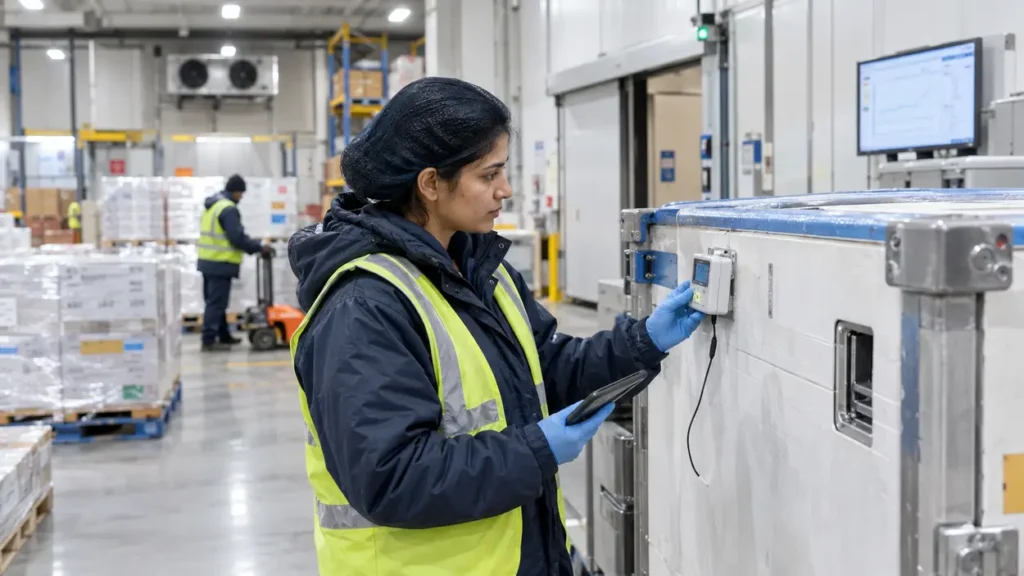
Producing a biologic is one of the most technically demanding undertakings in pharmaceutical manufacturing. Years of process development, characterization, and validation go into a single approved product. Yet manufacturing success protects that product only up to the point it leaves the facility. From there, quality depends on something far less visible: the conditions under which the product is packaged, stored, and moved.
Biologics can be sensitive to temperature excursions, rough handling, transportation delays, and storage equipment failures in ways that go beyond what many conventional pharmaceuticals experience. Cold chain logistics for biologics is the connective layer between a validated manufacturing process and the patient who ultimately receives the product, and it rarely gets the same attention as manufacturing itself.
Even a technically flawless batch can face quality, cost, or supply risk if distribution conditions aren’t managed with equivalent rigor. That gap between manufacturing excellence and distribution reliability is where this article begins.
Why Biologics Are So Dependent on Cold-Chain Logistics
Biologics are typically large, complex molecules — proteins, antibodies, cell-based therapies, and similar products — produced through living systems rather than chemical synthesis. That structural complexity makes many of them more susceptible to degradation from heat, freezing, agitation, or light exposure than small-molecule drugs, which often tolerate a wider range of storage and shipping conditions.
This doesn’t mean every biologic behaves the same way. Temperature sensitivity varies considerably from one product to another, and manufacturers establish product-specific storage and transportation requirements based on their own stability data, not a single universal rule. Some products require refrigerated conditions, others require frozen or ultra-cold storage, and some have narrower allowable ranges than others.
What ties these products together is the underlying principle: distribution conditions are not a logistics afterthought, they’re part of maintaining the product’s identity, strength, and quality between the point of manufacture and the point of use. Regulatory frameworks reflect this — for example, FDA’s guidance on container closure systems for human drugs and biologics expects packaging systems to withstand the manufacturing, storage, transportation, and handling conditions a product will actually encounter.
Where the Cold Chain Can Break Down
Cold-chain failure is rarely a single dramatic event. More often, it’s the accumulation of small vulnerabilities across a distribution network.
Manufacturing-to-Distribution Handoffs
Every time a biologic changes hands — from a manufacturer to a logistics provider, a warehouse, a distributor, or a healthcare facility — there’s an opportunity for a handling error, a documentation gap, or a delay. These handoffs are where responsibility for temperature control can become ambiguous if procedures aren’t clearly defined between the biopharmaceutical manufacturing organization and the parties receiving the shipment downstream.
Transportation Delays
Flight cancellations, customs holds, road closures, extreme weather, and unplanned rerouting are all part of real-world logistics. For most cargo, a delay is an inconvenience. For a biologic with a limited allowable temperature excursion window, a delay can directly threaten product quality, turning a routine shipment into a quality investigation.
Storage and Warehouse Conditions
Refrigerated storage depends on functioning equipment, calibrated temperature monitoring, tested backup power systems, and staff trained to follow handling procedures consistently. A single equipment failure or an undocumented deviation can compromise an entire batch sitting in inventory. These expectations echo the same audit-driven storage and documentation standards discussed in the site’s earlier coverage of EU GMP guidelines and supply chain audits.
The Last Mile
The final leg — from a distribution hub to a hospital, clinic, pharmacy, or vaccination site — is often the hardest to control. It may involve smaller vehicles, less specialized handling, and less monitoring infrastructure than earlier legs of the journey, even though the product is just as sensitive as it was on day one.
🏢 Verified Pharma Manufacturers Directory
Looking for verified and trusted pharmaceutical packaging & manufacturing services partners related to this topic? Explore our comprehensive directory.
Explore Directory →Temperature Excursions: The Risk No Manufacturer Wants
A temperature excursion occurs when a product is exposed to conditions outside its defined storage or transport range. What determines the consequence isn’t the excursion alone, but its duration, its severity, and whether it was detected and documented.
The World Health Organization’s model guidance for time- and temperature-sensitive pharmaceutical products defines an excursion in exactly these terms — exposure outside the prescribed range for storage or transport, based on limits the manufacturer sets from stability data.
It’s a common misconception that any excursion automatically renders a biologic unusable. In practice, a documented excursion typically triggers an assessment against product-specific stability data and established quality procedures. Depending on the outcome, the product may still be usable, may require additional testing, or in some cases may need to be discarded. The point is that this decision rests on evidence, not assumption.
That said, excursions are not without consequence even when a product is ultimately cleared for use. Investigations take time, documentation adds administrative burden, and repeated excursions can signal a systemic weakness in a distribution network that needs to be addressed before it affects supply.
Why Cold-Chain Logistics Is Becoming More Difficult
Several structural pressures are converging to make temperature-controlled distribution harder to manage well. The global volume of biologic medicines continues to grow, partly driven by the expansion of biosimilars entering the market over the next decade, which adds more temperature-sensitive shipments moving through global networks at any given time.
Distribution itself has become more global and more layered, often spanning multiple carriers, customs jurisdictions, and regional infrastructure standards within a single shipment’s journey. Expansion into markets with less mature cold-chain infrastructure adds further variability, as does the growing frequency of extreme weather events disrupting transportation routes.
At the same time, expectations for supply-chain visibility are rising. Stakeholders increasingly want to know not just that a shipment arrived, but that its conditions were verifiable throughout. The European Medicines Agency’s good distribution practice framework reflects this shift toward documented, traceable distribution rather than informal handling assumptions.
The underlying challenge isn’t simply keeping a product cold. It’s maintaining validated, documented, and reliable conditions across every handoff in an increasingly complex network.
The Technology Behind a More Reliable Cold Chain
Real-Time Temperature Monitoring
Connected data loggers can record conditions continuously throughout a shipment, giving quality and logistics teams visibility they wouldn’t otherwise have until a package was already opened.
GPS and Shipment Tracking
Location tracking helps logistics teams identify delays as they happen rather than after the fact, creating a window to intervene before a minor delay becomes a temperature risk.
Automated Alerts and Data Systems
Systems that flag deviations, unexpected delays, or route changes in near real time allow teams to respond while a shipment is still in transit, rather than discovering a problem on arrival.
Smarter Packaging
Insulated shipping containers, passive systems using phase-change materials, and active temperature-controlled units all serve different shipment profiles depending on duration, route, and product sensitivity. The goal is matching the packaging solution to the specific product and journey, a principle covered in detail in resources such as ISPE’s Good Practice Guide on cold chain management.
None of these tools replace sound procedures on their own — they support faster detection and better decision-making within a system that still depends on trained people and validated processes.
🏢 Verified Pharma Manufacturers Directory
Looking for verified and trusted pharmaceutical packaging & manufacturing services partners related to this topic? Explore our comprehensive directory.
Explore Directory →The Cost of Getting Cold-Chain Logistics Wrong
The consequences of a cold-chain failure extend well beyond the cost of transportation. A compromised shipment can mean product wastage and the cost of replacing it, along with delivery delays that ripple into inventory shortages at the receiving end.
Investigating an excursion often requires additional testing or a formal quality assessment, consuming time and resources that wouldn’t otherwise be needed. Depending on the severity and scope of the issue, there can be regulatory and compliance implications to address as well.
Beyond the direct costs, there’s the question of patient access — a delayed or unusable shipment can mean a delayed treatment. And repeated distribution failures can affect how logistics partners, healthcare providers, and regulators perceive a manufacturer’s supply-chain reliability. The financial impact of any single incident varies enormously by product, shipment size, and circumstance, which is why blanket cost estimates for cold-chain failure are rarely meaningful.
How Biopharma Companies Can Build a More Resilient Cold Chain
Design Distribution Around Product Requirements
Shipping conditions should be built around the specific product’s approved stability and storage requirements rather than a generic cold-chain template applied across an entire portfolio.
Strengthen Logistics Partner Qualification
Evaluating logistics providers on their temperature-control capabilities, monitoring systems, documented procedures, geographic coverage, and contingency planning matters as much as evaluating price or transit time. Many manufacturers also formalize relationships with qualified distributors and wholesalers who can demonstrate consistent compliance with these standards.
Plan for Excursions and Disruptions
Contingency routes, backup storage arrangements, emergency response procedures, and clearly documented escalation paths turn a potential crisis into a manageable, controlled response.
Improve End-to-End Visibility
Reviewing shipment data across a distribution network — not just investigating isolated incidents — helps manufacturers identify recurring weak points, whether that’s a specific route, a particular partner, or a seasonal pattern, and address the root cause rather than the symptom.
What the Future of Biologics Cold-Chain Distribution Could Look Like
Looking ahead, several developments are likely to shape how biologics move through global supply chains: broader adoption of connected monitoring across every shipment tier, more predictive logistics planning that anticipates disruptions before they occur, continued improvement in packaging technologies, and smarter route planning informed by historical performance data.
Regional distribution infrastructure is also likely to expand, reducing the distance — and therefore the risk exposure — between manufacturing hubs and patients in different parts of the world. Greater supply-chain visibility and tighter integration between logistics data and quality management systems could make excursion detection and response faster and more consistent.
Still, technology alone won’t resolve the underlying challenge. Reliable infrastructure, trained personnel, validated procedures, and effective quality management will remain just as essential as the tools used to support them.
🏢 Verified Pharma Manufacturers Directory
Looking for verified and trusted pharmaceutical packaging & manufacturing services partners related to this topic? Explore our comprehensive directory.
Explore Directory →Frequently Asked Questions
Why do biologics require cold-chain logistics? Many biologics have specific temperature and handling requirements established through product stability data. Maintaining those conditions throughout distribution helps preserve the product’s identity, strength, and quality until it reaches the patient.
What is a temperature excursion? A temperature excursion is exposure to conditions outside a product’s specified storage or transport range. Its impact depends on the product involved and the duration and severity of the exposure.
What happens when a biologic experiences a temperature excursion? The shipment typically undergoes a quality assessment based on product-specific stability data and established procedures. The outcome — continued use, additional testing, or disposal — depends on that assessment, not on the excursion alone.
How can companies reduce cold-chain risks? Common strategies include real-time temperature monitoring, product-appropriate packaging, qualifying logistics partners on their temperature-control capabilities, contingency planning for disruptions, and maintaining end-to-end shipment visibility.
Final Thoughts — The Supply Chain Is Part of Product Quality
A biologic isn’t protected simply because it was manufactured correctly. Its quality has to be preserved through every storage point, transportation leg, handoff, and final delivery — which is exactly why cold chain logistics for biologics deserves the same discipline applied to manufacturing itself.
As biologic medicines reach more patients across more regions, the ability to distribute them reliably will increasingly shape how biopharmaceutical companies plan their supply chains — not as a downstream logistics detail, but as a strategic function tied directly to patient access and product integrity.