A test tube holder is a basic laboratory tool designed to grip and manipulate an individual test tube without requiring direct hand contact with the tube itself. It is particularly useful when handling heated glassware, moving certain laboratory samples, or positioning a tube during a procedure that requires controlled manual handling.
Although small and simple, a test tube holder plays an important role in laboratory safety. Incorrect gripping, unsuitable materials, damaged glassware, and improper heating techniques can lead to burns, breakage, chemical splashes, or sample contamination. Understanding how the holder works—and when it should not be used—is essential for laboratory technicians, pharmaceutical quality control personnel, biotechnology researchers, diagnostic laboratory staff, and students.
This guide explains what a test tube holder is, its main functions, the different types available, how to use it safely, and how it differs from a test tube rack or clamp.
What Is a Test Tube Holder?
Definition and Basic Structure
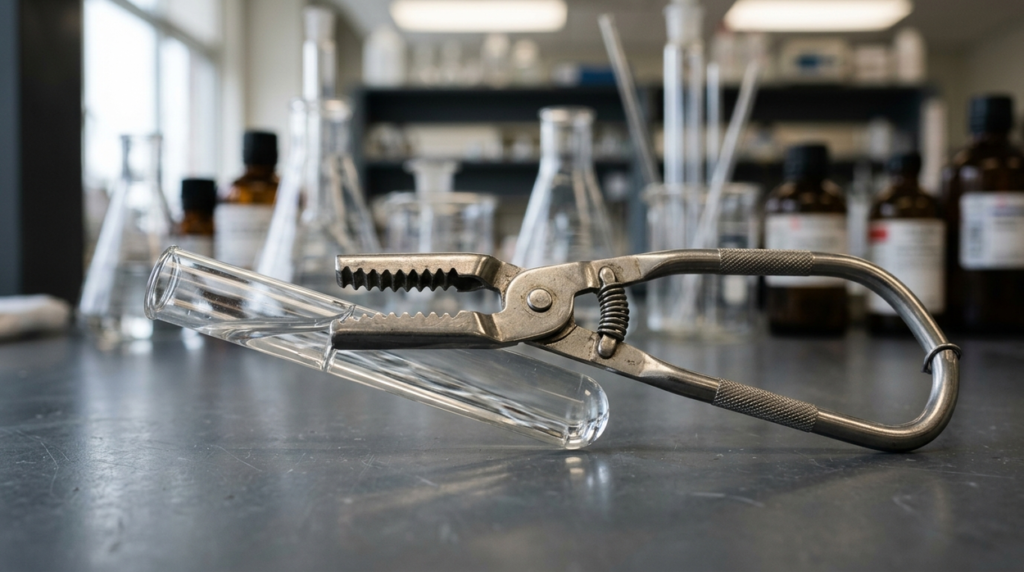
A test tube holder is a handheld laboratory accessory used to grip, lift, hold, or reposition a single test tube. It helps maintain a controlled grip while keeping the user’s fingers away from the tube’s surface, which may be hot, contaminated, or unsuitable for direct handling.
Most conventional test tube holders consist of three main components:
- Gripping jaws: Contact the tube and hold it in position.
- Handle: Provides a surface for the user to hold and control the tool.
- Spring, hinge, or gripping mechanism: Allows the jaws to open and close, depending on the design.
Some holders are made from a single shaped piece of material, while others use a hinged or spring-loaded mechanism. The jaws may have a shaped contact surface to improve grip and reduce slipping.
The exact construction matters because not every holder is suitable for every test tube, temperature, chemical, or laboratory procedure. A holder intended for routine educational demonstrations may have different performance limits from one selected for repeated use in a professional laboratory.
How a Test Tube Holder Differs From a Test Tube Rack
A test tube holder, rack, and clamp may all be used with laboratory tubes, but they perform different functions.
A test tube holder is primarily intended for manual handling. It allows a user to grip and move an individual tube when direct contact is unsuitable.
A test tube rack supports test tubes in a stationary position, usually upright. It is useful for organizing samples, preparing multiple tubes, and temporarily storing them during laboratory work. For more information about rack designs and their applications, see this guide to test tube racks, their types, materials, and uses.
A test tube clamp is generally attached to a laboratory stand or support system. It holds a tube in a selected position during procedures where hands-free support is required.
Selecting the correct accessory helps maintain stability and control. A handheld holder should not be treated as a permanent support, and a rack should not be used to handle a hot tube unless its design and the procedure specifically permit it.
Main Functions of a Test Tube Holder in the Laboratory
Holding Test Tubes During Heating
One of the most familiar test tube holder uses is holding a compatible tube during heating with an appropriate laboratory heat source. The holder provides a grip that allows the user to position and move the tube without touching the glass directly.
Heating requires particular care. The open end of the tube must point away from the user and everyone nearby because liquids can boil suddenly, splash, or eject from the opening. When the procedure requires gradual heating, the tube should be moved through the heating zone as instructed rather than held stationary in a way that could cause localized overheating.
The holder must be suitable for the temperature and heating method. Excessive squeezing can crack glass, while an insecure grip can allow the tube to slip. A holder also does not prevent the contents from reacting unexpectedly or the glass from breaking due to thermal stress.
Never assume that every test tube holder is heat-resistant. Check the manufacturer’s specifications and the laboratory procedure before using one near a flame or another heat source.
Moving Test Tubes Containing Samples or Reagents
A laboratory test tube holder can help move an individual tube between compatible work areas when direct contact is unsuitable. This may include handling warm glassware or transferring a tube during a procedure that requires a controlled grip.
However, using a holder does not eliminate the hazards associated with the tube’s contents. Chemical splashes, leaking containers, contaminated surfaces, and aerosols can still cause exposure. Suitable gloves, eye protection, protective clothing, and containment measures must be selected according to the task.
Sealed tubes, pressurized vessels, and tubes containing volatile or highly hazardous substances require specific handling procedures. A standard handheld holder should not be used to move them unless the procedure and equipment are explicitly suitable.
Supporting Controlled Manipulation During Laboratory Procedures
A holder can help stabilize a tube while its position is adjusted during appropriate manual procedures. Its value lies in providing a controlled grip, not in replacing equipment designed for fixed support.
Keep the work surface clear, maintain a comfortable hand position, and move deliberately. If a procedure requires hands-free positioning, prolonged heating, or a stable fixed angle, a suitable stand and clamp may be more appropriate.
🏢 Featured Laboratory Suppliers Directory Listing
Looking for verified and trusted laboratory suppliers partners related to this topic? Explore our comprehensive directory.
Explore Directory →Types of Test Tube Holders and Their Materials
Test tube holders differ in construction, gripping mechanism, and material. Choosing the right design requires considering both the tube and the conditions in which it will be used.
Wooden Test Tube Holders
Wooden test tube holders are commonly found in teaching laboratories and basic chemistry demonstrations. Many use a simple spring or hinged gripping mechanism and provide a handle separated from the gripping end.
Wood can be useful for selected manual heating tasks, provided the particular holder is designed for that use. However, wood may char, absorb moisture, degrade, or lose its grip after repeated exposure to unsuitable conditions. Chemical spills may also be difficult to remove completely from porous surfaces.
Do not use a wooden holder if it is damaged, contaminated beyond effective cleaning, or unsuitable for the intended temperature and chemical exposure.
Metal Test Tube Holders
Metal holders commonly feature hinged or spring-loaded jaws and are available in designs intended for gripping individual tubes. Models made from suitable metals may be appropriate for certain heated-glassware procedures.
Their suitability depends on the specific construction. Metal can conduct heat, meaning the handle may become hot during use. Corrosion resistance, jaw shape, spring tension, and compatibility with cleaning agents should also be evaluated.
A metal holder should not automatically be considered suitable for every heating application merely because it is made from metal.
Plastic or Polymer Holders
Plastic or polymer holders are used for selected laboratory handling tasks where their material properties suit the application. They may be useful for routine manipulation of compatible tubes under conditions within the manufacturer’s stated limits.
Temperature resistance varies considerably among polymers. Some can deform or soften when heated, while certain chemicals and disinfectants may weaken or damage particular materials.
Do not use an ordinary plastic holder near an open flame unless the manufacturer explicitly rates it for that application. Chemical compatibility and cleaning requirements should also be confirmed before use.
Choosing a Holder for the Intended Task
When selecting a test tube holder, evaluate:
- Tube compatibility: Supported diameter, shape, and material.
- Grip design: Jaw geometry, spring strength, and resistance to slipping.
- Temperature limits: Permitted operating temperature and duration of exposure.
- Chemical compatibility: Resistance to the samples, reagents, and cleaning agents involved.
- Maintenance: Ease of inspection, cleaning, decontamination, and replacement.
A holder used in an educational demonstration may not be suitable for a pharmaceutical laboratory operating under documented quality procedures. The correct choice should be based on manufacturer specifications and the intended procedure, rather than appearance or price alone.
How to Use a Test Tube Holder Safely: Step-by-Step Procedure
The following steps provide general guidance for routine handling. The approved laboratory procedure and manufacturer’s instructions take precedence whenever they specify different requirements.
Step 1 — Inspect the holder and test tube
Check the holder for loose joints, damaged jaws, corrosion, deformation, and weakened springs. Inspect the tube for chips, cracks, and other defects. Confirm that both items are suitable for the intended task and temperature. Do not use damaged equipment.
Step 2 — Position the holder correctly
Open the gripping mechanism and position its jaws around a suitable section of the tube, following the holder’s instructions. Apply enough pressure to hold the tube securely without crushing or stressing the glass. Keep the grip balanced and controllable.
Step 3 — Confirm a secure grip before moving
Check that the tube does not slide or rotate unexpectedly. Keep it away from your face and body, and ensure the destination is clear. Use secondary containment when required. Do not carry multiple tubes with a holder designed for one.
Step 4 — Heat the tube only when appropriate
Verify that the tube, holder, contents, and procedure are suitable for heating. Wear the required protective equipment and use the specified heat source. Keep the opening pointed away from everyone, heat gradually when instructed, and move the tube through the heating zone as required. Never heat a sealed tube unless the equipment and approved procedure are specifically designed for that purpose.
Step 5 — Transfer and set down the tube carefully
Move the tube slowly and place it in a suitable rack or designated support. Treat heated glass as hot even when it looks cool. Use a designated cooling area and appropriate handling equipment when necessary. Never leave a hot tube unsupported on a bench or in a rack that is not suitable for it.
Step 6 — Clean, inspect, and store the holder
Follow the applicable cleaning or decontamination procedure using a method compatible with the material and substances handled. Inspect the jaws and mechanism after use. Store the holder in its designated location and separate contaminated equipment where required.
Safety Precautions When Using a Test Tube Holder
Preventing Burns and Heat-Related Injuries
Both glassware and metal components can remain hot after heating. A tube may retain heat after visible boiling stops, and a metal handle can become hot through conduction.
Wear suitable eye protection, a laboratory coat, and other task-specific personal protective equipment (PPE). Follow the procedure for cooling and handling heated equipment. Never rely on appearance alone to determine whether a tube is safe to touch.
🏢 Featured Laboratory Suppliers Directory Listing
Looking for verified and trusted laboratory suppliers partners related to this topic? Explore our comprehensive directory.
Explore Directory →Avoiding Breakage, Splashes, and Spills
Excessive gripping force, loose jaws, incorrect holder size, and damaged glassware can all increase the risk of accidents. Avoid overfilling test tubes, and keep openings directed away from people during heating.
If a tube breaks or releases its contents, stop work and follow the laboratory’s spill-response and broken-glass procedures. The correct response depends on whether the contents are ordinary laboratory materials, hazardous chemicals, infectious samples, or another substance requiring specialized precautions.
Handling Chemical and Biological Samples
A test tube holder reduces the need to touch a tube directly, but it does not prevent exposure through splashes, aerosols, leaks, or contaminated surfaces.
Before handling hazardous chemicals, consult the relevant safety data sheet (SDS), risk assessment, and standard operating procedure (SOP). The Occupational Safety and Health Administration’s laboratory safety guidance explains the role of appropriate work practices, protective equipment, and chemical hygiene measures in laboratories.
For biological materials, containment and decontamination requirements depend on the sample and its assessed risks. The World Health Organization’s Laboratory Biosafety Manual provides a risk-based framework for selecting appropriate biosafety measures.
A holder is a mechanical handling accessory, not a sterile barrier or containment device. It cannot replace a biological safety cabinet, chemical fume hood, or other engineering control when one is required.
Common Mistakes That Make a Holder Unsafe
Avoid these common errors:
- Using jaws that are too loose to secure the tube or so tight that they stress the glass.
- Using a wooden or ordinary plastic holder for an unsuitable heating task.
- Pointing the open end of a heated tube toward another person.
- Handling chipped or cracked glassware.
- Assuming a tube is cool because its contents have stopped boiling.
- Using a handheld holder as a permanent support when a rack or clamp is needed.
- Reusing contaminated equipment without the required cleaning or decontamination.
Safe handling depends on the complete procedure, not simply on having the right accessory in hand.
Where Test Tube Holders Are Used in Pharmaceutical and Biotechnology Laboratories
Pharmaceutical Quality Control and Analytical Laboratories
In pharmaceutical quality control (QC) laboratories, test tube holders may be used during manual sample preparation, selected heating procedures, and routine handling of compatible glassware. Their role is generally limited to basic manipulation rather than analytical measurement itself.
For example, a technician may use a suitable holder to reposition a tube during a manual preparation procedure. Analytical instruments, automated sample handlers, and other specialized systems require their own compatible accessories and operating instructions.
In laboratories operating under quality management systems, equipment suitability, cleaning, and handling should follow applicable documented procedures. The holder should be appropriate for the task and should not introduce avoidable contamination or compromise sample integrity.
Biotechnology and Research Laboratories
Biotechnology and research laboratories use test tubes for a wide range of biochemical experiments, sample preparation activities, and teaching procedures. A holder may assist with selected manual handling tasks when its design is compatible with the tube and procedure.
However, biological sample type and contamination-control requirements determine how a tube should be handled. A holder does not make a sample sterile, prevent aerosol formation, or eliminate the need for suitable containment.
Diagnostic and Educational Laboratories
In educational laboratories, test tube holders help students learn controlled tube handling and basic heating techniques. In diagnostic settings, they may be used for selected manual preparation activities where the approved procedure permits them.
Diagnostic work may involve infectious material, strict sample identification requirements, and validated methods. Staff should follow the applicable SOPs and biosafety controls rather than assuming that a technique suitable for a classroom is automatically suitable for clinical testing.
Test Tube Holder vs Test Tube Rack vs Test Tube Clamp
The main difference between these accessories is whether the task requires manual gripping, stationary support, or fixed positioning.
| Feature | Test tube holder | Test tube rack | Test tube clamp |
| Primary function | Grip and manipulate a tube | Support multiple tubes | Secure a tube to a stand |
| Typical use | Moving or holding an individual tube | Storage, organization, and preparation | Positioning a tube during selected procedures |
| Portability | Handheld | Usually placed on a bench | Usually attached to a support stand |
| Heating suitability | Depends on material and design | Only if specifically suitable for the heating method | Depends on clamp design and procedure |
| Main selection factor | Grip, size, and material | Capacity, stability, and tube compatibility | Mounting, adjustment, and grip stability |
Choose the accessory according to the task. A holder offers manual control, a rack provides organized stationary support, and a clamp allows a tube to be secured to a suitable stand. These tools serve complementary purposes rather than interchangeable ones.
How to Choose the Right Test Tube Holder for a Laboratory
Match the Holder to Tube Size and Design
Check the manufacturer’s stated gripping range and confirm that the jaws are appropriate for the tube’s diameter, shape, and material. The holder should secure the tube without excessive pressure or unwanted movement.
Compatibility matters for both glass and plastic tubes. A design suitable for one type of tube may not provide adequate grip or may damage another.
Evaluate Temperature and Chemical Compatibility
Confirm the maximum permitted operating temperature and any restrictions on heating duration or direct flame exposure. Review compatibility with the chemicals, cleaning agents, and disinfectants used in the laboratory.
🏢 Featured Laboratory Suppliers Directory Listing
Looking for verified and trusted laboratory suppliers partners related to this topic? Explore our comprehensive directory.
Explore Directory →Do not assume that all wooden, metal, or polymer products have the same resistance to heat or chemicals. Manufacturer specifications are the most appropriate starting point for evaluating these limits.
Consider Cleaning, Maintenance, and Procurement Requirements
Laboratory purchasing teams should evaluate durability, inspection requirements, ease of cleaning, replacement frequency, and storage needs.
In pharmaceutical and biotechnology facilities, selection should also reflect internal quality procedures and the intended application. Relevant supplier documentation can help establish material specifications and permitted operating conditions. Additional certification should be required only when applicable to the particular product, process, or regulatory framework.
A suitable holder is one that performs reliably under the actual working conditions, can be maintained appropriately, and supports the laboratory’s safety and quality requirements.
Conclusion
A test tube holder is a simple but important laboratory handling tool. It provides a controlled grip on an individual test tube and can help reduce the risk of burns, accidental contact, and loss of control during appropriate manual procedures.
Safe use begins with selecting a holder that matches the tube, temperature, and chemical exposure. Users should inspect the equipment, secure the tube without excessive force, keep heated tube openings pointed away from people, and follow the applicable handling and decontamination procedures.
It is equally important to distinguish a holder from a test tube rack or clamp. Each serves a different purpose, and choosing the correct accessory improves control and helps prevent avoidable accidents.
Ultimately, reliable laboratory work depends not only on having suitable equipment but also on understanding its limitations and applying consistent safety practices.
Frequently Asked Questions About Test Tube Holders
1. What is the main function of a test tube holder?
The main function of a test tube holder is to grip and manipulate an individual test tube when direct hand contact is unsuitable. It is commonly used for controlled handling of heated glassware and other compatible tubes during laboratory procedures.
2. Can a test tube holder be used to heat a test tube?
Yes, some test tube holders are designed for use during heating. However, suitability depends on the holder’s material, temperature tolerance, tube type, and the approved procedure. Always check the manufacturer’s instructions and use the required protective equipment.
3. Why should a test tube be pointed away from the face while heating?
Liquids can boil suddenly, splash, or eject from an open test tube during heating. Directing the opening away from the face and other people reduces the risk of burns and injuries from hot or hazardous contents.
4. What is the difference between a test tube holder and a test tube rack?
A test tube holder grips an individual tube for manual handling, whereas a test tube rack supports tubes in a stationary position. A holder is useful for moving or positioning a tube, while a rack is intended for organization, preparation, and suitable temporary storage.
5. Can a test tube holder prevent chemical exposure?
No. A holder can reduce the need for direct hand contact with a tube, but it cannot prevent splashes, leaks, aerosols, or contact with contaminated surfaces. Appropriate PPE, containment, risk assessment, and established laboratory procedures remain essential.