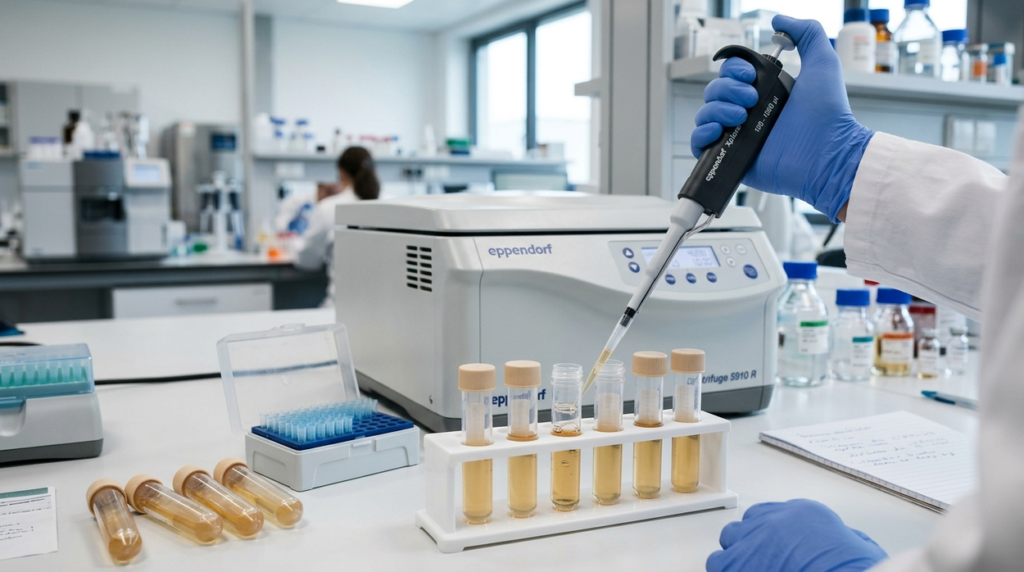
Phosphate-buffered saline (PBS) is one of the most commonly used buffers in biological and biomedical laboratories. It provides an aqueous, salt-containing environment with buffering capacity that is compatible with many routine research procedures, including cell washing, sample handling, immunostaining, and molecular-biology workflows.
The term 10X PBS refers to a concentrated stock formulation intended to be diluted to a lower working concentration, most commonly 1X PBS. A typical tenfold dilution uses one part 10X stock and enough water to produce the required final volume of 1X solution.
However, there is an important practical point: there is no single universal PBS formulation. Recipes and commercial products can differ in phosphate composition, pH specification, calcium and magnesium content, sterility, nuclease specifications, and other quality attributes. For that reason, a laboratory should always check the exact formulation required by its protocol rather than assuming that every product labeled “10X PBS” is interchangeable.
This guide explains what 10X PBS is, its typical composition, how to prepare a representative 1-liter stock, how to dilute it correctly, and the quality considerations that matter when PBS is used in biotechnology and pharmaceutical laboratory workflows.
What Is 10X PBS?
Understanding the “10X” concentration
10X PBS is a concentrated stock solution. It is generally diluted tenfold before use to produce 1X PBS.
For example, if a protocol calls for 100 mL of 1X PBS, 10 mL of 10X PBS stock is required, with water added until the final volume reaches 100 mL.
The basic dilution equation is:
C₁V₁ = C₂V₂
Where:
- C₁ = concentration of the stock solution
- V₁ = volume of stock required
- C₂ = desired final concentration
- V₂ = desired final volume
For a 10X stock being diluted to 1X:
10X × V₁ = 1X × V₂
Therefore:
V₁ = V₂ ÷ 10
The remaining volume is supplied by the appropriate water or diluent.
Importantly, “10X” describes the stock relative to the specified 1X formulation. It does not mean that every individual ingredient should be interpreted independently without considering the complete formulation.
What makes PBS different from ordinary saline?
The “saline” component of PBS primarily provides dissolved ions and contributes to ionic strength and osmotic conditions. Sodium chloride is particularly important in this respect.
The “phosphate-buffered” component provides buffering capacity around the intended pH range. Phosphate species, typically involving combinations of dibasic and monobasic phosphate salts, establish the buffer system.
This combination makes PBS different from a simple sodium chloride solution. Depending on the application, the balance of salts and phosphate can influence cell handling, sample compatibility, protein behavior, and assay performance.
10X PBS Composition and Typical Concentrations
A conventional 10X PBS formulation commonly contains:
- Sodium chloride (NaCl)
- Potassium chloride (KCl)
- Disodium hydrogen phosphate (Na₂HPO₄)
- Potassium dihydrogen phosphate (KH₂PO₄)
- Purified or deionized water
A published laboratory protocol, for example, describes a 10X PBS preparation containing 80 g NaCl, 2 g KCl, 14.4 g Na₂HPO₄, and 2.4 g KH₂PO₄ per liter, with the pH adjusted to 7.4.
Sodium chloride
Sodium chloride provides much of the ionic strength of PBS and contributes to the solution’s osmotic characteristics.
In the representative formulation above, 80 g of NaCl per liter corresponds to approximately 1.37 M NaCl in the 10X stock, which becomes approximately 137 mM after tenfold dilution to 1X.
This concentration is characteristic of many conventional PBS formulations, but it should not be assumed for every commercial product.
Potassium chloride
KCl is included in many conventional PBS recipes and contributes potassium ions to the buffer’s ionic environment.
The representative 10X formulation contains approximately 27 mM KCl, corresponding to approximately 2.7 mM KCl in the resulting 1X PBS.
Phosphate salts
Phosphate is the buffering component of PBS. Commonly used salts include:
- Disodium hydrogen phosphate (Na₂HPO₄)
- Potassium dihydrogen phosphate (KH₂PO₄)
Their relative amounts influence the phosphate equilibrium and therefore contribute to the final pH and buffering characteristics.
For example, a commonly published recipe using 14.4 g Na₂HPO₄ and 2.4 g KH₂PO₄ produces approximately 100 mM dibasic phosphate and 18 mM monobasic phosphate in the 10X preparation.
Typical 10X versus 1X composition
| Component | Representative 10X concentration | Approximate 1X concentration | Primary function |
| NaCl | ~1.37 M | ~137 mM | Ionic strength and osmotic environment |
| KCl | ~27 mM | ~2.7 mM | Provides potassium ions |
| Na₂HPO₄ | ~100 mM | ~10 mM | Phosphate buffering |
| KH₂PO₄ | ~18 mM | ~1.8 mM | Phosphate buffering |
| Total phosphate | ~118 mM in this formulation | ~12 mM | Buffering system |
These values illustrate one established formulation rather than defining a universal PBS standard. Commercial formulations can use different phosphate ratios and concentrations. For example, one current Thermo Scientific 10X PBS specification lists 1.37 M NaCl, 27 mM KCl, 101.4 mM sodium phosphate dibasic, and 17.6 mM potassium phosphate monobasic, with pH specified as 7.4 ± 0.2 after 1X dilution.
An Invitrogen molecular-biology-grade 10X PBS product similarly specifies a 1X composition of 137 mM NaCl, 2.7 mM KCl, 8 mM Na₂HPO₄, and 2 mM KH₂PO₄.
These examples demonstrate why the product specification or validated laboratory protocol should take precedence over a generic PBS recipe.
Why formulations can differ
Two solutions can both be labeled 10X PBS while differing in important ways.
Differences may include:
🏢 Featured Laboratory Suppliers Directory Listing
Looking for verified and trusted laboratory suppliers partners related to this topic? Explore our comprehensive directory.
Explore Directory →- Target pH
- Phosphate salt ratio
- Total phosphate concentration
- Calcium and magnesium content
- Sterility
- Endotoxin specifications
- RNase/DNase specifications
- Grade and intended application
- Storage requirements
A routine research PBS solution may therefore not be an appropriate substitute for a specialized formulation used in a sensitive molecular-biology or cell-culture workflow.
A Standard 10X PBS Recipe for Laboratory Preparation
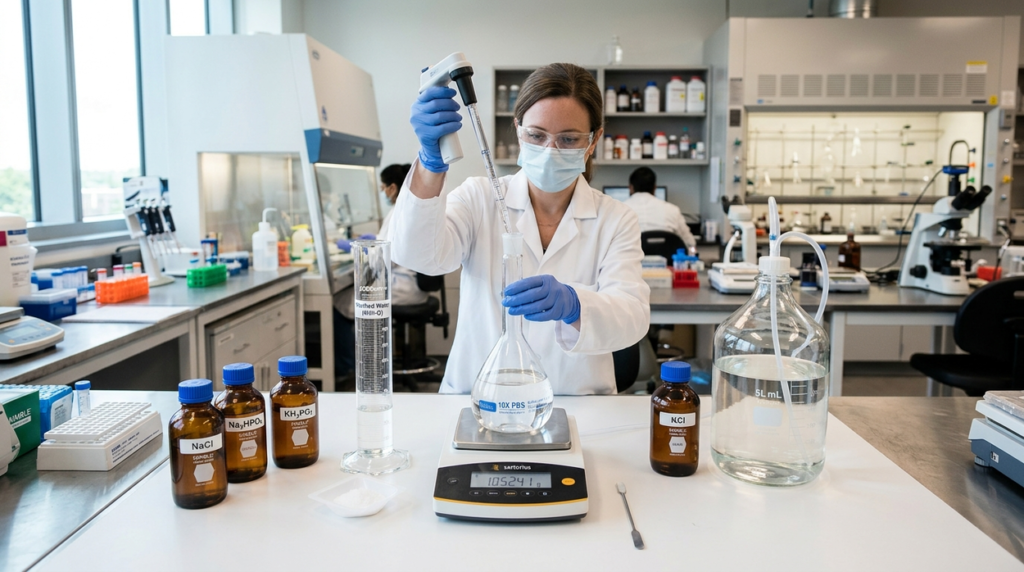
For laboratories preparing their own stock solution, the following is a representative 1-liter 10X PBS formulation based on a commonly published protocol.
Typical ingredients for 1 liter of 10X PBS
| Reagent | Representative quantity |
| Sodium chloride (NaCl) | 80 g |
| Potassium chloride (KCl) | 2 g |
| Disodium hydrogen phosphate (Na₂HPO₄) | 14.4 g |
| Potassium dihydrogen phosphate (KH₂PO₄) | 2.4 g |
| Purified/deionized water | To 1 L final volume |
This formulation has been described in peer-reviewed laboratory protocols and is adjusted to approximately pH 7.4.
It should be treated as a representative formulation, not the only valid 10X PBS recipe.
Basic preparation sequence
A typical preparation workflow is:
- Accurately weigh the required salts.
- Add the salts to a suitable volume of purified, deionized or otherwise specified laboratory-grade water rather than starting with the complete final volume.
- Mix until the salts are completely dissolved.
- Measure the pH using a calibrated pH meter.
- Adjust the pH according to the formulation or validated protocol.
- Add additional water to reach the specified final volume.
- Apply the appropriate sterilization procedure if required.
- Label the container with formulation, concentration, pH where relevant, preparation date, and other required quality information.
- Store under the conditions specified by the laboratory protocol or product documentation.
The exact sequence can vary depending on the formulation and laboratory’s validated SOP.
Why final volume matters
One of the easiest mistakes in buffer preparation is confusing the amount of water used for dissolving reagents with the final volume of the solution.
For a 1-liter preparation, the salts should not simply be added to 1 liter of water and assumed to produce exactly 1 liter of final solution. The correct approach is generally to dissolve the components in a partial volume and then bring the solution up to the final volume.
This distinction matters because dissolved solids contribute volume. If the final volume is incorrect, the resulting concentrations will also be incorrect.
pH adjustment considerations
Many conventional PBS formulations target approximately pH 7.4, but the exact specification depends on the formulation.
The pH should be measured using an appropriately calibrated pH meter rather than inferred from the quantities of salts alone.
Commercial products can also specify their pH after dilution rather than requiring the user to adjust the concentrated stock. For example, Thermo Scientific specifies pH 7.4 ± 0.2 after 1X dilution for one 10X PBS formulation.
For a validated assay or regulated laboratory workflow, the applicable SOP or manufacturer’s specification should determine the acceptable pH range.
How to Dilute 10X PBS to 1X
The basic 10-fold dilution
The simplest way to understand 10X-to-1X dilution is:
1 part 10X PBS + 9 parts water = 1X PBS
The important point is that the combined volume should equal the desired final volume.
For example, to prepare 100 mL of 1X PBS:
- 10 mL 10X PBS
- Add water to a final volume of 100 mL
This is preferable to thinking of the calculation simply as “10 mL stock + exactly 90 mL water” when high precision is important, because “bring to final volume” accounts for the final volumetric requirement.
Dilution calculation using C₁V₁ = C₂V₂
Suppose a laboratory needs 750 mL of 1X PBS from a 10X stock:
10X × V₁ = 1X × 750 mL
Therefore:
V₁ = 75 mL
The laboratory would use 75 mL of 10X stock and add the appropriate water until the final volume reaches 750 mL.
Practical dilution table
| Final 1X PBS volume | 10X PBS required | Water |
| 100 mL | 10 mL | Bring to 100 mL |
| 250 mL | 25 mL | Bring to 250 mL |
| 500 mL | 50 mL | Bring to 500 mL |
| 1 L | 100 mL | Bring to 1 L |
For routine laboratory preparation, the water used should meet the quality requirements of the intended application.
Where 10X and 1X PBS Are Used in the Laboratory
Although 10X PBS is useful as a stock solution, 1X PBS is generally the working concentration used directly in many laboratory procedures.
Cell culture and cell washing
PBS is widely used for washing cells and removing residual culture medium or other soluble components before subsequent procedures.
The exact formulation matters. Some cell-culture workflows specifically call for PBS without calcium and magnesium. Commercial products are available with defined calcium/magnesium specifications for such applications.
The choice of PBS can affect cell handling, particularly when adhesion and dissociation are important.
Molecular biology and nucleic-acid workflows
PBS can serve as a washing or handling solution in selected molecular-biology workflows. However, not every nucleic-acid procedure is compatible with every PBS formulation.
For applications where nuclease contamination is a concern, a specialized molecular-biology-grade product may be preferable to a general laboratory preparation. For example, Invitrogen’s RNase-free 10X PBS is specifically certified for the absence of contaminating nonspecific endonuclease, exonuclease, and RNase activity.
Immunostaining and laboratory washing steps
PBS is frequently used as a washing or sample-handling buffer in immunostaining and related laboratory procedures.
Depending on the protocol, PBS may be used between incubation steps to remove unbound material. Some workflows also modify PBS by adding other components, such as detergents or proteins.
Those modifications should be prepared according to the validated assay protocol rather than added arbitrarily.
Tissue and sample handling
PBS can provide a buffered aqueous environment for handling biological samples where the protocol calls for an isotonic or near-physiological salt solution.
The appropriate formulation depends on the sample type, downstream assay, and required quality attributes.
Reagent preparation and general laboratory workflows
PBS can also be used as a diluent or preparation buffer for compatible laboratory reagents.
However, PBS should not automatically be treated as a universal diluent. Factors such as protein stability, phosphate sensitivity, ionic strength, calcium dependence, and downstream assay chemistry should be considered before substituting PBS for another buffer.
Calcium-Free, Magnesium-Free, and Modified PBS Formulations
Why some PBS formulations exclude calcium and magnesium
Calcium and magnesium ions can influence cellular adhesion and interactions between cells and their surrounding matrix.
🏢 Featured Laboratory Suppliers Directory Listing
Looking for verified and trusted laboratory suppliers partners related to this topic? Explore our comprehensive directory.
Explore Directory →For this reason, many cell-culture workflows use PBS specifically formulated without Ca²⁺ and Mg²⁺ when the protocol requires reduced divalent-cation activity.
Commercial PBS products can explicitly identify whether calcium and magnesium are absent, making the product specification an important part of reagent selection.
When modified PBS may be required
Depending on the application, a laboratory may encounter:
- Calcium-containing PBS
- Magnesium-containing PBS
- Calcium- and magnesium-free PBS
- PBS containing EDTA
- PBS containing detergents
- RNase-free PBS
- Other application-specific PBS formulations
These should not be considered interchangeable.
For example, PBS containing EDTA introduces a chelating agent that can substantially change the chemical environment compared with standard PBS.
Why the formulation should match the protocol
A small difference in buffer composition can become important when an assay depends on enzyme activity, cell adhesion, protein interactions, metal ions, or nuclease-free conditions.
Before replacing one PBS product with another, check:
- Salt composition
- Phosphate concentration
- pH
- Calcium/magnesium status
- Additives
- Sterility
- Grade
- Endotoxin requirements
- RNase/DNase requirements
The label “PBS” alone does not provide enough information to determine whether two formulations are functionally equivalent.
Sterilization, Storage, and Quality Control
Sterilization options
For laboratory-prepared PBS, sterilization may involve membrane filtration or autoclaving, depending on the formulation and intended application.
Published protocols demonstrate both approaches. One laboratory protocol prepares 10X PBS and sterilizes it through a 0.22 μm filter, while another describes autoclaving a prepared 10X stock.
The appropriate method should be determined by the validated laboratory procedure and the stability of the formulation.
Commercial products can also differ substantially. For example, Thermo Fisher states that certain cell-culture PBS products are filter-sterilized, while its RNase-free 10X PBS products have different molecular-biology quality specifications and are not necessarily sterile cell-culture products.
Therefore, RNase-free and sterile should not be treated as synonymous quality attributes.
Storage conditions
Storage requirements depend on the specific formulation, container, sterility status, and manufacturer’s instructions.
A laboratory should maintain clear labeling that identifies, as appropriate:
- PBS concentration
- Formulation
- pH
- Preparation date
- Lot or batch information
- Expiration or review date
- Storage conditions
- Sterility or grade status
Published protocols demonstrate that storage conditions can vary. Some describe room-temperature storage, while others specify refrigerated storage for particular preparations.
For commercial products, the manufacturer’s current storage specification should take precedence.
Quality checks before use
Before using prepared PBS, particularly in sensitive workflows, check for:
- Correct concentration
- Appropriate pH
- Clear appearance
- Absence of unexpected precipitate
- Correct formulation
- Appropriate storage history
- Required sterility status
- Required nuclease or endotoxin specifications
Unexpected cloudiness or precipitate should be investigated rather than ignored. Thermo Fisher, for example, states that visible precipitate in certain PBS products is not considered normal.
Research-grade versus specialized laboratory-grade PBS
A general laboratory PBS preparation may be entirely suitable for routine work, but specialized applications can require additional quality attributes.
For example, molecular-biology-grade PBS may include testing for nuclease contamination. Some commercial products are also supplied with defined endotoxin specifications or certificates of analysis.
When PBS is used in a sensitive workflow, the laboratory should select the grade according to the requirements of the application rather than assuming that a basic in-house preparation offers the same quality profile as a specialized commercial reagent.
Common 10X PBS Preparation and Dilution Mistakes
Using the wrong dilution ratio
The standard relationship between a 10X stock and 1X working solution is tenfold.
Using equal volumes of 10X PBS and water would produce a 5X solution, not 1X PBS.
For 1X PBS, use one part 10X stock and bring the solution to a total of ten parts.
Incorrect final volume
Adding the correct mass of salts does not guarantee the correct final concentration if the final volume is wrong.
Always make the solution up to the specified final volume.
Skipping or incorrectly performing pH verification
Salt quantities alone do not guarantee the required pH.
Where the formulation requires pH adjustment, use a calibrated pH meter and follow the validated procedure.
Mixing different PBS formulations
PBS formulations from different manufacturers, protocols, or product grades should not automatically be combined.
Differences in phosphate concentrations, additives, sterility, calcium/magnesium content, or molecular-biology specifications may make them unsuitable substitutes.
Ignoring calcium and magnesium specifications
A protocol requiring calcium- and magnesium-free PBS should not be performed with a formulation containing these ions simply because both products are labeled PBS.
🏢 Featured Laboratory Suppliers Directory Listing
Looking for verified and trusted laboratory suppliers partners related to this topic? Explore our comprehensive directory.
Explore Directory →This is particularly relevant to cell-culture workflows.
Assuming sterile stock and sterile working solution are equivalent
Diluting a sterile stock does not automatically guarantee that the resulting working solution remains sterile.
The water, containers, pipettes, mixing process, and subsequent handling can introduce contamination. Sterile technique and an appropriate validated procedure are therefore important when sterility is required.
Using visibly compromised PBS
Cloudiness, unexpected precipitate, discoloration, or other unexplained changes should trigger an investigation before the solution is used.
A visually compromised buffer may indicate contamination, formulation problems, inappropriate storage, or another quality issue.
When Should a Laboratory Prepare 10X PBS In-House Versus Buy It Ready-Made?
The decision depends on the laboratory’s workflow, quality requirements, reagent volume, and available resources.
Situations where in-house preparation may make sense
In-house preparation can be practical when a laboratory:
- Uses large quantities of a standardized formulation
- Has reliable access to appropriate reagents
- Has calibrated equipment for weighing and pH measurement
- Has suitable water and sterilization capability
- Maintains an established SOP
- Can perform appropriate quality control
For routine research workflows, preparing a validated stock can be an efficient approach.
Situations where commercial PBS may be preferable
A commercial product can be more appropriate when the laboratory requires:
- Defined sterility characteristics
- Lot-specific documentation
- Certificate of analysis
- RNase/DNase specifications
- Defined endotoxin limits
- Application-specific quality control
- Consistent formulation between batches
Commercial products can also reduce preparation time and minimize variability when a laboratory does not have an established buffer-preparation workflow.
What to compare when selecting commercial PBS
Before purchasing or substituting a 10X PBS product, compare:
- Concentration — confirm that it is actually 10X if that is what the protocol requires.
- pH — check both the stated pH and whether it applies before or after dilution.
- Calcium/magnesium status — particularly important for cell culture.
- Sterility — determine whether the product is sterile and how sterility was achieved.
- Grade — research, cell-culture, molecular-biology, or another specified grade.
- Nuclease specifications — relevant to RNA and DNA workflows.
- Endotoxin specifications — relevant to applications where endotoxin levels matter.
- Storage requirements — follow the manufacturer’s current instructions.
- Certificate of analysis — useful when lot-specific quality information is required.
- Intended application — make sure the formulation matches the validated protocol.
10X PBS at a Glance: Quick Reference
| Parameter | Quick reference |
| What is 10X PBS? | A concentrated PBS stock intended for dilution |
| Typical working solution | 1X PBS |
| Standard dilution | 1 part 10X stock to final 10 parts |
| Common target pH | Around 7.4, depending on formulation |
| Major components | NaCl, KCl and phosphate salts |
| Representative 1X NaCl | ~137 mM |
| Representative 1X KCl | ~2.7 mM |
| Common applications | Cell washing, sample handling, immunostaining and selected molecular-biology workflows |
| Ca²⁺/Mg²⁺ | May be absent or present depending on formulation |
| Sterility | Must be verified for the specific product or preparation |
| Specialized grades | RNase-free, cell-culture and other application-specific formulations are available |
The most important point is that this table is a reference framework, not a substitute for the formulation specification used by a particular laboratory.
Conclusion
A reliable 10X PBS preparation is more than a simple mixture of salts. The concentration, phosphate system, pH, calcium and magnesium content, sterility status, and intended laboratory application all influence whether a particular PBS formulation is appropriate.
For routine preparation, a representative 10X PBS recipe may contain 80 g NaCl, 2 g KCl, 14.4 g Na₂HPO₄, and 2.4 g KH₂PO₄ per liter, followed by pH adjustment and bringing the solution to its final volume. Published protocols support this formulation, but commercial products demonstrate that legitimate PBS formulations can differ in phosphate composition and quality specifications.
When converting 10X PBS to 1X, the basic calculation is straightforward: use one part 10X stock and bring the mixture to ten parts final volume. The more important laboratory decision is selecting a formulation that matches the application.
Before preparing or purchasing PBS, laboratories should therefore verify the required composition, pH, calcium/magnesium status, sterility, nuclease specifications, storage conditions, and any other quality attributes defined by the applicable protocol or manufacturer’s documentation.
That approach helps ensure that PBS functions as a controlled laboratory reagent rather than simply being treated as a generic buffer.
FAQs
What is 10X PBS used for?
10X PBS is primarily used as a concentrated stock that is diluted to 1X before use. The resulting 1X PBS is commonly used for cell washing, sample handling, immunostaining and selected molecular-biology workflows.
How do you make 1X PBS from 10X PBS?
Use the tenfold dilution principle: take one part 10X PBS and add water until the final volume is ten parts. For example, 10 mL of 10X PBS can be diluted to a final volume of 100 mL to produce 1X PBS.
What is the typical composition of 10X PBS?
A representative formulation contains sodium chloride, potassium chloride, disodium hydrogen phosphate and potassium dihydrogen phosphate. One commonly published 1-liter recipe uses 80 g NaCl, 2 g KCl, 14.4 g Na₂HPO₄ and 2.4 g KH₂PO₄. Exact commercial formulations can differ.
What is the pH of 10X PBS?
Many common PBS formulations are designed around pH 7.4, but the exact specification depends on the formulation. Some manufacturers specify the pH after dilution to 1X, so the product documentation should be checked before adjustment.
Does PBS contain calcium and magnesium?
Not necessarily. Many PBS formulations used for cell culture are specifically formulated without calcium and magnesium, while other modified PBS formulations can contain these ions. The calcium/magnesium specification should therefore be checked before substituting one PBS formulation for another.