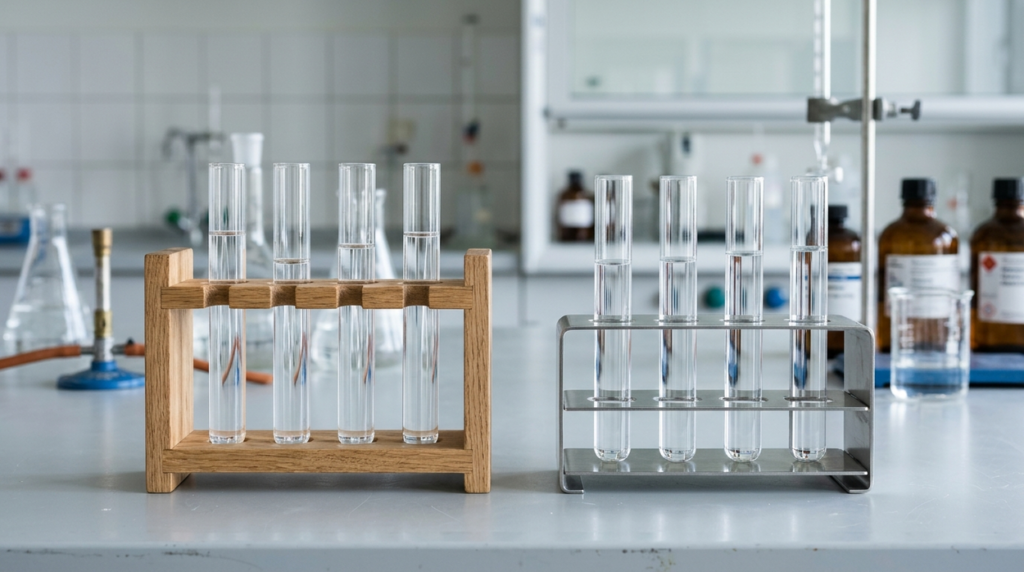
A test tube holder may be a small piece of laboratory equipment, but its material and design can make a meaningful difference when handling heated glassware, preparing samples, or maintaining consistent laboratory workflows. Choosing between a wooden test tube holder and a metal test tube holder involves more than comparing purchase prices. Grip reliability, thermal conductivity, chemical compatibility, cleaning requirements, durability, and contamination control all influence whether a particular design is suitable for the task.
In a teaching laboratory, a lightweight wooden holder may provide a comfortable grip during routine chemistry experiments. In a pharmaceutical quality-control (QC) laboratory, a suitably constructed metal holder may be preferable when repeated use, surface inspection, and compatibility with established cleaning procedures are priorities.
Neither option is universally superior. The right choice depends on the test tube’s material and dimensions, the temperature involved, the handling method, the substances being used, and the laboratory’s maintenance requirements. This guide compares wooden and metal test tube holders and explains how laboratory professionals can select the most appropriate option for their specific applications.
How Wooden and Metal Test Tube Holders Differ in Construction and Function
Test tube holders are designed to grip a test tube securely while allowing the user to handle, transfer, or position it without directly touching the tube. Although both wooden and metal models serve this basic purpose, their construction and operating characteristics can differ considerably.
Wooden test tube holders: Construction and typical design
A wooden test tube holder is commonly made from shaped wood with a groove, clamp, or gripping arrangement that accommodates a test tube. Some designs use a metal spring or other mechanical components to maintain pressure on the tube, while simpler models rely on their construction and manual clamping action.
Wood generally transfers heat less readily than common metals. This property can help reduce heat transfer toward the user’s hand under some conditions, making a wooden holder useful for certain heating procedures. Wooden models are also typically lightweight and easy to handle.
However, wood is not a uniform engineering material. Its performance depends on the species, moisture content, finish, construction quality, and condition of the holder. Repeated exposure to moisture, chemicals, or excessive heat can cause staining, swelling, cracking, splintering, or charring. Damaged surfaces may also retain residues that are difficult to remove.
A wooden holder should therefore be selected according to its intended application rather than assumed to be suitable for every laboratory heating task.
Metal test tube holders: Construction and common mechanisms
Metal test tube holders are manufactured using materials such as stainless steel, plated steel, or other metals, depending on the product. Common designs include spring-loaded clamps, scissor-style holders, and tong-like gripping mechanisms.
A suitable metal design can offer consistent mechanical strength, a durable gripping mechanism, and resistance to wear during repeated handling. Smooth metal surfaces may also be easier to inspect and clean than damaged or porous wooden surfaces.
Nevertheless, the term metal holder covers products with different alloys, coatings, joints, and spring mechanisms. Corrosion resistance depends on the specific material and its exposure conditions. Plated surfaces may deteriorate if their coatings are damaged, while springs can weaken and moving joints can become loose.
Metal also generally conducts heat more readily than wood. Depending on the holder’s geometry and exposure to a heated tube or apparatus, heat can travel toward the handle. This does not make every metal holder unsafe for heating, but it makes product design and the intended procedure important considerations.
Why design can matter more than material alone
Material selection is only one part of a test tube holder comparison. The following design features also influence performance:
- Jaw geometry: The gripping surfaces must accommodate the tube without concentrating excessive force on the glass.
- Clamping force: Weak pressure can allow slipping, while excessive pressure may damage fragile tubes.
- Tube compatibility: The holder must fit the tube’s diameter and shape.
- Handle length: Adequate separation between the hand and heated area supports safer handling.
- Surface finish: Smooth, worn, or slippery gripping surfaces can affect stability.
- Mechanical components: Springs, joints, coatings, and exposed fasteners may influence durability and cleaning.
A well-designed wooden holder can provide a more reliable grip than a poorly designed metal one, and the reverse is equally possible. Evaluate the complete product rather than relying on material labels alone.
Wooden vs. Metal Test Tube Holders: A Side-by-Side Performance Comparison
The following table summarizes the general differences between wooden and metal test tube holders. These are typical tendencies, not guaranteed specifications for every product.
| Comparison factor | Wooden test tube holder | Metal test tube holder |
| Thermal insulation | Generally lower thermal conductivity | Generally higher thermal conductivity |
| Grip | Depends on shape, finish, and condition | Depends on jaw geometry, spring tension, and finish |
| Mechanical durability | Can deteriorate through moisture, cracking, or charring | Can offer long service life but may corrode, deform, or develop spring faults |
| Cleaning | Porosity and surface damage may complicate cleaning | Compatible smooth surfaces may be easier to clean |
| Chemical compatibility | Depends on wood, finish, adhesives, and other components | Depends on alloy, coating, and chemical exposure |
| Contamination control | Absorption and retained residues may be concerns | Surface inspection may be easier, but residues and corrosion remain possible |
| Reuse | Depends on condition, contamination, and cleaning requirements | Depends on construction, cleaning compatibility, and mechanism condition |
| Handling comfort | Often lightweight | Varies with weight, shape, and handle design |
| Heating applications | Suitable only when the design and procedure permit | Suitable only when the design and procedure permit |
| Initial cost | May be relatively low | Varies by material, mechanism, and manufacturer |
| Potential applications | Educational and routine laboratory handling | Repeated-use workflows and compatible cleaning-intensive tasks |
Which material provides better thermal insulation?
Thermal conductivity describes how readily heat travels through a material. Wood generally has lower thermal conductivity than common metals, which is why a wooden handle may reduce heat transfer toward the hand compared with an otherwise similar metal handle.
However, the temperature of a holder’s handle is not determined by thermal conductivity alone. It also depends on contact with the heated tube, exposure duration, handle length, material thickness, and the temperature of nearby equipment.
A wooden holder can still become dangerously hot or char when exposed to excessive heat. A metal holder may remain manageable under a suitable procedure, particularly when its design limits heat transfer to the handle. Neither material should be assumed safe for direct-flame exposure without appropriate manufacturer instructions and an approved laboratory procedure.
For heating applications, verify the holder’s intended use and operating limitations before selecting it.
Which holder offers a more reliable grip?
Grip reliability depends primarily on the interaction between the tube and the holder’s gripping mechanism. Jaw shape, spring tension, contact area, and surface condition all contribute to stability.
A holder that is too large for the tube may allow movement or slippage. One that clamps too tightly may place excessive stress on thin glass. These problems can become more consequential when handling hot tubes or fragile glassware.
Before use, check that the holder fits the intended tube and can secure it without visible damage or instability. Where appropriate, test the grip with an empty, unheated tube. Avoid squeezing glass tubes excessively, and replace holders with bent jaws, weakened springs, or worn gripping surfaces.
Which is easier to clean and maintain?
Suitable metal holders often have an advantage when routine cleaning and visual inspection are important. Smooth, corrosion-resistant surfaces may allow residues to be removed more consistently, provided the cleaning agent and process are compatible with the product.
Wood can absorb moisture and some substances, particularly when its finish is damaged or its surface is exposed. Cracks, splinters, and deteriorating joints may further complicate cleaning. These characteristics can make some wooden holders unsuitable for workflows with stringent contamination-control requirements.
However, a metal holder is not automatically cleanable under every laboratory protocol. Springs, hinges, joints, coatings, and narrow spaces can retain residues. Corrosion can also compromise surface integrity.
Visible cleanliness does not establish microbiological cleanliness. Cleaning, disinfection, and sterilization are distinct processes, and the ability to withstand one does not establish suitability for another. Reusable status and compatibility with any required cleaning or sterilization process must be confirmed for the specific product.
Which is more economical over its useful life?
Initial purchase price is only one component of total cost of ownership. A low-cost holder may become more expensive if it deteriorates quickly, requires frequent replacement, or cannot withstand the laboratory’s cleaning procedures.
A durable metal holder may justify a higher purchase price when its material and mechanism suit repeated use. Conversely, a simple wooden holder may be economical for routine educational exercises or other applications where its service life and handling performance meet requirements.
🏢 Featured Laboratory Suppliers Directory Listing
Looking for verified and trusted laboratory suppliers partners related to this topic? Explore our comprehensive directory.
Explore Directory →Laboratory buyers should consider:
- Purchase price and expected service life.
- Inspection and maintenance time.
- Cleaning supplies and process compatibility.
- Replacement frequency and availability.
- Storage, disposal, and contamination-related replacement requirements.
There is no universal cost winner. The better investment is the holder that meets the procedure’s requirements reliably over its expected service life.
Which Test Tube Holder Is Better for Heating Applications?
Heating is one of the most important considerations when choosing a test tube holder. However, the correct choice depends on the heating method, the tube material, the temperature involved, and the manufacturer’s instructions.
Heating test tubes over a laboratory burner
When heating a test tube over a laboratory burner, the holder must provide a secure grip while keeping the user’s hand at an appropriate distance from the heated area. The tube should be handled according to the laboratory’s established heating procedure, including any requirements for positioning, movement, and personal protective equipment.
A wooden holder may be appropriate when its construction and intended use support the procedure. Its relatively low thermal conductivity can help limit heat transfer toward the handle, but wood is combustible and can char or ignite under unsuitable conditions.
A metal holder may also be suitable for a particular heating procedure, provided its design and material limitations are appropriate. However, metal can transfer heat toward the handle, especially during prolonged contact with a hot tube or nearby heated surfaces.
Follow institutional guidance for heating equipment and combustible materials, such as the laboratory safety recommendations provided by Cornell University’s Environment, Health and Safety department. Never expose a holder directly to a flame unless its manufacturer and the approved procedure explicitly permit that use.
Handling test tubes in water baths and heating blocks
Water baths, heating blocks, and other controlled-temperature systems present different handling requirements from direct-flame heating. In these workflows, the holder may be needed only to transfer a tube into or out of the heating equipment rather than to maintain a grip throughout the heating period.
Before selecting a holder, determine whether it can reach the tube without contacting hot equipment, obstructing the apparatus, or compromising the tube’s stability.
A dedicated test tube rack or purpose-built fixture may be more appropriate when several tubes must remain upright during prolonged heating or batch processing. For transfers, consider condensation, wet gripping surfaces, hot tube walls, and the risk of liquid contamination.
The safest option is not necessarily a wooden or metal holder. It may be a rack or handling tool specifically designed for the equipment and workflow.
Why test tube material and temperature matter
The holder does not determine whether a test tube is suitable for heating. That depends on the tube’s material, dimensions, contents, temperature limits, and resistance to thermal shock.
For example, borosilicate laboratory glass generally offers better thermal-shock resistance than ordinary soda-lime glass, but its suitability still depends on the specific product and operating conditions. Plastic test tubes have different temperature limitations and must not be heated beyond their specified use conditions.
Sealed tubes, tubes containing volatile solvents, and tubes holding hazardous substances require particular caution. Heating can cause pressure buildup, unexpected reactions, or hazardous releases. Such tubes should be heated only under an explicitly approved procedure using equipment designed for the application.
Check the tube manufacturer’s instructions alongside those of the holder and heating apparatus. A holder with a comfortable handle cannot compensate for an unsuitable tube or an unsafe heating method.
Choosing a Holder for Pharmaceutical, Biotech, and Research Laboratories
In professional laboratories, selecting handling equipment involves more than convenience. Material compatibility, residue retention, cleaning requirements, and the potential consequences of contamination can influence the decision.
Pharmaceutical quality-control laboratories
Pharmaceutical QC laboratories handle samples during analytical preparation, testing, and other laboratory procedures. A test tube holder may be used to transfer samples, position tubes during heating, or support routine handling.
The appropriate choice depends on the holder’s actual role. A tool that handles the outside of a closed sample tube presents a different contamination risk from equipment that contacts an open tube, a sample spill, or a product-contact surface.
A suitably constructed metal holder may be advantageous when repeated use, surface inspection, and compatible cleaning are important. However, a metal product should not be selected solely because it is made from stainless steel. Its material grade, finish, construction, and cleaning limitations must match the intended application.
The FDA’s guidance on current good manufacturing practice requirements for equipment explains the importance of appropriate equipment cleaning, maintenance, and controls against contamination in regulated pharmaceutical operations.
This does not mean that every test tube holder used inside a pharmaceutical laboratory is automatically GMP-regulated process equipment. Controls should reflect the holder’s intended use, contamination risk, and applicable quality-system requirements.
Biotechnology and molecular biology research laboratories
Biotechnology laboratories may handle tubes containing buffers, enzymes, nucleic acids, cell-culture materials, or other biological samples. In these settings, preventing unintended sample transfer can be more important than choosing the material with the longest expected service life.
A holder that contacts tube openings, closures, or spilled sample material may require additional cleaning or replacement controls. A dedicated holder for a particular workflow can help reduce opportunities for cross-contamination when supported by the laboratory’s procedures.
Metal holders with compatible surfaces may be easier to clean than damaged wooden models, but neither material is inherently sterile. Researchers must also consider compatibility with disinfectants, solvents, detergents, and other cleaning agents.
For sensitive workflows, a suitable rack, dedicated handling tool, or single-use accessory may be preferable to a general-purpose holder.
Teaching laboratories and routine chemistry work
Wooden test tube holders are often practical for basic chemistry exercises because they are lightweight, straightforward to use, and widely familiar in educational settings. A suitable metal holder may also be appropriate, particularly when the design offers a secure grip for the tubes used in repeated demonstrations.
Teaching laboratories should prioritize ease of use, cost, availability, and clear safety instructions. Inexperienced users may need supervision when heating tubes, and holders should be inspected regularly for loose springs, damaged gripping surfaces, cracks, or signs of heat damage.
For procedures that involve holding several tubes at once or maintaining tubes in a fixed position, a test tube rack or clamp may be more appropriate than a hand-held holder.
Laboratories with stricter cleaning and contamination-control requirements
Laboratories working with sensitive samples or demanding cleanliness requirements should evaluate the complete holder rather than relying on general material properties.
A suitable metal design can offer a smooth, inspectable surface, but its joints, coatings, and moving parts may complicate cleaning. Wooden holders may be unsuitable for some high-cleanliness workflows because their porous structure and surface deterioration can make residue removal difficult.
Where applicable, cleaning compatibility, contamination risks, and documented procedures should guide equipment selection. The European Commission’s EudraLex Volume 4 GMP guidance provides a regulatory framework for relevant pharmaceutical manufacturing operations. Its applicability depends on the activity and regulatory context; it should not be interpreted as a blanket certification requirement for ordinary laboratory accessories.
When a Wooden Test Tube Holder Is the Better Choice
A wooden holder can be a sensible option when its construction provides the required grip and its limitations are compatible with the laboratory procedure.
🏢 Featured Laboratory Suppliers Directory Listing
Looking for verified and trusted laboratory suppliers partners related to this topic? Explore our comprehensive directory.
Explore Directory →Consider a wooden test tube holder when:
- Thermal insulation is useful: Its relatively low thermal conductivity may help limit heat transfer toward the hand during an appropriate procedure.
- The application is routine: Educational experiments and general laboratory tasks may not require specialized cleaning or high mechanical durability.
- The holder remains in suitable condition: The wood, gripping surfaces, and any mechanical components are intact.
- The design fits the tube: The holder securely accommodates the tube without excessive force or movement.
- A lightweight tool is sufficient: The laboratory needs straightforward handling rather than a specialized fixture or cleaning-intensive accessory.
Limitations to check before selecting wood
Wooden holders can deteriorate when exposed to excessive moisture, incompatible chemicals, repeated heating, or unsuitable storage conditions. Cracks, splinters, charred areas, and damaged finishes may compromise handling and increase concerns about residue retention.
The presence of metal springs or other components can introduce additional maintenance requirements. A wooden holder should be removed from service if it no longer provides a secure grip or if contamination cannot be adequately addressed under the applicable procedure.
Wood is therefore a procedure-dependent option, not an automatic first choice for every heating application.
When a Metal Test Tube Holder Is the Better Choice
A metal holder may be preferable when the laboratory requires repeated handling, a durable gripping mechanism, or a surface that is relatively easy to inspect and maintain.
Consider a suitable metal test tube holder when:
- Repeated use is expected: The product’s construction supports the required handling frequency.
- Cleaning is important: Its surfaces and mechanisms are compatible with the laboratory’s cleaning agents and procedures.
- Consistent gripping performance is needed: The jaws and spring mechanism securely accommodate the intended tube dimensions.
- Mechanical durability matters: The holder can withstand the expected handling conditions without unacceptable deformation or wear.
- Documented compatibility is available: The manufacturer provides sufficient information about materials, operating conditions, and maintenance.
Limitations to check before selecting metal
Metal holders can transfer heat, corrode under incompatible exposure conditions, and develop mechanical faults. Spring fatigue, loose joints, bent jaws, and damaged coatings can reduce performance even when the main body appears intact.
Stainless steel should not be treated as a single uniform material. Different grades and surface finishes offer different properties, and resistance to a particular chemical or cleaning process must be verified for the product in question.
Likewise, a reusable metal holder is not automatically compatible with an autoclave, a high-temperature washer, or a particular disinfection process. Always follow the manufacturer’s restrictions.
A Practical Selection Framework for Laboratory Buyers
Laboratory managers and procurement specialists should compare test tube holders against documented requirements instead of choosing the lowest-priced product or defaulting to a preferred material.
Match the holder to the procedure and tube dimensions
Start by identifying the tube and the handling task. Consider whether the tube is made from ordinary glass, borosilicate glass, or plastic, and check its diameter, length, and shape.
Determine whether the holder will be used for heating, transferring tubes, or routine sample preparation. Confirm that the jaws fit securely without damaging the tube or interfering with the equipment.
Verify temperature and chemical compatibility
Request product-specific operating limitations from the supplier. Confirm compatibility with the intended chemicals, cleaning agents, and environmental conditions.
Pay particular attention to coatings, adhesives, springs, and other components that may have different limitations from the main material. Do not assume that a holder is suitable for direct-flame exposure, washing, or sterilization simply because it is made from wood or stainless steel.
Assess cleaning, reuse, and contamination risks
Identify the likely contamination risks and define the required cleaning, disinfection, or sterilization procedures, where applicable. Establish inspection and replacement criteria, including how damaged or contaminated holders will be managed.
For sensitive applications, consider whether dedicated holders or alternative handling equipment would reduce the potential for cross-contamination.
Compare supplier specifications and lifecycle costs
Use the following checklist when evaluating products from laboratory equipment suppliers.
Laboratory test tube holder buyer’s checklist
Use this checklist when comparing suppliers.
0 of 8
Construction material and metal grade, where applicable
Supported tube diameters, lengths, and shapes
Jaw geometry, grip strength, and handle length
Specified operating temperature and heating restrictions
Chemical and cleaning-agent compatibility
Washing, disinfection, and sterilization limitations
Inspection, maintenance, and replacement criteria
🏢 Featured Laboratory Suppliers Directory Listing
Looking for verified and trusted laboratory suppliers partners related to this topic? Explore our comprehensive directory.
Explore Directory →Purchase price, expected service life, and replacement availability
Copy checklist
Common Selection Mistakes That Can Compromise Safe Tube Handling
Several avoidable mistakes can undermine the performance of even a well-made holder.
Assuming wood is fireproof or metal is always unsafe for heating
Wood’s relatively low thermal conductivity does not make it fire-resistant. Similarly, metal’s higher thermal conductivity does not automatically make every metal holder unsuitable for heating. Evaluate the complete design, intended operating conditions, and approved procedure.
Choosing a holder without checking tube size and grip
A mismatch between the holder and tube can cause slipping, unstable handling, or damage to fragile glass. Confirm dimensional compatibility before routine use, especially when handling heated tubes.
Reusing damaged or contaminated holders
Cracks, splinters, residue accumulation, corrosion, and weakened springs can compromise safe handling or cleaning. Remove defective holders from service according to laboratory procedures rather than continuing to use them until they fail.
Assuming a reusable holder is automatically sterilizable
Reuse does not establish compatibility with every cleaning or sterilization process. Verify the manufacturer’s instructions and the laboratory’s requirements before subjecting a holder to detergents, disinfectants, autoclaving, or other treatment.
Purchasing solely on the basis of initial price
A low purchase price may be offset by frequent replacement, poor grip, unsuitable cleaning characteristics, or additional maintenance. Compare products on their ability to meet the required performance and service-life expectations.
Wooden vs. Metal Test Tube Holders: Which One Should Your Lab Choose?
The best test tube holder depends on the work being performed. The following recommendations provide a practical starting point.
| Laboratory requirement | Recommended approach |
| Routine educational experiments | Consider either material if the holder fits the tube and suits the experiment |
| Heated tubes where an insulating grip is useful | Evaluate a suitable wooden design and verify its operating and flame-exposure limitations |
| Repeated handling requiring mechanical durability | Consider a suitable metal holder with a reliable gripping mechanism |
| Frequent cleaning | Select a product with documented compatibility with the required cleaning process |
| Sensitive sample handling | Prioritize contamination control and the actual cleaning requirements |
| High-cleanliness or regulated workflows | Verify material suitability, cleaning compatibility, intended use, and applicable quality-system requirements |
| Prolonged tube support or batch processing | Consider a suitable test tube rack or purpose-built fixture |
Three principles should guide the final decision:
- For heat-related work: Prioritize procedure-specific temperature limits, a secure grip, and safe separation between the hand and heated area.
- For repeated use and cleaning: Prioritize documented material compatibility, maintainability, and routine inspection.
- For pharmaceutical and biotechnology workflows: Prioritize contamination-control needs and applicable quality-system requirements rather than assuming either material is automatically compliant.
Conclusion
Choosing between a wooden and metal test tube holder requires a practical assessment of handling conditions, not a universal ranking of materials. Wooden holders can be useful when lightweight construction and relatively low thermal conductivity support the procedure. Appropriately designed metal holders may offer advantages in mechanical durability, consistent gripping performance, and compatibility with certain cleaning routines.
Neither option is automatically suitable for every laboratory application. Temperature limitations, tube dimensions, chemical exposure, surface condition, and contamination risks must all be considered. For pharmaceutical QC and biotechnology laboratories, the holder’s actual role and compatibility with established procedures are particularly important.
The best test tube holder is the one that safely supports the intended procedure and meets the laboratory’s handling, cleaning, and maintenance requirements. Evaluate the complete product, follow manufacturer instructions, and consider lifecycle costs alongside the initial purchase price.
Frequently Asked Questions
1. Is a wooden or metal test tube holder better for heating test tubes?
A wooden holder may offer an insulating advantage because wood generally conducts heat less readily than common metals. However, wood can char or ignite, while metal can transfer heat toward the handle. The better choice depends on the holder’s design, tube material, temperature, exposure conditions, and approved heating procedure.
2. Can a metal test tube holder be used over a Bunsen burner?
Only if the specific holder and laboratory procedure permit the intended heating application. Check manufacturer instructions, temperature limitations, and safe-handling requirements. Do not assume that all metal holders are designed for direct-flame exposure.
3. Are wooden test tube holders reusable?
Yes, some wooden holders can be reused when their construction, condition, and intended application permit it. Reuse depends on contamination history, cleaning compatibility, and the absence of cracks, splinters, charring, or weakened gripping mechanisms. Replace a holder when its suitability can no longer be established.
4. Are metal test tube holders easier to clean than wooden ones?
Suitable metal holders often have an advantage because smooth surfaces can be easier to inspect and clean. However, springs, joints, coatings, and corrosion can complicate maintenance. The cleaning suitability of either material depends on the specific product and the laboratory’s required cleaning process.
5. What should pharmaceutical laboratories consider when choosing a test tube holder?
Pharmaceutical laboratories should evaluate tube dimensions, handling safety, chemical compatibility, cleaning requirements, residue retention, and contamination risks. They should also determine whether the holder’s actual use requires additional controls under the applicable quality system. Neither wood nor metal automatically establishes suitability for a regulated workflow.