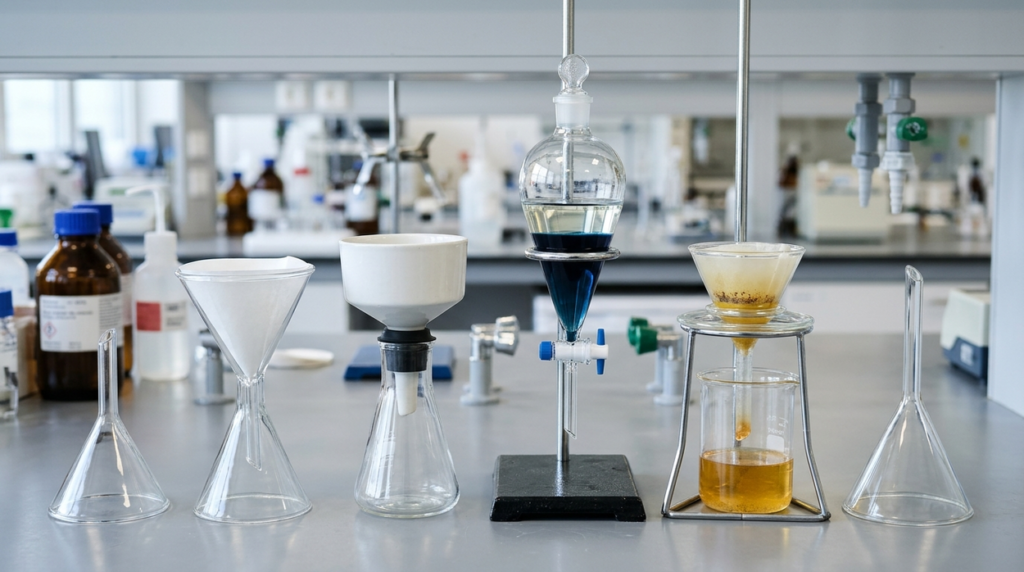
Transferring a prepared chemical solution from a beaker into a narrow-necked flask seems like a simple laboratory task. Without the right equipment, however, the liquid may spill, some of the sample may be lost, or the receiving vessel may become contaminated. A laboratory funnel helps control this process by directing liquids and solids into suitable containers.
But what is a funnel used for in chemistry beyond transferring materials? Depending on its design, a funnel can also support gravity filtration, vacuum-assisted solid recovery, hot-solution filtration, and liquid-liquid separation. These operations require different equipment, even though the instruments share a similar basic shape.
In pharmaceutical research, biotechnology, analytical chemistry, and quality control (QC), selecting the correct funnel can influence sample recovery, handling efficiency, chemical compatibility, and contamination control. A conventional glass funnel may be sufficient for routine transfers, while filtration or extraction procedures may require a specialized design.
Understanding the different types of laboratory funnels, how they work, and when to use them helps laboratory personnel make better equipment choices and maintain reliable experimental workflows.
What Is a Laboratory Funnel and What Does It Do?
A laboratory funnel is a piece of equipment with a broad opening and a narrower outlet or stem. Its primary purpose is to guide materials into another container or facilitate a specific separation process.
A conventional funnel generally consists of three main parts:
- Bowl or cone: Receives the liquid, powder, or mixture.
- Stem: Directs the material toward the receiving vessel.
- Outlet: Provides the passage through which the material leaves the funnel.
Some designs include additional components. A filter funnel holds filter paper or another suitable filtration medium, while a Büchner funnel has a perforated or porous filtering surface. A separatory funnel includes a stopper and stopcock to control the release of individual liquid phases.
The funnel’s construction determines which laboratory operations it can support. Not every funnel is suitable for every type of transfer or separation.
The Main Functions of a Chemistry Funnel
The main laboratory funnel uses include:
- Transferring liquids: Directing prepared solutions, solvents, and reagents into narrow-necked flasks or bottles.
- Transferring solids: Guiding powders, crystals, and granular reagents into suitable containers with minimal spillage.
- Filtering mixtures: Retaining insoluble particles while allowing the liquid to pass through an appropriate filter medium.
- Collecting precipitates: Recovering solids formed during chemical reactions or crystallization.
- Separating immiscible liquids: Allowing two liquid phases to be drained separately using a separatory funnel.
These functions are related but not interchangeable. A standard transfer funnel does not independently filter fine particles or separate two immiscible liquids.
Why Funnel Design Matters in Laboratory Work
Funnel geometry affects how easily materials enter and leave the instrument. A wider bowl can accommodate a larger pouring stream, while the stem length and outlet diameter influence positioning and flow.
The material is equally important. Glass provides visibility of the sample, whereas certain plastic funnels may be more convenient for routine transfers or applications where breakage is a concern. Both require chemical compatibility checks.
In filtration, the shape of the funnel and the arrangement of the filter medium influence how the mixture contacts the filtering surface. In quantitative analysis, material left on the funnel walls or filter paper may also affect recovery.
A suitable funnel therefore supports an appropriate procedure, but it cannot guarantee accurate results on its own. Good technique, proper cleaning, compatible materials, and suitable receiving vessels remain essential.
Six Common Types of Laboratory Funnels and Their Uses
Laboratory funnels range from simple transfer tools to specialized instruments for filtration and phase separation. The following types cover many routine chemistry applications.
1. Ordinary Laboratory Funnel: For Transferring Liquids and Solids
An ordinary laboratory funnel has a broad conical bowl and a narrow stem. It is commonly used to transfer solutions into volumetric flasks, reagent bottles, storage containers, and reaction vessels.
Typical applications include pouring liquid reagents, transferring prepared solutions, introducing crystalline solids into containers, and supporting simple gravity filtration when suitable filter paper is fitted.
Ordinary funnels may be manufactured from borosilicate glass, polypropylene, polyethylene, or other materials selected for particular applications. The appropriate choice depends on the chemicals, temperature, cleaning requirements, and intended use.
A standard funnel is useful for controlled transfer, but it should not replace specialized filtration equipment when the procedure requires defined particle retention or vacuum-assisted separation.
2. Filter Funnel: For Gravity Filtration
A filter funnel holds filter paper or another compatible filtration medium to separate suspended solids from a liquid. During gravity filtration, the liquid passes through the medium and collects below as the filtrate, while retained particles remain on the filter.
A typical procedure involves selecting an appropriate filter medium, positioning it inside the funnel, wetting it when required by the method, and carefully pouring the mixture without overflowing the paper.
Filter selection depends on particle size, desired flow rate, sample viscosity, and whether the target material is the liquid or the solid. An unsuitable filter grade may allow particles to pass through, slow the process excessively, or retain some of the desired compound.
Gravity filtration is often appropriate when the liquid filtrate is the material of interest. For a useful overview of the distinction between gravity and suction methods, see the Chemistry LibreTexts guide to filtering methods.
3. Büchner Funnel: For Vacuum Filtration
A Büchner funnel typically has a cylindrical body and a flat, perforated plate that supports filter paper or another suitable filter medium. It is commonly used in vacuum filtration, where reduced pressure beneath the funnel accelerates liquid movement through the filter.
Applications include collecting precipitates after chemical reactions, recovering crystals following crystallization, and separating suitable solids from liquids more quickly than gravity filtration alone.
A typical vacuum filtration assembly includes:
- A Büchner funnel and compatible filter medium.
- A suitable vacuum flask with a side arm.
- An appropriate adapter and vacuum tubing.
- A vacuum source and, where needed, a protective trap.
The filter paper must cover the perforations appropriately, and the apparatus should be inspected before use. A university chemistry laboratory guide to vacuum filtration provides further procedural context.
Vacuum filtration is not suitable for every mixture. Volatile solvents, foaming samples, temperature-sensitive materials, and substances that react with air may require different approaches or additional precautions.
4. Separatory Funnel: For Liquid-Liquid Separation
🏢 Featured Laboratory Suppliers Directory Listing
Looking for verified and trusted laboratory suppliers partners related to this topic? Explore our comprehensive directory.
Explore Directory →A separatory funnel is designed to separate immiscible liquids, such as an aqueous phase and a suitable organic solvent. These liquids form distinct layers under appropriate conditions, allowing them to be drained separately.
The instrument consists of a vessel, stopper, stopcock, and outlet. Its common applications include solvent extraction, washing an organic phase, and separating aqueous and organic layers during sample preparation.
A typical extraction involves adding the mixture and selected solvent, securing the stopper, mixing according to the procedure, venting safely when required, and allowing the phases to settle. The appropriate layer is then drained through the stopcock into a suitable container.
The organic layer is not always the upper layer. The relative positions depend on the densities and compositions of the liquids involved.
Pressure may develop during extraction, particularly when volatile solvents or acid-base reactions are involved. The funnel must be vented using the correct technique, with appropriate personal protective equipment and ventilation. The procedure should follow the chemical-specific safety instructions.
5. Hot Filtration Funnel: For Heated Solutions
Hot filtration is used in some crystallization procedures to remove insoluble impurities from a suitably heated solution before crystals form.
Maintaining an appropriate temperature helps prevent premature crystallization inside the funnel or stem, which could obstruct flow or reduce product recovery. The funnel, filter medium, solvent, and heating arrangement must all be suitable for the method.
Hot filtration is a procedural application rather than one universally standardized funnel design. A conventional glass funnel is not automatically appropriate for every heated solvent or temperature, and sudden temperature changes can cause glass breakage.
6. Powder or Wide-Stem Funnel: For Solid Reagents
A powder funnel has a design suited to transferring powders, crystals, or granular materials into containers with relatively narrow openings. Depending on the model, a wider stem can help larger particles pass through without excessive obstruction.
These funnels are useful when preparing reaction mixtures, transferring solid reagents, or moving crystalline products into storage vessels.
Fine powders can still generate dust, adhere to surfaces, or accumulate static charge. In analytical procedures requiring quantitative recovery, follow the prescribed transfer technique and account for any material retained on the funnel.
How the Main Funnel Types Compare
| Funnel type | Primary purpose | Typical application | Important consideration |
| Ordinary funnel | Controlled transfer | Moving solutions into narrow-necked vessels | Check chemical compatibility |
| Filter funnel | Gravity filtration | Removing suspended solids | Select the correct filter medium |
| Büchner funnel | Vacuum filtration | Collecting precipitates and crystals | Requires a compatible vacuum assembly |
| Separatory funnel | Liquid-liquid separation | Solvent extraction and phase separation | Manage pressure and identify the correct phase |
| Hot filtration funnel | Filtration of heated solutions | Removing impurities before crystallization | Maintain suitable temperature |
| Powder funnel | Solid transfer | Introducing powders or crystals into vessels | Minimize sample loss and dust |
Hot filtration and powder funnels describe particular designs or applications; they are not necessarily separate, standardized equipment categories. Some conventional funnels can serve these purposes when their construction and material are suitable.
How Does a Funnel Work in a Chemistry Experiment?
The working principle depends on whether the funnel is being used for transfer, filtration, or phase separation.
How Gravity Moves Liquids Through a Funnel
In a conventional funnel, gravity helps move liquid from the bowl through the stem into the receiving vessel. The flow rate also depends on the liquid’s viscosity, the outlet diameter, surface wetting, and the arrangement of the receiving container.
A narrow or obstructed outlet can slow the transfer, while an incorrectly positioned funnel may cause splashing or spillage. If the receiving vessel does not allow air to escape easily, liquid flow may also become irregular.
For routine transfers, position the funnel securely, use a receiving vessel with a suitable opening, and pour at a controlled rate. Avoid filling the funnel beyond its capacity to handle the incoming stream.
How Filter Media Separate Solids from Liquids
Filtration relies on a porous medium that retains particles while allowing the liquid to pass through. The liquid collected after filtration is called the filtrate, and the retained solid is the residue or filter cake.
Two common methods are:
- Gravity filtration: Liquid moves through the filter medium primarily under gravity and the resulting hydrostatic pressure.
- Vacuum filtration: A pressure difference across the filter medium accelerates liquid movement.
The choice depends partly on which fraction must be recovered. Gravity filtration is often preferred when collecting the filtrate, while vacuum filtration is frequently used when the solid product is the main target.
Filtration does not automatically mean sterilization. Ordinary filter paper is not designed to guarantee the removal of microorganisms. Sterilizing-grade filtration requires suitable filtration equipment, specified performance characteristics, and a validated process appropriate to the application.
How a Separatory Funnel Separates Two Liquid Phases
When two liquids are sufficiently immiscible, they form separate phases after mixing and settling under suitable conditions. Their relative densities help determine which layer sits above the other.
For example, a laboratory worker may extract a compound from an aqueous mixture into an immiscible organic solvent. After mixing and allowing the phases to separate, the layers can be drained individually through the stopcock.
The outcome depends on solvent choice, temperature, composition, and the compound’s distribution between phases. Emulsions or partially miscible liquids can make separation more difficult, so the procedure may require additional settling time or a method-specific adjustment.
Where Funnels Are Used in Pharmaceutical, Biotechnology, and Analytical Laboratories
Although funnels are basic laboratory glassware, their function extends into many research and testing workflows. Their suitability depends on the sample, the analytical objective, and the controls required for the procedure.
Sample Preparation and Analytical Chemistry
Analytical laboratories use funnels to transfer reagents, prepare solutions, filter mixtures, and perform suitable solvent-extraction steps before instrumental analysis.
For example, gravity filtration may remove visible insoluble particles from a sample before a subsequent analytical step. A separatory funnel may be used to transfer a target compound into a more suitable liquid phase before analysis.
The choice of funnel and filter medium matters when quantitative recovery is important. A compound may adsorb onto the filter, remain on the funnel walls, or become trapped in a precipitate. These losses can affect the measured result if the analytical method does not account for them.
For this reason, laboratories should follow the applicable analytical procedure rather than selecting a filter solely on the basis of its apparent fineness or flow rate.
Pharmaceutical Research and Formulation Development
In pharmaceutical research, funnels may be used to transfer formulation ingredients, compatible solutions, suspensions, and prepared samples between laboratory vessels.
They can also support small-scale experiments involving precipitation, crystallization, or separation of suitable solid-liquid mixtures. The appropriate funnel depends on the formulation’s viscosity, solvent system, temperature, and intended recovery.
These routine tools should not be confused with validated transfer systems or specialized process equipment used in larger-scale pharmaceutical manufacturing. Manufacturing operations may require additional controls for containment, product contact materials, cleaning, and process consistency.
Biotechnology and Bioprocess Research
Biotechnology laboratories may use conventional funnels during buffer preparation, reagent transfer, and selected sample-preparation procedures.
However, biological materials can be particularly sensitive to contamination, adsorption, temperature changes, or mechanical handling. Specialized applications may therefore require dedicated filtration systems, low-binding materials, sterile connectors, or other equipment designed for the sample.
An ordinary funnel does not provide an aseptic barrier. Likewise, conventional funnel filtration is not equivalent to sterile filtration, cell-retention filtration, or the specialized filtration operations used in bioprocessing.
Quality Control and Quality Assurance Laboratories
QC and QA laboratories depend on consistent procedures, suitable equipment, and effective contamination control. Funnel selection is one part of this system.
Relevant practices include:
🏢 Featured Laboratory Suppliers Directory Listing
Looking for verified and trusted laboratory suppliers partners related to this topic? Explore our comprehensive directory.
Explore Directory →- Inspecting equipment for damage before use.
- Cleaning and drying funnels according to the procedure and intended application.
- Preventing carryover between samples.
- Checking material compatibility with reagents and solvents.
- Maintaining equipment identification or usage records where required by the laboratory’s quality system.
The World Health Organization’s guidance on good practices for pharmaceutical quality control laboratories addresses broader laboratory controls, including cleaning, equipment management, and analytical procedures.
A funnel does not automatically require calibration simply because it is laboratory equipment. Qualification, verification, traceability, and documentation requirements depend on its function, the applicable method, and the laboratory’s quality system.
How to Choose the Right Funnel for an Experiment
Selecting laboratory equipment starts with the intended operation. The funnel’s shape, material, dimensions, and operating conditions should match the actual procedure rather than simply resemble the equipment used in another experiment.
Start With the Intended Operation
Use the following guide to identify an appropriate starting point:
- Moving liquids or powders: Consider an ordinary or powder funnel.
- Separating suspended solids from a liquid by gravity: Select a suitable filter funnel and filter medium.
- Recovering solids through vacuum-assisted filtration: Use a Büchner funnel with a compatible vacuum assembly.
- Separating immiscible liquids: Choose a suitable separatory funnel.
- Removing impurities from a suitably heated solution: Use equipment appropriate for hot filtration.
The method may impose additional requirements, particularly when the target compound is sensitive or quantitative recovery is important.
Check Chemical Compatibility and Material Selection
Glass and plastic funnels each have practical advantages, but neither material is suitable for every application.
Glass funnels offer visibility of the sample and can be suitable for many solvents and reagents. Borosilicate glass is widely used in laboratory glassware because of its useful thermal and chemical properties. However, its suitability still depends on the specific chemical, temperature, exposure conditions, and mechanical stress.
Glass can break if dropped, struck, or subjected to unsuitable thermal changes. Inspect it for cracks and chips before use.
Plastic funnels are lightweight and less prone to shattering. They can be useful for routine transfers, selected disposable workflows, and applications where breakage is a concern. However, chemical resistance varies by polymer. Some materials may swell, degrade, or interact with the sample under particular conditions.
In sensitive pharmaceutical and analytical work, also consider potential extractables, leachables, and other material interactions. Supplier compatibility information should support the intended application.
Match Funnel Dimensions to the Vessel and Procedure
A funnel should fit securely into the receiving vessel without being forced into the opening. Its bowl diameter, stem length, outlet size, and overall dimensions should suit the vessel and the quantity of material being handled.
An outlet that is too small may cause slow flow or blockage, particularly with viscous liquids or particulate suspensions. A funnel that is too large for the available working space may be awkward to position safely.
Filtration applications require additional consideration of the filter medium, available filtering area, and receiving vessel.
Consider Reusable or Disposable Equipment
Reusable glass funnels can be practical when the laboratory has appropriate cleaning, drying, inspection, and storage procedures. Disposable plastic funnels may reduce cleaning requirements and simplify some workflows.
Neither option is inherently safer in every situation. The decision should consider:
- Chemical compatibility and sample sensitivity.
- Cross-contamination risks.
- Cleaning effectiveness and drying requirements.
- Waste generation and operating costs.
- Requirements for sterile or single-use procedures.
Where contamination could affect a critical analytical result, the chosen approach should be consistent with the method and the laboratory’s contamination-control procedures.
Questions Laboratory Buyers Should Ask Before Purchasing Funnels
Procurement teams and laboratory managers should establish the intended use before comparing products. Useful questions include:
- What operation will the funnel support: transfer, gravity filtration, vacuum filtration, or liquid-liquid separation?
- Which chemicals, solvents, or biological materials will contact it?
- What material is it made from, and is compatibility documented?
- Is it suitable for the required temperature and operating conditions?
- Are its dimensions compatible with existing vessels and accessories?
- Can it be cleaned and inspected adequately for its intended use?
- Are technical specifications and relevant material or compliance documents available when required?
Supplier documentation should support the actual application. A general product description alone may not establish suitability for a sensitive sample or regulated workflow.
Common Funnel-Handling Mistakes That Affect Laboratory Results
Small handling errors can result in spills, sample loss, contamination, or inefficient separation.
Choosing the Wrong Funnel or Filter Medium
Using a basic transfer funnel when a defined filtration process is required may leave unwanted particles in the sample. Conversely, an inappropriate filter grade may slow the procedure, allow particles to pass through, or retain some of the target compound.
Choose the equipment according to the separation objective and the properties of the sample.
Overfilling the Funnel or Pouring Too Quickly
Pouring too rapidly can cause splashing, overflow, and material loss. This is particularly relevant when handling viscous, foaming, or reactive mixtures.
Control the flow rate, maintain sufficient space in the funnel, and keep the receiving vessel stable throughout the transfer.
Using Incompatible or Damaged Equipment
Cracked glass, chipped outlets, leaking stopcocks, or deteriorated plastic can compromise handling and sample integrity. Chemical exposure and unsuitable temperatures may also damage materials that initially appear intact.
Inspect the funnel and confirm compatibility before use.
Failing to Clean Equipment Between Samples
Residual chemicals, particles, or biological material can contaminate subsequent samples. Clean the funnel using a method appropriate to the residue and the material, rinse where required, and inspect it before reuse.
Trace analysis and sensitive biological applications may need documented cleaning and contamination-control procedures.
Mishandling a Separatory Funnel
Common errors include failing to secure the stopper, neglecting pressure release, shaking too aggressively for the system, or collecting the wrong phase.
Follow the procedure-specific mixing and venting instructions, identify the phases before draining, and use appropriate protective equipment and ventilation. Do not assume that a particular phase will always occupy the same position.
Safe Use, Cleaning, and Storage of Laboratory Funnels
Proper handling helps protect laboratory personnel, preserve sample integrity, and extend the useful life of reusable equipment.
Safe Handling During Chemical Transfer and Filtration
Wear appropriate personal protective equipment, including suitable gloves and eye protection, according to the hazards of the chemicals involved. Use a stable work surface and secure the receiving vessel before transferring material.
🏢 Featured Laboratory Suppliers Directory Listing
Looking for verified and trusted laboratory suppliers partners related to this topic? Explore our comprehensive directory.
Explore Directory →For corrosive, volatile, or otherwise hazardous substances, follow the relevant safety data sheet, institutional chemical hygiene procedures, and ventilation requirements. The OSHA Laboratory Standard provides guidance on protecting workers who handle hazardous chemicals in laboratories covered by the standard.
For vacuum filtration, use equipment rated for the intended vacuum conditions. Inspect the filter flask for cracks, secure the assembly, and use appropriate connections and protective components. Ordinary glassware should not be assumed to be suitable for vacuum service.
When using a separatory funnel, manage pressure according to the procedure and chemicals involved. Venting must be directed safely, away from people and potential ignition sources where applicable.
Cleaning, Drying, and Inspecting Funnels
Cleaning requirements depend on the material, previous contents, and next intended use. In general:
- Remove residual material promptly when appropriate and safe to do so.
- Select a cleaning method compatible with the funnel material and chemical residue.
- Rinse thoroughly when required by the procedure.
- Dry the funnel before storage or subsequent use if the method requires dry equipment.
- Inspect glassware for cracks and plastic for damage, discoloration, or deterioration.
- Check separatory funnel stopcocks, seals, and stoppers for correct fit and operation.
Avoid incompatible cleaning chemicals and abrupt temperature changes that may damage the equipment. In analytical and pharmaceutical laboratories, cleaning should follow the relevant procedure whenever residue could affect a subsequent sample.
When a Funnel Should Be Replaced
Replace or remove a funnel from service when damage makes it unsuitable for its intended application. Examples include cracked glass, chipped outlets that compromise safe handling, persistent contamination that cannot be adequately removed, leaking stopcocks, and deteriorated plastic.
The decision should reflect the severity of the defect and the consequences of equipment failure. A minor cosmetic mark and a structural crack are not equivalent, but neither should be ignored without appropriate assessment.
What a Laboratory Funnel Cannot Do
Understanding the limitations of laboratory funnels is as important as understanding their uses.
A Funnel Does Not Automatically Produce a Pure or Sterile Sample
A funnel directs material or supports a defined separation process. It does not independently guarantee chemical purity, eliminate all contaminants, or maintain sterility.
Ordinary filter paper can retain suitable particles, but it is not a substitute for a validated sterilizing filtration process. Where microbial control is required, the filtration equipment, membrane characteristics, operating conditions, and validation approach must be appropriate to the application.
Filtration Does Not Always Mean Complete Recovery
The desired compound may remain on the filter medium, adhere to the funnel walls, become trapped in a solid residue, or precipitate unexpectedly during handling.
In quantitative analytical work, such losses can influence measured concentrations and recovery. Method-specific rinsing, recovery studies, or other controls may be necessary to establish whether the procedure performs as intended.
One Funnel Design Cannot Replace Every Other Type
An ordinary funnel, filter funnel, Büchner funnel, and separatory funnel perform different functions. A transfer funnel may direct a solution efficiently, but it cannot replace a purpose-designed vacuum filtration assembly or a separatory funnel when those operations are required.
The correct equipment is the one that matches the separation principle, sample properties, and conditions of the experiment.
Conclusion
Laboratory funnels are simple but functionally distinct pieces of chemistry equipment. They support routine liquid and solid transfers, gravity filtration, vacuum-assisted solid recovery, hot filtration, and liquid-liquid extraction, depending on their design.
Choosing the right funnel helps reduce spills, prevent avoidable sample loss, and support consistent laboratory procedures. Material compatibility, dimensions, filter selection, cleaning practices, and safe handling are equally important, particularly when samples are sensitive or analytical recovery matters.
For pharmaceutical, biotechnology, and quality control laboratories, the practical lesson is straightforward: select the funnel according to the operation, not just its appearance. Integrating suitable equipment into a well-controlled procedure helps protect sample integrity and contributes to reliable experimental results.
FAQs
1. What is a funnel used for in chemistry experiments?
A chemistry funnel is used to transfer liquids and solids into suitable containers. Depending on its design, it can also support gravity filtration, vacuum filtration, hot-solution filtration, and the separation of immiscible liquids.
2. What is the difference between a filter funnel and a separatory funnel?
A filter funnel separates suspended solids from a liquid using filter paper or another filtration medium. A separatory funnel separates immiscible liquid phases, such as suitable aqueous and organic solvents, so they can be collected individually.
3. Why is a Büchner funnel used in chemistry?
A Büchner funnel is commonly used for vacuum filtration. It supports a filter medium while reduced pressure draws liquid through it, making it useful for collecting suitable precipitates and crystals and removing excess liquid from recovered solids.
4. Can a plastic funnel be used for chemical experiments?
Yes, provided the plastic is compatible with the chemicals, solvent, temperature, and intended procedure. The polymer’s chemical resistance and any potential sample interactions should be checked before use, especially in sensitive analytical or pharmaceutical applications.
5. Is a laboratory funnel the same as a filtration device used for sterilization?
No. A conventional laboratory funnel and ordinary filter paper do not inherently produce a sterile filtrate. Sterilizing filtration requires suitable filtration equipment, appropriate performance specifications, and a validated procedure when the application requires it.